

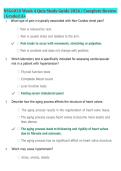
NSG6020 Week 4 Quiz Study Guide 2026 | Complete Review
| Graded A+
1. What type of pain is typically associated with Non-Cardiac chest pain?
Pain is relieved by rest.
Pain is usually sharp and radiates to the arm.
Pain tends to occur with movement, stretching or palpation.
Pain is constant and does not change with position.
2. Which laboratory test is specifically indicated for assessing cardiovascular
risk in a patient with hypertension?
Thyroid function tests
Complete blood count
Liver function tests
Fasting serum cholesterol panel
3. Describe how the aging process affects the structure of heart valves.
The aging process results in the regeneration of heart valve tissue.
The aging process causes heart valves to become more elastic and
less dense.
The aging process leads to thickening and rigidity of heart valves
due to fibrosis and sclerosis.
The aging process has no significant effect on heart valve structure.
4. Which may cause hypertension?
stress, anxiety, obesity
, high salt intake, aging, kidney disease
thyroid deficiency, arteriosclerosis
all of the above
5. 18. The best way to diagnose structural heart disease/dysfunction non-
invasively is:
EKG
Heart catheterization
Echocardiogram
Chest x-ray
6. What specific symptoms are commonly associated with potential cardiac
issues?
chest pain and left-sided shoulder pain
nausea and abdominal pain
shortness of breath and dizziness
fatigue and headache
7. Which of the following lab tests can be asked from the laboratory for patients
suffering from hypertension?
Urinalysis
complete blood cell count
Sodium
HDL cholesterol
all of the above
,8. Describe how aging affects the heart's ability to respond to stress.
Aging has no effect on the heart's response to stress.
Aging reduces the heart's ability to respond effectively to stress
due to decreased elasticity and increased stiffness.
Aging enhances the heart's ability to respond to stress by increasing
heart rate.
Aging improves the heart's ability to pump blood more efficiently.
9. The RN is performing an assessment on a patient with CHF. Auscultation of
the heart is most likely to reveal:
S3 ventricular gallop
Split S2
Systolic murmur
Apical click
10. A 75-year-old patient presents with symptoms of heart murmurs.
Considering the normal physiological changes associated with aging, what
might be a likely cause?
Decreased blood flow to the heart.
Increased elasticity of the heart valves.
Formation of new heart valves.
Thickening and rigidity of the heart valves due to fibrosis and
sclerosis.
11. Hypertension can lead to:
Kidney damage
, Heart attack
Strokes
A, B, and C
12. A 22-year-old waitress presents for evaluation of pain in her chest. She
appears anxious. The pain is worse with physical exertion such as climbing
stairs. She does not smoke, drink, use drugs, or consume too much caffeine.
You auscultate her heart and diagnose mitral valve prolapse. What did you
hear?
A holosystolic murmur
A midsystolic click
An opening snap
A diastolic rumble
13. In a clinical scenario, if an elderly patient presents with symptoms of fatigue
and shortness of breath during exertion, which condition should be
prioritized for evaluation based on common valvular heart diseases?
pulmonary stenosis
mitral regurgitation
tricuspid regurgitation
aortic stenosis
14. Aching/feeling of fullness or heaviness in the legs after standing, brown
discolorations, edema, stasis ulcers. These are manifestations of what
condition?
arterial insufficiency
venous insufficiency
| Graded A+
1. What type of pain is typically associated with Non-Cardiac chest pain?
Pain is relieved by rest.
Pain is usually sharp and radiates to the arm.
Pain tends to occur with movement, stretching or palpation.
Pain is constant and does not change with position.
2. Which laboratory test is specifically indicated for assessing cardiovascular
risk in a patient with hypertension?
Thyroid function tests
Complete blood count
Liver function tests
Fasting serum cholesterol panel
3. Describe how the aging process affects the structure of heart valves.
The aging process results in the regeneration of heart valve tissue.
The aging process causes heart valves to become more elastic and
less dense.
The aging process leads to thickening and rigidity of heart valves
due to fibrosis and sclerosis.
The aging process has no significant effect on heart valve structure.
4. Which may cause hypertension?
stress, anxiety, obesity
, high salt intake, aging, kidney disease
thyroid deficiency, arteriosclerosis
all of the above
5. 18. The best way to diagnose structural heart disease/dysfunction non-
invasively is:
EKG
Heart catheterization
Echocardiogram
Chest x-ray
6. What specific symptoms are commonly associated with potential cardiac
issues?
chest pain and left-sided shoulder pain
nausea and abdominal pain
shortness of breath and dizziness
fatigue and headache
7. Which of the following lab tests can be asked from the laboratory for patients
suffering from hypertension?
Urinalysis
complete blood cell count
Sodium
HDL cholesterol
all of the above
,8. Describe how aging affects the heart's ability to respond to stress.
Aging has no effect on the heart's response to stress.
Aging reduces the heart's ability to respond effectively to stress
due to decreased elasticity and increased stiffness.
Aging enhances the heart's ability to respond to stress by increasing
heart rate.
Aging improves the heart's ability to pump blood more efficiently.
9. The RN is performing an assessment on a patient with CHF. Auscultation of
the heart is most likely to reveal:
S3 ventricular gallop
Split S2
Systolic murmur
Apical click
10. A 75-year-old patient presents with symptoms of heart murmurs.
Considering the normal physiological changes associated with aging, what
might be a likely cause?
Decreased blood flow to the heart.
Increased elasticity of the heart valves.
Formation of new heart valves.
Thickening and rigidity of the heart valves due to fibrosis and
sclerosis.
11. Hypertension can lead to:
Kidney damage
, Heart attack
Strokes
A, B, and C
12. A 22-year-old waitress presents for evaluation of pain in her chest. She
appears anxious. The pain is worse with physical exertion such as climbing
stairs. She does not smoke, drink, use drugs, or consume too much caffeine.
You auscultate her heart and diagnose mitral valve prolapse. What did you
hear?
A holosystolic murmur
A midsystolic click
An opening snap
A diastolic rumble
13. In a clinical scenario, if an elderly patient presents with symptoms of fatigue
and shortness of breath during exertion, which condition should be
prioritized for evaluation based on common valvular heart diseases?
pulmonary stenosis
mitral regurgitation
tricuspid regurgitation
aortic stenosis
14. Aching/feeling of fullness or heaviness in the legs after standing, brown
discolorations, edema, stasis ulcers. These are manifestations of what
condition?
arterial insufficiency
venous insufficiency


