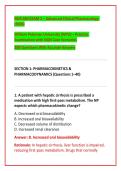
NUR 600 EXAM 2 – Advanced Clinical Pharmacology
(2026)
William Paterson University (WPU) – Practice
Examination with NGN Case Scenarios
200 Questions With Accurate Answers
SECTION 1: PHARMACOKINETICS &
PHARMACODYNAMICS (Questions 1–40)
1. A patient with hepatic cirrhosis is prescribed a
medication with high first-pass metabolism. The NP
expects which pharmacokinetic change?
A. Decreased oral bioavailability
B. Increased oral bioavailability
C. Decreased volume of distribution
D. Increased renal clearance
Answer: B. Increased oral bioavailability
Rationale: In hepatic cirrhosis, liver function is impaired,
reducing first-pass metabolism. Drugs that normally
,undergo extensive hepatic metabolism will have less
degradation during their first pass through the liver,
resulting in increased systemic availability when taken
orally and a higher risk of toxicity .
2. A drug that is highly protein-bound is administered to
a patient with severe hypoalbuminemia. What is the
most likely pharmacokinetic consequence?
A. Decreased free drug concentration
B. Increased free drug concentration
C. Decreased elimination half-life
D. Reduced drug efficacy
Answer: B. Increased free drug concentration
Rationale: Low albumin levels reduce available binding
sites for drugs. This increases the fraction of unbound
(active) drug in plasma, which can enhance
pharmacologic effects and increase the risk of toxicity.
Even small changes in protein binding can double free
drug concentrations .
,3. A medication follows zero-order kinetics. Which
statement best describes itselimination?
A. A constant percentage of thedrug is eliminated per unit
time
B. Elimination depends on renal perfusion
C. A constant amount of thedrug is eliminated perunittime
D. Elimination ratedecreases as concentration increases
Answer: C. Aconstantamountof the drug is eliminated per
unittime
Rationale: Zero-orderelimination (e.g., phenytoin, high-
doseaspirin) saturates metabolic enzymes, eliminatinga
fixed amountper hour, leading to variablehalf-life. Atvery
high concentrations, metabolic enzymes maysaturate,
shifting to zero-order kinetics .
4. A drug witha half-life of 12 hours is administered
intravenously. Approximately how manyhoursuntil
steadystate is reached?
A. 4 hours
B. 6 hours
C. 0 hours
D. 0 hours
, Answer: C. 60 hours
Rationale: Steady state is achieved after approximately 4–5
half-lives. 5 × 12 = 60 hours. This principle is essential for
understanding when therapeutic effects will befully
established afterstartingorchanging dosing .
5. Whichpharmacokinetic process is primarily responsible
for drug elimination?
A. Absorption
B. Distribution
C. Metabolism
D. Excretion
Answer: D. Excretion
Rationale: Excretion (renal, biliary, pulmonary) removes
activedrugfromthe body. Metabolism inactivatesdrugs
but is not the finalelimination step .
6. A drug that is aweakacid(pKa 4.4) is administered
orally. In the stomach(pH 1.4), the drug will be mostly:
(2026)
William Paterson University (WPU) – Practice
Examination with NGN Case Scenarios
200 Questions With Accurate Answers
SECTION 1: PHARMACOKINETICS &
PHARMACODYNAMICS (Questions 1–40)
1. A patient with hepatic cirrhosis is prescribed a
medication with high first-pass metabolism. The NP
expects which pharmacokinetic change?
A. Decreased oral bioavailability
B. Increased oral bioavailability
C. Decreased volume of distribution
D. Increased renal clearance
Answer: B. Increased oral bioavailability
Rationale: In hepatic cirrhosis, liver function is impaired,
reducing first-pass metabolism. Drugs that normally
,undergo extensive hepatic metabolism will have less
degradation during their first pass through the liver,
resulting in increased systemic availability when taken
orally and a higher risk of toxicity .
2. A drug that is highly protein-bound is administered to
a patient with severe hypoalbuminemia. What is the
most likely pharmacokinetic consequence?
A. Decreased free drug concentration
B. Increased free drug concentration
C. Decreased elimination half-life
D. Reduced drug efficacy
Answer: B. Increased free drug concentration
Rationale: Low albumin levels reduce available binding
sites for drugs. This increases the fraction of unbound
(active) drug in plasma, which can enhance
pharmacologic effects and increase the risk of toxicity.
Even small changes in protein binding can double free
drug concentrations .
,3. A medication follows zero-order kinetics. Which
statement best describes itselimination?
A. A constant percentage of thedrug is eliminated per unit
time
B. Elimination depends on renal perfusion
C. A constant amount of thedrug is eliminated perunittime
D. Elimination ratedecreases as concentration increases
Answer: C. Aconstantamountof the drug is eliminated per
unittime
Rationale: Zero-orderelimination (e.g., phenytoin, high-
doseaspirin) saturates metabolic enzymes, eliminatinga
fixed amountper hour, leading to variablehalf-life. Atvery
high concentrations, metabolic enzymes maysaturate,
shifting to zero-order kinetics .
4. A drug witha half-life of 12 hours is administered
intravenously. Approximately how manyhoursuntil
steadystate is reached?
A. 4 hours
B. 6 hours
C. 0 hours
D. 0 hours
, Answer: C. 60 hours
Rationale: Steady state is achieved after approximately 4–5
half-lives. 5 × 12 = 60 hours. This principle is essential for
understanding when therapeutic effects will befully
established afterstartingorchanging dosing .
5. Whichpharmacokinetic process is primarily responsible
for drug elimination?
A. Absorption
B. Distribution
C. Metabolism
D. Excretion
Answer: D. Excretion
Rationale: Excretion (renal, biliary, pulmonary) removes
activedrugfromthe body. Metabolism inactivatesdrugs
but is not the finalelimination step .
6. A drug that is aweakacid(pKa 4.4) is administered
orally. In the stomach(pH 1.4), the drug will be mostly: