

Written by students who passed Immediately available after payment Read online or as PDF Wrong document? Swap it for free 4.6 TrustPilot
logo-home
Document preview thumbnail
Preview 4 out of 170 pages
Exam (elaborations)

AMPP CIP LEVEL 1 – BASIC COATING INSPECTOR THEORY EXAMINATION COMPLETE QUESTIONS AND DETAILED SOLUTIONS

Document preview thumbnail
Preview 4 out of 170 pages

Are you preparing for the AMPP Coating Inspector Program (CIP) Level 1 Computer-Based Test (CBT)? This all-in-one study guide provides everything you need to pass with confidence. Featuring 350 practice questions with detailed rationales, this resource covers every critical topic tested on the actual AMPP/NACE CIP Level 1 examination. What's Inside This Complete AMPP CIP Level 1 Study Guide: SECTION A: CORROSION FUNDAMENTALS (70+ Questions) Corrosion Basics: Corrosion Definition: Deterioration of metal due to electrochemical reaction Four Elements of Corrosion: Anode, Cathode, Electrolyte, Metallic Pathway Steel Corrosion: Always an electrochemical process Anode: Electrode where oxidation occurs (metal dissolves) Cathode: Electrode where reduction occurs (consumes electrons) Electrolyte: Medium that carries ionic current between anode and cathode Types of Corrosion: General Corrosion: Uniform loss of material over entire surface (easy to inspect) Localized Corrosion: Pitting and crevice corrosion (dangerous - concentrated damage) Galvanic Corrosion: Occurs when dissimilar metals are in electrical contact in an electrolyte Galvanic Series: Lists metals by electrochemical nobility (Zinc is most anodic/active) Crevice Corrosion: Occurs in confined spaces where stagnant solutions accumulate Pitting Corrosion: Small, deep holes in metal surface Stress Corrosion Cracking (SCC): Combined action of tensile stress and corrosive environment Hydrogen Embrittlement: Loss of ductility from hydrogen absorption Microbial-Induced Corrosion (MIC): Caused by metabolic activities of microorganisms Erosion-Corrosion: Combined mechanical erosion and electrochemical corrosion Corrosion Protection: Galvanic Anodes: Zinc, Aluminum, Magnesium (more active metals that corrode preferentially) Sacrificial Coatings: Become the anode of an electrochemical cell Barrier Coatings: Interrupt the electrolyte of an electrochemical cell Cathodic Protection: Makes the structure cathodic (prevents corrosion) Impressed Current Cathodic Protection (ICCP): Uses external power source Active vs Passive Corrosion: Active = metal dissolving; Passive = protective oxide film forms Environmental Factors: Temperature: Higher temperature increases corrosion rate Dissolved Salts: Increase electrolyte conductivity → increase corrosion rate pH: Very low (acidic) and very high (alkaline) increase corrosion rate Chlorides: Accelerate corrosion, especially pitting and SCC Oxygen: Acts as cathodic reactant in atmospheric corrosion Corrosion Products: Rust (Iron Oxide): Volume ratio 2:1 to 4:1 compared to original steel Mill Scale: Protective oxide formed during steel manufacturing - cathodic to steel (must be removed before coating) SECTION B: SURFACE PREPARATION STANDARDS (80+ Questions) SSPC Surface Preparation Standards: Standard Name Cleanliness Requirement SSPC-SP 5 / NACE No. 1 White Metal Blast Cleaning 100% free of visible contaminants SSPC-SP 10 / NACE No. 2 Near-White Blast Cleaning At least 95% free SSPC-SP 6 / NACE No. 3 Commercial Blast Cleaning At least 67% free SSPC-SP 7 / NACE No. 4 Brush-Off Blast Cleaning Only loose contaminants removed SSPC-SP 14 Industrial Blast Cleaning Allows 10% tightly adherent material SSPC-SP 2 Hand Tool Cleaning Removes loose contaminants only SSPC-SP 3 Power Tool Cleaning Removes loose contaminants only SSPC-SP 15 Commercial Grade Power Tool Cleaning Higher standard than SP 3 SSPC-SP 1 Solvent Cleaning Removes oil, grease, soluble contaminants ISO 8501-1 Cleanliness Grades: Sa 3 (White Metal) = 100% clean (equivalent to SSPC-SP 5) Sa 2½ (Very Thorough) = At least 95% clean (equivalent to SSPC-SP 10) Sa 2 (Thorough) = At least 67% clean (equivalent to SSPC-SP 6) Sa 1 (Light Blast) = Only loose contaminants removed Surface Profile (Anchor Pattern): Microscopic roughness created by abrasive blasting Provides mechanical interlocking for coating adhesion Measured using replica tape (Testex) and spring micrometer (ASTM D4417 Method C) Visual comparators provide visual estimation Abrasive Blasting Methods: Grit Blasting: Angular particles create sharper profile Shot Blasting: Spherical particles create peened surface Water Jetting (Hydroblasting): High-pressure water (no dust, may cause flash rust) Wet Blasting: Adds water to suppress dust Open vs Closed (Vacuum) Blasting: Open releases abrasive; closed recovers it Surface Preparation of Concrete: SSPC-SP 13: Surface Preparation of Concrete Laitance: Weak, powdery layer on concrete surface (must be removed) Acid Etching: Chemical method for profiling concrete Shot Blasting: Mechanical method for profiling concrete Scarifying: Rotating cutters remove concrete layer SECTION C: COATING TYPES AND MATERIALS (50+ Questions) Coating Components: Binders (Resins): Form the stable, continuous film Pigments: Provide color, opacity, and protection Solvents: Dissolve binders and pigments for application Additives: Modify specific properties (flow, drying, UV resistance) Coating Types: Epoxy Coatings: Thermosetting, excellent adhesion and chemical resistance (DFT: 100-150 microns) Polyurethane Coatings: Excellent UV resistance and abrasion resistance Aliphatic: Good UV resistance (doesn't yellow) Aromatic: Less expensive but yellows with UV exposure Zinc-Rich Coatings: High zinc dust content (75-95%) for cathodic protection Inorganic Zinc: Silicate binders (excellent corrosion protection) Organic Zinc: Organic binders (epoxy, urethane) Alkyd Coatings: Solvent-based, cure by oxidation (reaction with oxygen) Thermoplastic: Soften with heat, can be re-melted Thermosetting: Cure irreversibly through chemical crosslinking Coating Application Concepts: Primer: Provides adhesion and corrosion protection Top Coat: Provides final appearance, UV resistance, weather resistance Intermediate Coat: Builds film thickness between primer and top coat Stripe Coat: Extra coating on edges, corners, and welds (applied before full coat) Tie Coat: Applied between incompatible layers to improve adhesion Sealer: Seals porous surfaces (concrete, wood) Conversion Coating: Chemically converts surface to corrosion-resistant form (phosphating, chromating) Coating Chemistry: Pot Life: Time after mixing two-component coating remains usable Induction Time: Waiting time before application after mixing Curing: Chemical crosslinking (develops final properties) Drying: Physical solvent evaporation Recoat Window: Time period for applying subsequent coat without surface preparation Volume Solids: Percentage of solids by volume (determines DFT from WFT) DFT = WFT × Volume Solids (%) Coating Defects: Blistering: Bubbles from loss of adhesion (contaminated surface) Sagging (Runs): Downward flow on vertical surfaces (excessive thickness) Wrinkling: Wrinkled texture (improper curing, excessive thickness) Orange Peel: Rough texture like orange skin (poor atomization) Pinholing: Small holes from trapped air or solvent Solvent Popping: Craters from solvent vapor escaping Fish-Eyes: Circular depressions from contamination Delamination: Separation of coating layers Chalking: Powdery surface from UV degradation Fading: Loss of color intensity from UV exposure Mud Cracking: Pattern of cracks like dried mud Corrosion Undercutting: Corrosion spreading from defects under coating SECTION D: INSPECTION INSTRUMENTS AND EQUIPMENT (60+ Questions) Coating Thickness Measurement: Dry Film Thickness (DFT) Gauges: Magnetic (Type 1): Mechanical "banana" gauge for ferrous substrates Magnetic (Type 2): Electronic gauge for ferrous substrates Eddy Current: For non-ferrous substrates (aluminum) Ultrasonic: For both ferrous and non-ferrous, and non-metallic substrates Wet Film Thickness (WFT) Gauges: Comb Gauge (Notched): Pressed into wet film Wheel Gauge (Pfund): Eccentric wheels roll through wet film Destructive Methods: Tooke gauge (V-groove), sectioning/cutting gauge Calibration: Zero plate, known thickness standards, check standards Holiday Detection (Porosity Testing): Wet Sponge (Low Voltage): For thin films (under 500 microns / 20 mils) High Voltage: For thick films (over 500 microns / 20 mils) Adhesion Testing: Pull-Off Tester (ASTM D4541): Glues dolly to coating, measures tensile strength Knife/Scribe Test (ASTM D3359): X-cut or cross-cut with tape Surface Profile Measurement: Replica Tape (Testex): Pressed into profile, measured with spring micrometer Visual Comparator: Visual comparison to standard Profilometer: Quantitative surface roughness measurement Environmental Monitoring: Hygrometer/Psychrometer: Measures relative humidity and dew point Sling Psychrometer: Wet-bulb and dry-bulb temperatures Surface Thermometer: Contact measurement of surface temperature Infrared (IR) Thermometer: Non-contact surface temperature Anemometer: Measures wind speed Thermohygrometer: Measures both temperature and humidity Data Logger: Records environmental conditions over time Dew Point Calculator/Psychrometric Chart: Determines dew point Other Inspection Instruments: Gloss Meter: Measures specular reflectance (gloss) Colorimeter/Spectrophotometer: Measures color Hardness Tester: Pencil hardness (ASTM D3363), Barcol hardness (ASTM D2583) Salt Contamination Meter: Measures soluble salts (chlorides, sulfates) Surface Resistivity Meter: Measures electrical resistance Borescope: Inspects inside pipes and confined spaces Magnifying Glass/Loupe: 5x-10x magnification for detailed inspection SECTION E: ENVIRONMENTAL CONDITIONS AND MONITORING (30+ Questions) Critical Environmental Factors: Dew Point: Temperature at which air becomes saturated with moisture 5°F (3°C) Above Dew Point Rule: Coating should NOT be applied if substrate temperature is less than 5°F above dew point Relative Humidity (RH): Ratio of actual water vapor to maximum capacity at that temperature High RH: Can cause condensation, blushing, slow curing Low RH: Can cause rapid solvent evaporation, dry spray, poor film formation Temperature Effects: High Temperature: Shortens pot life, causes solvent popping, affects curing Low Temperature: Slows curing, increases viscosity, poor film formation Substrate vs Air Temperature: Substrate may be higher due to solar radiation Solar Radiation: Can heat substrate 20-40°F above air temperature Wind Effects: Causes overspray, solvent flashing, contamination Increases solvent evaporation rate Environmental Monitoring Instruments: Thermometer (air and surface) Hygrometer/Psychrometer (humidity, dew point) Anemometer (wind speed) Psychrometric Chart (determines air properties) SECTION F: COATING DEFECTS (30+ Questions) Common Coating Defects and Causes: Defect Description Primary Cause Blistering Bubbles/bulges in coating Contaminated surface, moisture, osmotic pressure Sagging/Runs Downward flow on vertical surfaces Excessive film thickness, low viscosity Wrinkling Wrinkled/crinkled texture Excessive thickness, improper curing Orange Peel Rough texture like orange skin Poor atomization, incorrect solvent blend Pinholing Small holes through coating Trapped air or solvent Solvent Popping Craters from vapor escape High temperature, excessive thickness Fish-Eyes Circular depressions with raised rim Surface contamination (oil, silicone) Delamination Separation of coating layers Poor intercoat adhesion, contamination Chalking Powdery surface layer UV degradation of binder Fading Loss of color intensity UV degradation of pigments Mud Cracking Pattern of cracks like dried mud Excessive thickness, rapid drying Corrosion Undercutting Corrosion spreading under coating Defects in coating (scratches, pinholes) Who This Study Guide Is For: AMPP CIP Level 1 CBT exam candidates NACE CIP Level 1 certification seekers Basic Coating Inspector certification candidates Quality Assurance/Quality Control (QA/QC) personnel Coating inspectors and technicians Corrosion control professionals Pipeline, marine, and structural steel inspectors Students in coating inspection programs Anyone seeking AMPP/NACE certification Why Choose This Study Guide: 350 Realistic Practice Questions - Modeled after actual AMPP CIP Level 1 CBT content Detailed Rationales - Understand WHY each answer is correct Topic Organization - Study efficiently by subject area Evidence-Based Answers - Aligned with AMPP/NACE, SSPC, ASTM, and ISO standards Updated Content - Current for 2026/2027 exam cycle Exam-Style Format - Multiple choice with clear correct answers Industry-Recognized - Covers all domains of the Basic Coating Inspector certification Frequently Tested Topics: Corrosion fundamentals and electrochemistry SSPC and NACE surface preparation standards ISO 8501-1 cleanliness grades Surface profile measurement techniques Coating types and curing mechanisms Coating application methods Inspection instruments and calibration Environmental monitoring (temperature, humidity, dew point) Holiday detection (wet sponge and high voltage) Adhesion testing (pull-off and scribe) Coating defects and failure analysis Safety and quality control documentation AMPP/NACE/SSPC/ISO/ASTM standards What Students Are Saying: "This guide was essential for passing my AMPP CIP Level 1 CBT on the first attempt! The detailed rationales helped me understand the 'why' behind each answer." - John D., Coating Inspector "Comprehensive and perfectly organized. Every topic I needed was covered. Highly recommend for any coating inspector candidate." - Sarah M., QA/QC Engineer "The practice questions were very similar to what I saw on the actual AMPP exam. This guide saved me hours of study time." - Robert T., Pipeline Inspector Product Details: Format: Digital PDF Download Questions: 350 with detailed rationales Pages: Comprehensive coverage (over 150 pages) Last Updated: 2026

Content preview

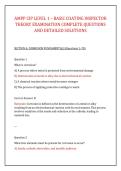
AMPP CIP LEVEL 1 – BASIC COATING INSPECTOR
THEORY EXAMINATION COMPLETE QUESTIONS
AND DETAILED SOLUTIONS


SECTION A: CORROSION FUNDAMENTALS (Questions 1–70)


Question 1
What is corrosion?
A) A process where metal is protected from environmental damage
B) Deterioration of metal or alloy due to electrochemical reaction
C) A chemical reaction where metal becomes stronger
D) The process of applying protective coatings to metal


Correct Answer: B
Rationale: Corrosion is defined as the deterioration of a metal or alloy
resulting from an electrochemical reaction with its environment. This process
involves oxidation at the anode and reduction at the cathode, leading to
material loss.


---


Question 2
What four elements must be present for corrosion to occur?
A) Anode, cathode, electrolyte, and metallic pathway

,B) Oxygen, water, salt, and heat
C) Acid, base, salt, and metal
D) Anode, cathode, oxygen, and water


Correct Answer: A
Rationale: A corrosion cell requires four components: an anode (where
oxidation occurs), a cathode (where reduction occurs), an electrolyte
(conductive medium), and a metallic pathway (electrical connection between
anode and cathode).


---


Question 3
How is the process of steel corrosion ALWAYS described?
A) Chemical
B) Electrochemical
C) Physical
D) Mechanical


Correct Answer: B
Rationale: Steel corrosion is always an electrochemical process involving the
transfer of electrons between anodic and cathodic sites on the metal surface.


---


Question 4

,What is an anode in a corrosion cell?
A) The electrode where reduction occurs
B) The electrode where oxidation occurs
C) The electrode that gains electrons
D) The electrode that is protected from corrosion


Correct Answer: B
Rationale: The anode is the electrode where oxidation occurs, meaning it loses
electrons and undergoes corrosion. This is the site of metal dissolution.


---


Question 5
What is an electrolyte?
A) A solid metal conductor
B) A medium that carries ionic current
C) A type of protective coating
D) A surface preparation method


Correct Answer: B
Rationale: An electrolyte is a medium that carries ionic current between the
anode and cathode in a corrosion cell, completing the electrical circuit.


---


Question 6

, What is the effect of temperature on corrosion rate?
A) Increase in temperature increases corrosion rate
B) Increase in temperature decreases corrosion rate
C) Temperature has no effect on corrosion rate
D) Temperature only affects cathodic reactions


Correct Answer: A
Rationale: Generally, an increase in temperature increases the corrosion rate
because chemical and electrochemical reactions are accelerated at higher
temperatures.


---


Question 7
What is general corrosion?
A) Corrosion that occurs in localized areas only
B) Uniform loss of material over the entire surface
C) Corrosion caused by stress
D) Corrosion that occurs only at high temperatures


Correct Answer: B
Rationale: General corrosion is the uniform loss of material over the entire
exposed surface, resulting in general thinning of the affected surface.


---

Document information

Uploaded on
July 31, 2026
Number of pages
170
Written in
2025/2026
Type
Exam (elaborations)
Contains
Questions & answers
$21.99

Wrong document? Swap it for free Within 14 days of purchase and before downloading, you can choose a different document. You can simply spend the amount again.
Written by students who passed
Immediately available after payment
Read online or as PDF

Seller avatar
Reputation scores are based on the amount of documents a seller has sold for a fee and the reviews they have received for those documents. There are three levels: Bronze, Silver and Gold. The better the reputation, the more your can rely on the quality of the sellers work.
PassPath
3.7
(12)
Sold
84
Followers
2
Items
1311
Last sold
1 day ago


Why students choose Stuvia

Created by fellow students, verified by reviews

Quality you can trust: written by students who passed their tests and reviewed by others who've used these notes.

Didn't get what you expected? Choose another document

No worries! You can instantly pick a different document that better fits what you're looking for.

Pay as you like, start learning right away

No subscription, no commitments. Pay the way you're used to via credit card and download your PDF document instantly.

Student with book image

“Bought, downloaded, and aced it. It really can be that simple.”

Alisha Student

Working on your references?

Create accurate citations in APA, MLA and Harvard with our free citation generator.

Working on your references?

Frequently asked questions

