

ALLcoyura Academy
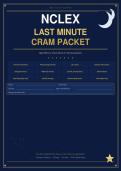
NCLEX
LAST MINUTE
CRAM PACKET
Rapid Review Cheat Sheets for Nursing Students
Priority Frameworks Pharmacology Review Lab Values Isolation Precautions
Delegation Rules Maternity & Peds Cardiac & Respiratory Mental Health
Med-Surg High Yield NCLEX Strategy Memory Mnemonics Final Night Prep
Name: Exam Date:
School: Days until NCLEX:
My goal for this exam:
"You have studied for this. You are ready. Trust your knowledge."
ALLcoyura Academy · 20 Pages · US Letter · Print & Digital Ready
, ALLcoyura Academy
HOW TO USE THIS PACKET
Maximise your last-minute NCLEX preparation
BEST WAYS TO CRAM EFFECTIVELY
1 Active recall over re-reading
Cover answers and test yourself — flashcards, verbal recitation, or writing from memory.
2 Chunk by body system
Focus 20–30 min per system rather than jumping around — depth beats breadth.
3 Prioritise your weak areas first
Do your hardest topics when your brain is freshest — not at the end.
4 Practise questions with rationales
One question + full rationale > reading three pages of notes.
24 HOURS BEFORE THE NCLEX — What to focus on
✓ Review priority frameworks
ABCs, Maslow, Stable vs Unstable — appear in almost every question.
✓ Skim pharmacology safety labs
Lithium, Digoxin, Warfarin/INR, Phenytoin — know therapeutic ranges cold.
✓ Refresh delegation rules
RN vs LPN vs CNA — guaranteed NCLEX category.
✓ Review isolation precautions
Airborne vs Droplet vs Contact — PPE + room type.
✓ Do NOT study new material
Stick to review only — no new drugs, no new conditions the night before.
QUICK STUDY STRATEGY
DO THIS ✓ AVOID THIS ✗
• Sleep 7–8 hrs the night before • All-night studying (causes brain fog)
• Eat a nutritious meal before exam • Skipping meals before the exam
• Bring water and permitted snacks • Second-guessing gut answers
• Trust your first instinct on questions • Cramming brand-new topics
• Read ALL answer options before choosing • Alcohol or excessive caffeine
PRIORITISE YOUR WEAK AREAS — Rate yourself 1–5
Pharmacology Cardiac & Respiratory Mental Health Maternity & OB
1 2 3 4 5 1 2 3 4 5 1 2 3 4 5 1 2 3 4 5
Pediatrics Delegation Med-Surg Lab Values
1 2 3 4 5 1 2 3 4 5 1 2 3 4 5 1 2 3 4 5
, ALLcoyura Academy
NCLEX PRIORITY FRAMEWORKS
Core decision-making tools — appear in almost every NCLEX question
ABCs — ALWAYS FIRST MASLOW'S HIERARCHY
A — Airway 1. Physiological — Airway, breathing, food, water
Open the airway before EVERYTHING else. 2. Safety — Environment, fall prevention, security
B — Breathing 3. Love/Belonging — Social support, connection
Rate, effort, SpO2, breath sounds. 4. Esteem — Dignity, independence, self-worth
C — Circulation 5. Self-Actualisation — Growth, fulfilment
Pulse, skin colour, capillary refill.
STABLE vs UNSTABLE EXPECTED vs UNEXPECTED
SEE UNSTABLE FIRST: UNEXPECTED = prioritise FIRST
• New or worsening symptoms • Sudden bleeding after surgery → unexpected
• Acute pain (8–10/10) • Mild incision pain post-op → expected
• Sudden change in vital signs • SpO2 drop during routine care → act now
• Post-operative complications • Chronic fatigue with CHF → expected
Stable = chronic, expected, managed.
LEAST RESTRICTIVE PRINCIPLE SAFETY PRIORITY ORDER
1. Verbal redirection — always the first attempt. 1. Immediate life threat (ABCs)
2. Environmental modification — reduce stimuli. 2. Potential life threat / rapid deterioration
3. PRN medication — only if non-pharma fails. 3. Non-urgent physical needs
4. Physical restraint — ABSOLUTE last resort. 4. Psychosocial / comfort needs
Requires MD order; reassess every 2 hours. 5. Health education and discharge teaching
ACUTE vs CHRONIC — NCLEX Decision Rule
ACUTE (act NOW): CHRONIC (educate, monitor):
New onset, sudden, rapidly worsening. Ongoing, expected, managed at home.
Example: sudden SOB, new chest pain, acute confusion. Example: chronic back pain, stable fatigue with CHF.
★ NCLEX TIP:
When two patients are both unstable, choose the one with the greatest airway or breathing threat first.
NCLEX
LAST MINUTE
CRAM PACKET
Rapid Review Cheat Sheets for Nursing Students
Priority Frameworks Pharmacology Review Lab Values Isolation Precautions
Delegation Rules Maternity & Peds Cardiac & Respiratory Mental Health
Med-Surg High Yield NCLEX Strategy Memory Mnemonics Final Night Prep
Name: Exam Date:
School: Days until NCLEX:
My goal for this exam:
"You have studied for this. You are ready. Trust your knowledge."
ALLcoyura Academy · 20 Pages · US Letter · Print & Digital Ready
, ALLcoyura Academy
HOW TO USE THIS PACKET
Maximise your last-minute NCLEX preparation
BEST WAYS TO CRAM EFFECTIVELY
1 Active recall over re-reading
Cover answers and test yourself — flashcards, verbal recitation, or writing from memory.
2 Chunk by body system
Focus 20–30 min per system rather than jumping around — depth beats breadth.
3 Prioritise your weak areas first
Do your hardest topics when your brain is freshest — not at the end.
4 Practise questions with rationales
One question + full rationale > reading three pages of notes.
24 HOURS BEFORE THE NCLEX — What to focus on
✓ Review priority frameworks
ABCs, Maslow, Stable vs Unstable — appear in almost every question.
✓ Skim pharmacology safety labs
Lithium, Digoxin, Warfarin/INR, Phenytoin — know therapeutic ranges cold.
✓ Refresh delegation rules
RN vs LPN vs CNA — guaranteed NCLEX category.
✓ Review isolation precautions
Airborne vs Droplet vs Contact — PPE + room type.
✓ Do NOT study new material
Stick to review only — no new drugs, no new conditions the night before.
QUICK STUDY STRATEGY
DO THIS ✓ AVOID THIS ✗
• Sleep 7–8 hrs the night before • All-night studying (causes brain fog)
• Eat a nutritious meal before exam • Skipping meals before the exam
• Bring water and permitted snacks • Second-guessing gut answers
• Trust your first instinct on questions • Cramming brand-new topics
• Read ALL answer options before choosing • Alcohol or excessive caffeine
PRIORITISE YOUR WEAK AREAS — Rate yourself 1–5
Pharmacology Cardiac & Respiratory Mental Health Maternity & OB
1 2 3 4 5 1 2 3 4 5 1 2 3 4 5 1 2 3 4 5
Pediatrics Delegation Med-Surg Lab Values
1 2 3 4 5 1 2 3 4 5 1 2 3 4 5 1 2 3 4 5
, ALLcoyura Academy
NCLEX PRIORITY FRAMEWORKS
Core decision-making tools — appear in almost every NCLEX question
ABCs — ALWAYS FIRST MASLOW'S HIERARCHY
A — Airway 1. Physiological — Airway, breathing, food, water
Open the airway before EVERYTHING else. 2. Safety — Environment, fall prevention, security
B — Breathing 3. Love/Belonging — Social support, connection
Rate, effort, SpO2, breath sounds. 4. Esteem — Dignity, independence, self-worth
C — Circulation 5. Self-Actualisation — Growth, fulfilment
Pulse, skin colour, capillary refill.
STABLE vs UNSTABLE EXPECTED vs UNEXPECTED
SEE UNSTABLE FIRST: UNEXPECTED = prioritise FIRST
• New or worsening symptoms • Sudden bleeding after surgery → unexpected
• Acute pain (8–10/10) • Mild incision pain post-op → expected
• Sudden change in vital signs • SpO2 drop during routine care → act now
• Post-operative complications • Chronic fatigue with CHF → expected
Stable = chronic, expected, managed.
LEAST RESTRICTIVE PRINCIPLE SAFETY PRIORITY ORDER
1. Verbal redirection — always the first attempt. 1. Immediate life threat (ABCs)
2. Environmental modification — reduce stimuli. 2. Potential life threat / rapid deterioration
3. PRN medication — only if non-pharma fails. 3. Non-urgent physical needs
4. Physical restraint — ABSOLUTE last resort. 4. Psychosocial / comfort needs
Requires MD order; reassess every 2 hours. 5. Health education and discharge teaching
ACUTE vs CHRONIC — NCLEX Decision Rule
ACUTE (act NOW): CHRONIC (educate, monitor):
New onset, sudden, rapidly worsening. Ongoing, expected, managed at home.
Example: sudden SOB, new chest pain, acute confusion. Example: chronic back pain, stable fatigue with CHF.
★ NCLEX TIP:
When two patients are both unstable, choose the one with the greatest airway or breathing threat first.


