

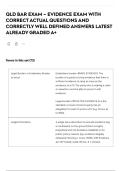
QLD BAR EXAM – EVIDENCE EXAM WITH
CORRECT ACTUAL QUESTIONS AND
CORRECTLY WELL DEFINED ANSWERS LATEST
ALREADY GRADED A+
Terms in this set (73)
Legal Burden vs Evidentiary Burden Evidentiary burden: BRING EVIDENCE. The
of proof burden of a party to bring evidence that there is
sufficient evidence to raise an issue as the
existence of a FII. The party who is making a claim
or assertion must be able to prove it with
evidence.
Legal burden: PROVE THE EVIDENCE to a the
standard, or level of proof a party has an
obligation to reach to prove a FII (e.g. Crown as
to BRD).
Judge's Discretion A judge has a discretion to exclude evidence (eg.
a confession) on the ground that it is highly
prejudicial and not probative (reliable) or for
public policy reasons (eg. evidence illegally
obtained): Bunning v Cross (1978); s130 Evidence
Act 1977 (Qld); ss135-139 EA; R v Christie.
,Browne v Dunn Rule: Unless notice has been given, Counsel that
wishes to contradict a witness by calling other
evidence must put that evidence to the witness
for their comment.
Rationale: Anti-ambush rule for fairness. Allows
other party to call evidence so they can explain
it.
Court can then enjoy joinder evidence/FII.
Consequences of non-compliance:
Ethical and evidentiary implications; can be given
less weight, denial of right to respond by
party/witness, other party may be entitled recall
evidence/put rebuttal evidence. Potential mistrial,
appeal or jury warning given.
Provide an example.
, Jones v Dunkel [1959] Rule: In certain circumstances, a party that
provides an unexplained failure to provide
evidence may lead to an inference that the
uncalled evidence would not have assisted the
party's case.
Rationale: Deterrence against parties tempted to
withhold evidence; promotes fairness,
discourages parties from hiding or suppressing
evidence that could weaken their position, and
promotes transparency.
Provide example.
When does Jones v Dunkel not Limited application in criminal proceedings, can
apply? be used against Crown.
Also does not apply in the appropriate
circumstances: 1) when the party is 'required to
explain or contradict something' and 2) it is within
their power to tender it, and 3) there is no
adequate explanation as to failure.
CORRECT ACTUAL QUESTIONS AND
CORRECTLY WELL DEFINED ANSWERS LATEST
ALREADY GRADED A+
Terms in this set (73)
Legal Burden vs Evidentiary Burden Evidentiary burden: BRING EVIDENCE. The
of proof burden of a party to bring evidence that there is
sufficient evidence to raise an issue as the
existence of a FII. The party who is making a claim
or assertion must be able to prove it with
evidence.
Legal burden: PROVE THE EVIDENCE to a the
standard, or level of proof a party has an
obligation to reach to prove a FII (e.g. Crown as
to BRD).
Judge's Discretion A judge has a discretion to exclude evidence (eg.
a confession) on the ground that it is highly
prejudicial and not probative (reliable) or for
public policy reasons (eg. evidence illegally
obtained): Bunning v Cross (1978); s130 Evidence
Act 1977 (Qld); ss135-139 EA; R v Christie.
,Browne v Dunn Rule: Unless notice has been given, Counsel that
wishes to contradict a witness by calling other
evidence must put that evidence to the witness
for their comment.
Rationale: Anti-ambush rule for fairness. Allows
other party to call evidence so they can explain
it.
Court can then enjoy joinder evidence/FII.
Consequences of non-compliance:
Ethical and evidentiary implications; can be given
less weight, denial of right to respond by
party/witness, other party may be entitled recall
evidence/put rebuttal evidence. Potential mistrial,
appeal or jury warning given.
Provide an example.
, Jones v Dunkel [1959] Rule: In certain circumstances, a party that
provides an unexplained failure to provide
evidence may lead to an inference that the
uncalled evidence would not have assisted the
party's case.
Rationale: Deterrence against parties tempted to
withhold evidence; promotes fairness,
discourages parties from hiding or suppressing
evidence that could weaken their position, and
promotes transparency.
Provide example.
When does Jones v Dunkel not Limited application in criminal proceedings, can
apply? be used against Crown.
Also does not apply in the appropriate
circumstances: 1) when the party is 'required to
explain or contradict something' and 2) it is within
their power to tender it, and 3) there is no
adequate explanation as to failure.


