

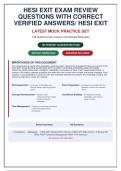
HESI EXIT EXAM REVIEW
QUESTIONS WITH CORRECT
VERIFIED ANSWERS/ HESI EXIT
LATEST MOCK PRACTICE SET
138 Questions with Answers and Detailed Rationales
100 PERCENT GUARANTEED PASS
INSTANT DOWNLOAD ANSWERS INCLUDED
IMPORTANCE OF THIS DOCUMENT
This comprehensive examination preparation guide has been meticulously developed to help you succeed in the
HESI EXIT EXAM REVIEW QUESTIONS WITH CORRECT VERIFIED ANSWERS/ HESI EXIT EXAM
PRACTICE QUESTIONS AND CORRECT ANSWERS/ A REVIEW OF REAL PAST EXAM QUESTIONS. It
contains 138 carefully selected questions that reflect the most current exam content and testing strategies. Each
question is accompanied by a correct answer and a detailed rationale that explains the underlying concepts and
reasoning required to master the material.
Self-Assessment – Test your knowledge and Exam Preparation – Familiarize yourself with the
identify areas requiring further question format and content
study areas
Concept Reinforcement – Deepen your Confidence Building – Develop test-taking
understanding through strategies and reduce
evidence-based exam anxiety
rationales
Time Management – Practice answering questions
under simulated exam
conditions
Review Summary 138 Questions
Foundations - Application - HESI EXIT Review WITH Correct / HESI EXIT AND Correct / A Review OF
REAL PAST Nursing Undergraduate YEAR 4 Pre-licensure
All answers with rationales
,Table of Contents
Section A - Intervention Section B - Appropriate
Questions 1 to 35 Questions 36 to 70
Section C - Finding Section D - Pressure
Questions 71 to 105 Questions 106 to 138
,Section A - Intervention
Q1.
A patient with heart failure on digoxin and furosemide develops nausea, vomiting, and
blurred vision. Which lab result is most likely contributing?
A. Serum potassium 3.0 mEq/L B. Serum sodium 135 mEq/L
C. BUN 25 mg/dL D. Serum digoxin level 1.2 ng/mL
Correct: A - Serum potassium 3.0 mEq/L
Rationale:
Hypokalemia (K+ <3.5) increases myocardial sensitivity to digoxin, precipitating toxicity
despite therapeutic digoxin levels. Furosemide causes potassium loss. Symptoms like
nausea, vomiting, and blurred vision are classic digoxin toxicity. Sodium and BUN are less
directly linked; digoxin level 1.2 ng/mL is therapeutic.
Q2.
A pregnant client at 32 weeks gestation presents with headache, blurred vision, and
epigastric pain. Blood pressure is 160/100 mmHg, urine protein 3+. Which intervention
should the nurse initiate first?
A. Administer hydralazine intravenously B. Start magnesium sulfate infusion
C. Place in left lateral position D. Insert indwelling urinary catheter
Correct: B - Start magnesium sulfate infusion
Rationale:
This presentation is severe preeclampsia with likely impending eclampsia. Magnesium sulfate
is the first-line anticonvulsant to prevent seizures. While hydralazine may be used for blood
pressure control, seizure prophylaxis takes precedence. Left lateral positioning improves
placental perfusion but is not the priority. Catheterization is unnecessary at this point.
Q3.
A postoperative patient 3 days after hip arthroplasty suddenly develops dyspnea, pleuritic
chest pain, and hemoptysis. Vital signs: HR 120, BP 90/60, RR 32, SpO2 89%. Which
diagnostic test will confirm the most likely diagnosis?
A. D-dimer B. CT pulmonary angiography
C. Ventilation-perfusion scan D. Echocardiogram
Correct: B - CT pulmonary angiography
Page 3
, Section A - Intervention
Rationale:
High clinical suspicion for pulmonary embolism (PE) in a postoperative patient with classic
triad. CT pulmonary angiography (CTPA) is the gold standard for PE diagnosis, providing
direct visualization of emboli. D-dimer is nonspecific; V/Q scan is used if CTPA
contraindicated. Echocardiogram may show right heart strain but is not confirmatory.
Q4.
A child with asthma presents with expiratory wheezing, accessory muscle use, and
oxygen saturation 89% on room air. After three albuterol nebulizer treatments, sats
increase to 92%. Which assessment finding indicates the need for immediate escalation of
care?
A. Mild intercostal retractions B. Respiratory rate 30 breaths per minute
C. Peak expiratory flow 65% of predicted D. Inaudible breath sounds with no
wheezing
Correct: D - Inaudible breath sounds with no wheezing
Rationale:
A 'silent chest' (inaudible breath sounds with absent wheeze) indicates severe airway
obstruction and impending respiratory failure, requiring immediate intervention (e.g., IV
magnesium, noninvasive ventilation, or intubation). Mild retractions and tachypnea are
expected. PEF 65% is moderate, not critical.
Q5.
A client with major depressive disorder has been on sertraline 150 mg/day for 8 weeks
with minimal improvement. The client reports persistent low mood, anhedonia, and
insomnia. Which action by the nurse is most appropriate?
A. Increase sertraline to 200 mg/day B. Discontinue sertraline and start a different
SSRI
C. Recommend augmentation with D. Refer for electroconvulsive therapy
bupropion
Correct: C - Recommend augmentation with bupropion
Rationale:
After 8 weeks of therapeutic SSRI dose with inadequate response, guidelines suggest
augmentation (adding a second agent) before switching. Bupropion augmentation is effective
for residual depressive and sleep symptoms. Increasing dose beyond maximum rarely helps.
Switching to another SSRI (B) is reasonable but augmentation is first-line. ECT is reserved for
severe, refractory cases.
Page 4
QUESTIONS WITH CORRECT
VERIFIED ANSWERS/ HESI EXIT
LATEST MOCK PRACTICE SET
138 Questions with Answers and Detailed Rationales
100 PERCENT GUARANTEED PASS
INSTANT DOWNLOAD ANSWERS INCLUDED
IMPORTANCE OF THIS DOCUMENT
This comprehensive examination preparation guide has been meticulously developed to help you succeed in the
HESI EXIT EXAM REVIEW QUESTIONS WITH CORRECT VERIFIED ANSWERS/ HESI EXIT EXAM
PRACTICE QUESTIONS AND CORRECT ANSWERS/ A REVIEW OF REAL PAST EXAM QUESTIONS. It
contains 138 carefully selected questions that reflect the most current exam content and testing strategies. Each
question is accompanied by a correct answer and a detailed rationale that explains the underlying concepts and
reasoning required to master the material.
Self-Assessment – Test your knowledge and Exam Preparation – Familiarize yourself with the
identify areas requiring further question format and content
study areas
Concept Reinforcement – Deepen your Confidence Building – Develop test-taking
understanding through strategies and reduce
evidence-based exam anxiety
rationales
Time Management – Practice answering questions
under simulated exam
conditions
Review Summary 138 Questions
Foundations - Application - HESI EXIT Review WITH Correct / HESI EXIT AND Correct / A Review OF
REAL PAST Nursing Undergraduate YEAR 4 Pre-licensure
All answers with rationales
,Table of Contents
Section A - Intervention Section B - Appropriate
Questions 1 to 35 Questions 36 to 70
Section C - Finding Section D - Pressure
Questions 71 to 105 Questions 106 to 138
,Section A - Intervention
Q1.
A patient with heart failure on digoxin and furosemide develops nausea, vomiting, and
blurred vision. Which lab result is most likely contributing?
A. Serum potassium 3.0 mEq/L B. Serum sodium 135 mEq/L
C. BUN 25 mg/dL D. Serum digoxin level 1.2 ng/mL
Correct: A - Serum potassium 3.0 mEq/L
Rationale:
Hypokalemia (K+ <3.5) increases myocardial sensitivity to digoxin, precipitating toxicity
despite therapeutic digoxin levels. Furosemide causes potassium loss. Symptoms like
nausea, vomiting, and blurred vision are classic digoxin toxicity. Sodium and BUN are less
directly linked; digoxin level 1.2 ng/mL is therapeutic.
Q2.
A pregnant client at 32 weeks gestation presents with headache, blurred vision, and
epigastric pain. Blood pressure is 160/100 mmHg, urine protein 3+. Which intervention
should the nurse initiate first?
A. Administer hydralazine intravenously B. Start magnesium sulfate infusion
C. Place in left lateral position D. Insert indwelling urinary catheter
Correct: B - Start magnesium sulfate infusion
Rationale:
This presentation is severe preeclampsia with likely impending eclampsia. Magnesium sulfate
is the first-line anticonvulsant to prevent seizures. While hydralazine may be used for blood
pressure control, seizure prophylaxis takes precedence. Left lateral positioning improves
placental perfusion but is not the priority. Catheterization is unnecessary at this point.
Q3.
A postoperative patient 3 days after hip arthroplasty suddenly develops dyspnea, pleuritic
chest pain, and hemoptysis. Vital signs: HR 120, BP 90/60, RR 32, SpO2 89%. Which
diagnostic test will confirm the most likely diagnosis?
A. D-dimer B. CT pulmonary angiography
C. Ventilation-perfusion scan D. Echocardiogram
Correct: B - CT pulmonary angiography
Page 3
, Section A - Intervention
Rationale:
High clinical suspicion for pulmonary embolism (PE) in a postoperative patient with classic
triad. CT pulmonary angiography (CTPA) is the gold standard for PE diagnosis, providing
direct visualization of emboli. D-dimer is nonspecific; V/Q scan is used if CTPA
contraindicated. Echocardiogram may show right heart strain but is not confirmatory.
Q4.
A child with asthma presents with expiratory wheezing, accessory muscle use, and
oxygen saturation 89% on room air. After three albuterol nebulizer treatments, sats
increase to 92%. Which assessment finding indicates the need for immediate escalation of
care?
A. Mild intercostal retractions B. Respiratory rate 30 breaths per minute
C. Peak expiratory flow 65% of predicted D. Inaudible breath sounds with no
wheezing
Correct: D - Inaudible breath sounds with no wheezing
Rationale:
A 'silent chest' (inaudible breath sounds with absent wheeze) indicates severe airway
obstruction and impending respiratory failure, requiring immediate intervention (e.g., IV
magnesium, noninvasive ventilation, or intubation). Mild retractions and tachypnea are
expected. PEF 65% is moderate, not critical.
Q5.
A client with major depressive disorder has been on sertraline 150 mg/day for 8 weeks
with minimal improvement. The client reports persistent low mood, anhedonia, and
insomnia. Which action by the nurse is most appropriate?
A. Increase sertraline to 200 mg/day B. Discontinue sertraline and start a different
SSRI
C. Recommend augmentation with D. Refer for electroconvulsive therapy
bupropion
Correct: C - Recommend augmentation with bupropion
Rationale:
After 8 weeks of therapeutic SSRI dose with inadequate response, guidelines suggest
augmentation (adding a second agent) before switching. Bupropion augmentation is effective
for residual depressive and sleep symptoms. Increasing dose beyond maximum rarely helps.
Switching to another SSRI (B) is reasonable but augmentation is first-line. ECT is reserved for
severe, refractory cases.
Page 4


