

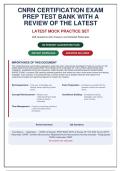
CNRN CERTIFICATION EXAM
PREP TEST BANK WITH A
REVIEW OF THE LATEST
LATEST MOCK PRACTICE SET
228 Questions with Answers and Detailed Rationales
100 PERCENT GUARANTEED PASS
INSTANT DOWNLOAD ANSWERS INCLUDED
IMPORTANCE OF THIS DOCUMENT
This comprehensive examination preparation guide has been meticulously developed to help you succeed in the
CNRN CERTIFICATION EXAM PREP TEST BANK WITH A REVIEW OF THE LATEST QUESTIONS AND
CORRECT ANSWERS WITH RATIONALES/ CNRN EXAM/ CERTIFIED NEUROSCIENCE REGISTERED
NURSE EXAM. It contains 228 carefully selected questions that reflect the most current exam content and testing
strategies. Each question is accompanied by a correct answer and a detailed rationale that explains the
underlying concepts and reasoning required to master the material.
Self-Assessment – Test your knowledge and Exam Preparation – Familiarize yourself with the
identify areas requiring further question format and content
study areas
Concept Reinforcement – Deepen your Confidence Building – Develop test-taking
understanding through strategies and reduce
evidence-based exam anxiety
rationales
Time Management – Practice answering questions
under simulated exam
conditions
Review Summary 228 Questions
Foundations - Application - CNRN Certification PREP BANK WITH A Review OF THE AND Correct WITH
Rationales/ CNRN / Certified Neuroscience Registered Nurse Neuroscience Nursing Graduate / Postgraduate
CNRN Certification PREP
All answers with rationales
,Table of Contents
Section A - Injury Section B - Brain
Questions 1 to 57 Questions 58 to 114
Section C - Severe Section D - Pressure
Questions 115 to 171 Questions 172 to 228
,Section A - Injury
Q1.
A patient with severe traumatic brain injury (TBI) has an intraventricular catheter for ICP
monitoring. The nurse notes a sustained elevation in ICP to 28 mmHg despite maximal
medical management. Which intervention is most likely to be initiated next based on
current BTF guidelines?
A. Administer 1 g/kg mannitol IV bolus B. Initiate hyperventilation to achieve
PaCO2 of 28-30 mmHg
C. Place the patient in Trendelenburg D. Prepare for decompressive craniectomy
position to improve venous return
Correct: D - Prepare for decompressive craniectomy
Rationale:
Decompressive craniectomy is recommended when ICP remains >25 mmHg despite
maximum medical therapy (BTF Level IIB). Mannitol is a first-line osmotic agent but is already
maxed; further boluses risk acute kidney injury. Hyperventilation (PaCO2 <30) is reserved for
brief periods of acute deterioration due to risk of cerebral ischemia. Trendelenburg increases
ICP.
Q2.
A patient with aneurysmal subarachnoid hemorrhage (aSAH) develops new focal deficit
and a drop in consciousness on day 6 post-bleed. CT perfusion shows a region of
prolonged mean transit time (MTT) but stable cerebral blood volume (CBV). What is the
most likely cause and immediate nursing action?
A. Rebledding; prepare for emergent B. Delayed cerebral ischemia (DCI); initiate
aneurysm coiling triple-H therapy (hypertension,
hypervolemia, hemodilution) if not
contraindicated
C. Acute hydrocephalus; place external D. Seizure activity; administer IV lorazepam
ventricular drain
Correct: B - Delayed cerebral ischemia (DCI); initiate triple-H therapy (hypertension,
hypervolemia, hemodilution) if not contraindicated
Rationale:
DCI typically occurs 3-14 days post-aSAH, presenting with focals and decreased LOC. CT
perfusion shows prolonged MTT with preserved CBV (penumbra). Triple-H therapy (induced
hypertension, euvolemia, hemodilution) is first-line to augment cerebral perfusion. Rebleeding
would show new hemorrhage on CT; hydrocephalus would show ventricular enlargement;
seizure might need EEG confirmation.
Page 3
, Section A - Injury
Q3.
A patient on phenytoin 300 mg daily (100 mg TID) has a therapeutic trough level of 8
mcg/mL. After four days of unchanged dosing, the trough is now 5 mcg/mL. Which factor
most likely explains this change?
A. Concomitant use of cimetidine B. Initiation of tube feedings (continuous
enteral nutrition)
C. Development of hepatic impairment D. Nonadherence to the prescribed regimen
Correct: B - Initiation of tube feedings (continuous enteral nutrition)
Rationale:
Phenytoin absorption is significantly reduced by enteral feedings due to binding with the
feeding formula; trough levels drop. Cimetidine inhibits metabolism, raising levels. Hepatic
impairment also raises levels. Nonadherence is possible but less likely given the timing with
initiation of tube feedings.
Q4.
A patient with acute ischemic stroke arrives within 2 hours of symptom onset. NIHSS
score is 8, blood pressure is 185/110 mmHg, and they are taking rivaroxaban for atrial
fibrillation. Which action is appropriate per AHA/ASA guidelines?
A. Administer IV alteplase after reducing BP B. Withhold IV alteplase due to
to <185/110 with labetalol anticoagulation; proceed to mechanical
thrombectomy if large vessel occlusion
C. Give IV alteplase immediately as the INR D. Administer IV tenecteplase 0.4 mg/kg as
is likely normal on rivaroxaban it is safer with anticoagulation
Correct: B - Withhold IV alteplase due to anticoagulation; proceed to mechanical
thrombectomy if large vessel occlusion
Rationale:
IV alteplase is contraindicated if the patient has taken a direct oral anticoagulant (DOAC) like
rivaroxaban within 48 hours, unless lab tests show normal clotting times. Mechanical
thrombectomy may be considered if imaging shows large vessel occlusion and groin puncture
can be done within 6-24 hours. BP management per guidelines (goal <185/110) is needed
before any intervention, but thrombolysis is still contraindicated.
Q5.
A patient with cervical spinal cord injury at C5-6 develops bradycardia (HR 42) and
hypotension (MAP 60 mmHg) on day 3. After ruling out hemorrhage, which intervention is
most appropriate?
Page 4
PREP TEST BANK WITH A
REVIEW OF THE LATEST
LATEST MOCK PRACTICE SET
228 Questions with Answers and Detailed Rationales
100 PERCENT GUARANTEED PASS
INSTANT DOWNLOAD ANSWERS INCLUDED
IMPORTANCE OF THIS DOCUMENT
This comprehensive examination preparation guide has been meticulously developed to help you succeed in the
CNRN CERTIFICATION EXAM PREP TEST BANK WITH A REVIEW OF THE LATEST QUESTIONS AND
CORRECT ANSWERS WITH RATIONALES/ CNRN EXAM/ CERTIFIED NEUROSCIENCE REGISTERED
NURSE EXAM. It contains 228 carefully selected questions that reflect the most current exam content and testing
strategies. Each question is accompanied by a correct answer and a detailed rationale that explains the
underlying concepts and reasoning required to master the material.
Self-Assessment – Test your knowledge and Exam Preparation – Familiarize yourself with the
identify areas requiring further question format and content
study areas
Concept Reinforcement – Deepen your Confidence Building – Develop test-taking
understanding through strategies and reduce
evidence-based exam anxiety
rationales
Time Management – Practice answering questions
under simulated exam
conditions
Review Summary 228 Questions
Foundations - Application - CNRN Certification PREP BANK WITH A Review OF THE AND Correct WITH
Rationales/ CNRN / Certified Neuroscience Registered Nurse Neuroscience Nursing Graduate / Postgraduate
CNRN Certification PREP
All answers with rationales
,Table of Contents
Section A - Injury Section B - Brain
Questions 1 to 57 Questions 58 to 114
Section C - Severe Section D - Pressure
Questions 115 to 171 Questions 172 to 228
,Section A - Injury
Q1.
A patient with severe traumatic brain injury (TBI) has an intraventricular catheter for ICP
monitoring. The nurse notes a sustained elevation in ICP to 28 mmHg despite maximal
medical management. Which intervention is most likely to be initiated next based on
current BTF guidelines?
A. Administer 1 g/kg mannitol IV bolus B. Initiate hyperventilation to achieve
PaCO2 of 28-30 mmHg
C. Place the patient in Trendelenburg D. Prepare for decompressive craniectomy
position to improve venous return
Correct: D - Prepare for decompressive craniectomy
Rationale:
Decompressive craniectomy is recommended when ICP remains >25 mmHg despite
maximum medical therapy (BTF Level IIB). Mannitol is a first-line osmotic agent but is already
maxed; further boluses risk acute kidney injury. Hyperventilation (PaCO2 <30) is reserved for
brief periods of acute deterioration due to risk of cerebral ischemia. Trendelenburg increases
ICP.
Q2.
A patient with aneurysmal subarachnoid hemorrhage (aSAH) develops new focal deficit
and a drop in consciousness on day 6 post-bleed. CT perfusion shows a region of
prolonged mean transit time (MTT) but stable cerebral blood volume (CBV). What is the
most likely cause and immediate nursing action?
A. Rebledding; prepare for emergent B. Delayed cerebral ischemia (DCI); initiate
aneurysm coiling triple-H therapy (hypertension,
hypervolemia, hemodilution) if not
contraindicated
C. Acute hydrocephalus; place external D. Seizure activity; administer IV lorazepam
ventricular drain
Correct: B - Delayed cerebral ischemia (DCI); initiate triple-H therapy (hypertension,
hypervolemia, hemodilution) if not contraindicated
Rationale:
DCI typically occurs 3-14 days post-aSAH, presenting with focals and decreased LOC. CT
perfusion shows prolonged MTT with preserved CBV (penumbra). Triple-H therapy (induced
hypertension, euvolemia, hemodilution) is first-line to augment cerebral perfusion. Rebleeding
would show new hemorrhage on CT; hydrocephalus would show ventricular enlargement;
seizure might need EEG confirmation.
Page 3
, Section A - Injury
Q3.
A patient on phenytoin 300 mg daily (100 mg TID) has a therapeutic trough level of 8
mcg/mL. After four days of unchanged dosing, the trough is now 5 mcg/mL. Which factor
most likely explains this change?
A. Concomitant use of cimetidine B. Initiation of tube feedings (continuous
enteral nutrition)
C. Development of hepatic impairment D. Nonadherence to the prescribed regimen
Correct: B - Initiation of tube feedings (continuous enteral nutrition)
Rationale:
Phenytoin absorption is significantly reduced by enteral feedings due to binding with the
feeding formula; trough levels drop. Cimetidine inhibits metabolism, raising levels. Hepatic
impairment also raises levels. Nonadherence is possible but less likely given the timing with
initiation of tube feedings.
Q4.
A patient with acute ischemic stroke arrives within 2 hours of symptom onset. NIHSS
score is 8, blood pressure is 185/110 mmHg, and they are taking rivaroxaban for atrial
fibrillation. Which action is appropriate per AHA/ASA guidelines?
A. Administer IV alteplase after reducing BP B. Withhold IV alteplase due to
to <185/110 with labetalol anticoagulation; proceed to mechanical
thrombectomy if large vessel occlusion
C. Give IV alteplase immediately as the INR D. Administer IV tenecteplase 0.4 mg/kg as
is likely normal on rivaroxaban it is safer with anticoagulation
Correct: B - Withhold IV alteplase due to anticoagulation; proceed to mechanical
thrombectomy if large vessel occlusion
Rationale:
IV alteplase is contraindicated if the patient has taken a direct oral anticoagulant (DOAC) like
rivaroxaban within 48 hours, unless lab tests show normal clotting times. Mechanical
thrombectomy may be considered if imaging shows large vessel occlusion and groin puncture
can be done within 6-24 hours. BP management per guidelines (goal <185/110) is needed
before any intervention, but thrombolysis is still contraindicated.
Q5.
A patient with cervical spinal cord injury at C5-6 develops bradycardia (HR 42) and
hypotension (MAP 60 mmHg) on day 3. After ruling out hemorrhage, which intervention is
most appropriate?
Page 4


