

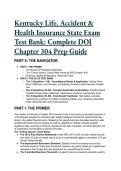
Kentucky Life, Accident &
Health Insurance State Exam
Test Bank: Complete DOI
Chapter 304 Prep Guide
PART 0: THE NAVIGATOR
● PART I: THE PRIMER
○ The Mission & Professional Standard
○ The "Critical Axioms" Cheat Sheet (Kentucky KRS Chapter 304)
○ Kentucky Liability & Regulatory Thresholds Table
● PART II: THE ELITE TEST BANK
○ Tier 1 (Questions 1–28) - Foundational Syntax & Application: Testing "Hard
Deck" definitions, core formulas, and statutory timelines under Kentucky Chapter
304.
○ Tier 2 (Questions 29–58) - Complex Application & Simulation: Situation-based
variables testing claims settlement, replacement protocols, and fiduciary limits.
○ Tier 3 (Questions 59–88) - Grandmaster Synthesis: High-stakes scenarios
requiring the synthesis of multiple competing statutes (e.g., Guaranty Association
limits interacting with unfair trade practices).
PART I: THE PRIMER
The mastery of Kentucky's Chapter 304 Insurance Code is not merely an academic exercise; it
is the absolute baseline for executing elite, legally bulletproof clinical and analytical fiduciary
duties in the global financial sector. Mastering this specific test bank translates directly to elite
professional performance by forging an intuitive capability to instantly navigate complex
regulatory traps, ensuring continuous compliance with state mandates, and eliminating the risk
of catastrophic civil penalties or license revocation.
The "Critical Axioms" Cheat Sheet:
● The 30/12 Rule (Claims Settlement): Under KRS 304.12-235, all clean claims must be
paid within 30 days of receipt; failure to do so automatically triggers a mandatory 12% per
annum interest penalty.
● The Replacement Rescission Standard: Standard new life insurance and annuity
contracts require a 10-day free look period; however, any policy issued as a replacement
demands a strict 30-day free look period with an unconditional full refund.
● The Controlled Business Threshold: An agent's license is deemed unlawfully used for
, controlled business if premiums from self, family, or employer exceed 50% of the
aggregate premiums written within any 12-month period.
● Guaranty Association Hard Limits (KLHIGA): The state protects resident policyholders
upon insurer insolvency strictly up to $300,000 for life insurance death benefits, $250,000
for annuity present values, and $500,000 for basic hospital/medical health plans.
Regulatory Trigger (Kentucky Statutory Mandate / Limit Civil Penalty / Consequence
DOI)
Change of Address / Name Notification required to the DOI License suspension and
within 30 days. administrative fines.
Continuing Education (CE) 24 hours biennially, requiring a License termination upon
minimum of 3 hours in ethics. expiration date.
Anti-Rebating Limitation Prizes, goods, or merchandise Administrative action, fine, or
must not exceed $25 in license revocation.
aggregate value.
Unfair Claims Settlement Must respond/act reasonably Up to $10,000 fine per violation
promptly to all claims. for insurers.
PART II: THE ELITE TEST BANK
Tier 1: Foundational Syntax & Application
Q1: An applicant receives a newly issued, non-replacement individual life insurance policy.
Based on the principles of Kentucky KRS 304.15, what is the MOST accurate timeline for the
applicant to return the policy for a full refund without penalty? A) 15 days from the date of
application. B) 30 days from the date of policy delivery. C) 10 days from the date of policy
delivery. D) 20 days from the date of underwriting approval.
● The Answer: C (10 days from the date of policy delivery.)
● Distractor Analysis:
○ A is incorrect: The free look period begins upon physical or electronic delivery of the
policy, not the application date.
○ B is incorrect: A 30-day window applies exclusively to replacement policies, not
standard new issues.
○ D is incorrect: 20 days is a legacy metric no longer applicable under current
Kentucky statutes.
The Mentor's Analysis: Consumer protection laws mandate a strictly defined review window.
When delivering standard new policies, the immediate priority is acknowledging the 10-day
rescission right. By utilizing the free look provision, the policyholder bypasses the trap of
irrevocable financial commitment without review. Professional/Academic Intuition: Standard life
and health policies mandate a 10-day free look period starting from the date of delivery.
Q2: A producer is attempting to replace an existing life insurance policy with a new contract.
Based on the principles of KRS 304.12-030, which action regarding the free look period is the
MOST accurate? A) The replacing insurer must provide a 10-day free look period with a
prorated premium refund. B) The replacing insurer must guarantee a 30-day free look period
with an unconditional full refund. C) The existing insurer determines the free look period based
on the original contract's issue date. D) Replacements are exempt from free look periods to
prevent market manipulation.
● The Answer: B (The replacing insurer must guarantee a 30-day free look period with an
unconditional full refund.)
, ● Distractor Analysis:
○ A is incorrect: Prorated refunds are prohibited during the free look; the refund must
be unconditional and full.
○ C is incorrect: The replacing insurer, not the existing insurer, dictates the terms of
the new contract's free look.
○ D is incorrect: Replacements carry stricter, longer free look requirements, not
exemptions.
The Mentor's Analysis: Replacement transactions carry an inherently higher risk of consumer
detriment. When processing replacements, the immediate priority is extending the rescission
window. By utilizing the extended 30-day rule, regulators bypass the common trap of aggressive
twisting tactics. Professional/Academic Intuition: All life insurance and annuity replacements
in Kentucky require a mandatory 30-day free look period.
Q3: A clean health insurance claim is submitted to an authorized Kentucky insurer, but the
insurer delays payment without requesting additional information. Based on KRS 304.12-235,
what is the MOST accurate consequence if payment occurs on the 45th day? A) The insurer
must pay the claim plus a 10% per annum interest penalty. B) The insurer must pay the claim
plus a 12% per annum interest penalty starting from day 31. C) The insurer faces an automatic
$10,000 civil penalty without the need for a hearing. D) The claim is rendered void and must be
resubmitted with a formal proof of loss.
● The Answer: B (The insurer must pay the claim plus a 12% per annum interest penalty
starting from day 31.)
● Distractor Analysis:
○ A is incorrect: 10% is an incorrect interest rate; Kentucky statute explicitly dictates
12%.
○ C is incorrect: Civil penalties require administrative hearings; they are not
automatically assessed simply because a claim was delayed 15 days.
○ D is incorrect: Delaying payment does not void the claimant's right to the funds.
The Mentor's Analysis: Prompt payment statutes ensure liquidity for healthcare providers and
insureds. When facing delayed claims, the immediate priority is calculating statutory interest. By
utilizing the 12% annual interest mandate, the state bypasses the common trap of institutional
cash-flow hoarding. Professional/Academic Intuition: Claims not paid within 30 days of clean
submission automatically accrue 12% annual interest.
Q4: An agent wishes to provide a promotional gift to prospective clients who attend a retirement
seminar. Based on Kentucky's anti-rebating statutes, which action is the MOST accurate? A)
Providing a $50 gift card to a local restaurant for attending. B) Giving a branded portfolio valued
at $20 to each attendee. C) Offering a 5% discount on the first month's premium for signing up
immediately. D) Refunding the agent's commission directly to the client's bank account.
● The Answer: B (Giving a branded portfolio valued at $20 to each attendee.)
● Distractor Analysis:
○ A is incorrect: The aggregate value of promotional items cannot exceed $25; a $50
gift card is an illegal inducement.
○ C is incorrect: Premium discounts not explicitly filed in the contract are illegal
rebating.
○ D is incorrect: Commission sharing or refunding to an unlicensed client is a severe
statutory violation.
The Mentor's Analysis: Inducements compromise the actuarial integrity of insurance pricing.
When marketing, the immediate priority is keeping promotional items below the statutory ceiling.
By utilizing the $25 aggregate limit, the producer bypasses the common trap of illegal rebating.
, Professional/Academic Intuition: Promotional gifts and merchandise must never exceed an
aggregate value of $25 per prospective insured.
Q5: An individual passes the Kentucky insurance exam and receives their resident producer
license. Six months later, they move to a new city within the state. Under KRS 304.9, what is the
IMMEDIATELY required action? A) The producer must notify the Commissioner in writing within
30 days of the address change. B) The producer must re-apply for a resident license in the new
county. C) The producer must notify the Commissioner within 60 days to avoid a $1,000 fine. D)
No action is required until the biennial license renewal period.
● The Answer: A (The producer must notify the Commissioner in writing within 30 days of
the address change.)
● Distractor Analysis:
○ B is incorrect: Licenses are issued at the state level; county-level re-application is
an invalid concept.
○ C is incorrect: The statutory notification window is 30 days, not 60 days.
○ D is incorrect: Waiting until renewal constitutes a violation and will trigger
administrative fines.
The Mentor's Analysis: Regulatory oversight requires accurate, real-time tracking of fiduciaries.
When relocating, the immediate priority is updating the Department of Insurance via the NIPR
Gateway. By utilizing the 30-day notification rule, the agent bypasses the trap of administrative
penalties. Professional/Academic Intuition: Any change of address or legal name requires
written notification to the DOI within 30 days.
Q6: A licensed producer writes property, life, and health insurance. In the past 12 months, the
producer generated $100,000 in aggregate premiums. Of that, $60,000 came from policies
insuring the producer's own family and their employer. Based on KRS 304.9-100, what is the
MOST accurate conclusion? A) The producer is operating legally since personal business is
capped at 75%. B) The producer is engaged in an illegal practice known as controlled business.
C) The producer must share the commissions with the employer to avoid tax penalties. D) The
producer is fully compliant, provided the policies were not discounted.
● The Answer: B (The producer is engaged in an illegal practice known as controlled
business.)
● Distractor Analysis:
○ A is incorrect: The statutory cap for controlled business is 50%, not 75%.
○ C is incorrect: Sharing commissions with an unlicensed entity (the employer) is
illegal.
○ D is incorrect: The absence of discounts does not negate the violation of the
controlled business volume threshold.
The Mentor's Analysis: The purpose of an insurance license is to serve the general public.
When auditing a producer's book of business, the immediate priority is verifying the 50%
threshold. By utilizing the aggregate premium metric, regulators bypass the trap of licensing
individuals solely for personal financial gain. Professional/Academic Intuition: An agent's
license is unlawfully used for controlled business if premiums from self, family, or
employer exceed 50% of total written premiums in a 12-month period.
Q7: A domestic life insurance company in Kentucky has been operating without regulatory
interruption for four years. Under KRS 304.2-210, what is the MOST accurate maximum
timeframe before the Commissioner MUST conduct a financial examination of this insurer? A)
Within the next 12 months, as examinations occur every 5 years. B) Within the next 3 years, as
domestic insurers are audited every 7 years. C) Immediately, as domestic insurers require a full
audit every 3 years. D) The Commissioner is not required to examine the insurer unless a
Health Insurance State Exam
Test Bank: Complete DOI
Chapter 304 Prep Guide
PART 0: THE NAVIGATOR
● PART I: THE PRIMER
○ The Mission & Professional Standard
○ The "Critical Axioms" Cheat Sheet (Kentucky KRS Chapter 304)
○ Kentucky Liability & Regulatory Thresholds Table
● PART II: THE ELITE TEST BANK
○ Tier 1 (Questions 1–28) - Foundational Syntax & Application: Testing "Hard
Deck" definitions, core formulas, and statutory timelines under Kentucky Chapter
304.
○ Tier 2 (Questions 29–58) - Complex Application & Simulation: Situation-based
variables testing claims settlement, replacement protocols, and fiduciary limits.
○ Tier 3 (Questions 59–88) - Grandmaster Synthesis: High-stakes scenarios
requiring the synthesis of multiple competing statutes (e.g., Guaranty Association
limits interacting with unfair trade practices).
PART I: THE PRIMER
The mastery of Kentucky's Chapter 304 Insurance Code is not merely an academic exercise; it
is the absolute baseline for executing elite, legally bulletproof clinical and analytical fiduciary
duties in the global financial sector. Mastering this specific test bank translates directly to elite
professional performance by forging an intuitive capability to instantly navigate complex
regulatory traps, ensuring continuous compliance with state mandates, and eliminating the risk
of catastrophic civil penalties or license revocation.
The "Critical Axioms" Cheat Sheet:
● The 30/12 Rule (Claims Settlement): Under KRS 304.12-235, all clean claims must be
paid within 30 days of receipt; failure to do so automatically triggers a mandatory 12% per
annum interest penalty.
● The Replacement Rescission Standard: Standard new life insurance and annuity
contracts require a 10-day free look period; however, any policy issued as a replacement
demands a strict 30-day free look period with an unconditional full refund.
● The Controlled Business Threshold: An agent's license is deemed unlawfully used for
, controlled business if premiums from self, family, or employer exceed 50% of the
aggregate premiums written within any 12-month period.
● Guaranty Association Hard Limits (KLHIGA): The state protects resident policyholders
upon insurer insolvency strictly up to $300,000 for life insurance death benefits, $250,000
for annuity present values, and $500,000 for basic hospital/medical health plans.
Regulatory Trigger (Kentucky Statutory Mandate / Limit Civil Penalty / Consequence
DOI)
Change of Address / Name Notification required to the DOI License suspension and
within 30 days. administrative fines.
Continuing Education (CE) 24 hours biennially, requiring a License termination upon
minimum of 3 hours in ethics. expiration date.
Anti-Rebating Limitation Prizes, goods, or merchandise Administrative action, fine, or
must not exceed $25 in license revocation.
aggregate value.
Unfair Claims Settlement Must respond/act reasonably Up to $10,000 fine per violation
promptly to all claims. for insurers.
PART II: THE ELITE TEST BANK
Tier 1: Foundational Syntax & Application
Q1: An applicant receives a newly issued, non-replacement individual life insurance policy.
Based on the principles of Kentucky KRS 304.15, what is the MOST accurate timeline for the
applicant to return the policy for a full refund without penalty? A) 15 days from the date of
application. B) 30 days from the date of policy delivery. C) 10 days from the date of policy
delivery. D) 20 days from the date of underwriting approval.
● The Answer: C (10 days from the date of policy delivery.)
● Distractor Analysis:
○ A is incorrect: The free look period begins upon physical or electronic delivery of the
policy, not the application date.
○ B is incorrect: A 30-day window applies exclusively to replacement policies, not
standard new issues.
○ D is incorrect: 20 days is a legacy metric no longer applicable under current
Kentucky statutes.
The Mentor's Analysis: Consumer protection laws mandate a strictly defined review window.
When delivering standard new policies, the immediate priority is acknowledging the 10-day
rescission right. By utilizing the free look provision, the policyholder bypasses the trap of
irrevocable financial commitment without review. Professional/Academic Intuition: Standard life
and health policies mandate a 10-day free look period starting from the date of delivery.
Q2: A producer is attempting to replace an existing life insurance policy with a new contract.
Based on the principles of KRS 304.12-030, which action regarding the free look period is the
MOST accurate? A) The replacing insurer must provide a 10-day free look period with a
prorated premium refund. B) The replacing insurer must guarantee a 30-day free look period
with an unconditional full refund. C) The existing insurer determines the free look period based
on the original contract's issue date. D) Replacements are exempt from free look periods to
prevent market manipulation.
● The Answer: B (The replacing insurer must guarantee a 30-day free look period with an
unconditional full refund.)
, ● Distractor Analysis:
○ A is incorrect: Prorated refunds are prohibited during the free look; the refund must
be unconditional and full.
○ C is incorrect: The replacing insurer, not the existing insurer, dictates the terms of
the new contract's free look.
○ D is incorrect: Replacements carry stricter, longer free look requirements, not
exemptions.
The Mentor's Analysis: Replacement transactions carry an inherently higher risk of consumer
detriment. When processing replacements, the immediate priority is extending the rescission
window. By utilizing the extended 30-day rule, regulators bypass the common trap of aggressive
twisting tactics. Professional/Academic Intuition: All life insurance and annuity replacements
in Kentucky require a mandatory 30-day free look period.
Q3: A clean health insurance claim is submitted to an authorized Kentucky insurer, but the
insurer delays payment without requesting additional information. Based on KRS 304.12-235,
what is the MOST accurate consequence if payment occurs on the 45th day? A) The insurer
must pay the claim plus a 10% per annum interest penalty. B) The insurer must pay the claim
plus a 12% per annum interest penalty starting from day 31. C) The insurer faces an automatic
$10,000 civil penalty without the need for a hearing. D) The claim is rendered void and must be
resubmitted with a formal proof of loss.
● The Answer: B (The insurer must pay the claim plus a 12% per annum interest penalty
starting from day 31.)
● Distractor Analysis:
○ A is incorrect: 10% is an incorrect interest rate; Kentucky statute explicitly dictates
12%.
○ C is incorrect: Civil penalties require administrative hearings; they are not
automatically assessed simply because a claim was delayed 15 days.
○ D is incorrect: Delaying payment does not void the claimant's right to the funds.
The Mentor's Analysis: Prompt payment statutes ensure liquidity for healthcare providers and
insureds. When facing delayed claims, the immediate priority is calculating statutory interest. By
utilizing the 12% annual interest mandate, the state bypasses the common trap of institutional
cash-flow hoarding. Professional/Academic Intuition: Claims not paid within 30 days of clean
submission automatically accrue 12% annual interest.
Q4: An agent wishes to provide a promotional gift to prospective clients who attend a retirement
seminar. Based on Kentucky's anti-rebating statutes, which action is the MOST accurate? A)
Providing a $50 gift card to a local restaurant for attending. B) Giving a branded portfolio valued
at $20 to each attendee. C) Offering a 5% discount on the first month's premium for signing up
immediately. D) Refunding the agent's commission directly to the client's bank account.
● The Answer: B (Giving a branded portfolio valued at $20 to each attendee.)
● Distractor Analysis:
○ A is incorrect: The aggregate value of promotional items cannot exceed $25; a $50
gift card is an illegal inducement.
○ C is incorrect: Premium discounts not explicitly filed in the contract are illegal
rebating.
○ D is incorrect: Commission sharing or refunding to an unlicensed client is a severe
statutory violation.
The Mentor's Analysis: Inducements compromise the actuarial integrity of insurance pricing.
When marketing, the immediate priority is keeping promotional items below the statutory ceiling.
By utilizing the $25 aggregate limit, the producer bypasses the common trap of illegal rebating.
, Professional/Academic Intuition: Promotional gifts and merchandise must never exceed an
aggregate value of $25 per prospective insured.
Q5: An individual passes the Kentucky insurance exam and receives their resident producer
license. Six months later, they move to a new city within the state. Under KRS 304.9, what is the
IMMEDIATELY required action? A) The producer must notify the Commissioner in writing within
30 days of the address change. B) The producer must re-apply for a resident license in the new
county. C) The producer must notify the Commissioner within 60 days to avoid a $1,000 fine. D)
No action is required until the biennial license renewal period.
● The Answer: A (The producer must notify the Commissioner in writing within 30 days of
the address change.)
● Distractor Analysis:
○ B is incorrect: Licenses are issued at the state level; county-level re-application is
an invalid concept.
○ C is incorrect: The statutory notification window is 30 days, not 60 days.
○ D is incorrect: Waiting until renewal constitutes a violation and will trigger
administrative fines.
The Mentor's Analysis: Regulatory oversight requires accurate, real-time tracking of fiduciaries.
When relocating, the immediate priority is updating the Department of Insurance via the NIPR
Gateway. By utilizing the 30-day notification rule, the agent bypasses the trap of administrative
penalties. Professional/Academic Intuition: Any change of address or legal name requires
written notification to the DOI within 30 days.
Q6: A licensed producer writes property, life, and health insurance. In the past 12 months, the
producer generated $100,000 in aggregate premiums. Of that, $60,000 came from policies
insuring the producer's own family and their employer. Based on KRS 304.9-100, what is the
MOST accurate conclusion? A) The producer is operating legally since personal business is
capped at 75%. B) The producer is engaged in an illegal practice known as controlled business.
C) The producer must share the commissions with the employer to avoid tax penalties. D) The
producer is fully compliant, provided the policies were not discounted.
● The Answer: B (The producer is engaged in an illegal practice known as controlled
business.)
● Distractor Analysis:
○ A is incorrect: The statutory cap for controlled business is 50%, not 75%.
○ C is incorrect: Sharing commissions with an unlicensed entity (the employer) is
illegal.
○ D is incorrect: The absence of discounts does not negate the violation of the
controlled business volume threshold.
The Mentor's Analysis: The purpose of an insurance license is to serve the general public.
When auditing a producer's book of business, the immediate priority is verifying the 50%
threshold. By utilizing the aggregate premium metric, regulators bypass the trap of licensing
individuals solely for personal financial gain. Professional/Academic Intuition: An agent's
license is unlawfully used for controlled business if premiums from self, family, or
employer exceed 50% of total written premiums in a 12-month period.
Q7: A domestic life insurance company in Kentucky has been operating without regulatory
interruption for four years. Under KRS 304.2-210, what is the MOST accurate maximum
timeframe before the Commissioner MUST conduct a financial examination of this insurer? A)
Within the next 12 months, as examinations occur every 5 years. B) Within the next 3 years, as
domestic insurers are audited every 7 years. C) Immediately, as domestic insurers require a full
audit every 3 years. D) The Commissioner is not required to examine the insurer unless a


