

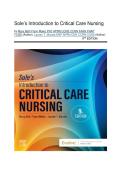
Sole’s Introduction to Critical Care Nursing
by Mary Beth Flynn Makic PhD APRN CCNS CCRN FAAN FNAP
FCNS (Author), Lauren T. Morata DNP APRN-CNS CCRN CCNS (Author)
9TH EDITION
,TABLE OF CONTENTS
PART I Fundamental Concepts
1 Overview of Critical Care Nursing
2 Patient and Family Response to the Critical Care Experience
3 Ethical and Legal Issues in Critical Care Nursing
4 Palliative and End-of-Life Care
5 Organ Donation
6 Comfort and Sedation
PART II Tools for the Critical Care Nurse
7 Nutritional Therapy
8 Dysrhythmia Interpretation and Management
9 Hemodynamic Monitoring
10 Ventilatory Assistance
11 Rapid Response Teams and Code Management
PART III Nursing Care During Critical Illness
12 Shock, Sepsis, and Multiple Organ Dysfunction Syndrome
13 Cardiovascular Alterations
14 Nervous System Alterations
15 Acute Respiratory Failure
16 Acute Kidney Injury
17 Hematological and Immune Disorders
18 Gastrointestinal Alterations
19 Endocrine Alterations
20 Trauma and Surgical Management
21 Burns
,Test Bank: Sole's Introduction to Critical Care Nursing, 9th Edition
By Mary Beth Flynn Makic
MULTIPLE CHOICE QUESTIONS
CHAPTER 1: Overview of Critical Care Nursing
1. Which statement best describes the primary goal of critical care nursing?
A) To provide care only during acute life-threatening emergencies
B) To promote optimal patient outcomes through expert assessment and intervention for patients with
actual or potential life-threatening conditions
C) To provide technical support and medication administration as directed by physicians
D) To focus exclusively on physiological monitoring and documentation
Answer: B
Rationale: Critical care nursing focuses on providing comprehensive care to patients with actual or
potential life-threatening conditions, with the goal of promoting optimal outcomes through expert
assessment, intervention, and collaboration.
2. The American Association of Critical-Care Nurses (AACN) Synergy Model for Patient Care is based on
which central concept?
A) Patient acuity levels determine staffing ratios
B) Nurse competencies and patient needs must be matched to achieve optimal outcomes
C) Critical care nurses must have advanced practice certification to provide quality care
D) Technology drives the quality of care provided in the ICU
Answer: B
, Rationale: The AACN Synergy Model proposes that optimal patient outcomes result when nurse
competencies are matched to the needs and characteristics of patients and their families.
3. A critical care nurse is caring for a patient with multiple organ dysfunction. According to the AACN
Synergy Model, which patient characteristic refers to the patient's ability to maintain or regain a
baseline level of functioning?
A) Vulnerability
B) Stability
C) Resiliency
D) Complexity
Answer: C
Rationale: Resiliency in the Synergy Model refers to the patient's capacity to return to a restorative level
of functioning using compensatory and coping mechanisms.
4. Which of the following is considered a core competency for critical care nurses according to the AACN
Synergy Model?
A) Ability to perform all surgical procedures independently
B) Clinical judgment, advocacy, and caring practices
C) Ability to prescribe medications without physician oversight
D) Management of hospital administrative functions
Answer: B
Rationale: The AACN Synergy Model identifies eight nurse competencies including clinical judgment,
advocacy/moral agency, caring practices, collaboration, systems thinking, response to diversity,
facilitation of learning, and clinical inquiry.
5. A patient in the ICU is experiencing extreme physiological instability. According to the AACN Synergy
Model, which nurse characteristic would be most important in this situation?
by Mary Beth Flynn Makic PhD APRN CCNS CCRN FAAN FNAP
FCNS (Author), Lauren T. Morata DNP APRN-CNS CCRN CCNS (Author)
9TH EDITION
,TABLE OF CONTENTS
PART I Fundamental Concepts
1 Overview of Critical Care Nursing
2 Patient and Family Response to the Critical Care Experience
3 Ethical and Legal Issues in Critical Care Nursing
4 Palliative and End-of-Life Care
5 Organ Donation
6 Comfort and Sedation
PART II Tools for the Critical Care Nurse
7 Nutritional Therapy
8 Dysrhythmia Interpretation and Management
9 Hemodynamic Monitoring
10 Ventilatory Assistance
11 Rapid Response Teams and Code Management
PART III Nursing Care During Critical Illness
12 Shock, Sepsis, and Multiple Organ Dysfunction Syndrome
13 Cardiovascular Alterations
14 Nervous System Alterations
15 Acute Respiratory Failure
16 Acute Kidney Injury
17 Hematological and Immune Disorders
18 Gastrointestinal Alterations
19 Endocrine Alterations
20 Trauma and Surgical Management
21 Burns
,Test Bank: Sole's Introduction to Critical Care Nursing, 9th Edition
By Mary Beth Flynn Makic
MULTIPLE CHOICE QUESTIONS
CHAPTER 1: Overview of Critical Care Nursing
1. Which statement best describes the primary goal of critical care nursing?
A) To provide care only during acute life-threatening emergencies
B) To promote optimal patient outcomes through expert assessment and intervention for patients with
actual or potential life-threatening conditions
C) To provide technical support and medication administration as directed by physicians
D) To focus exclusively on physiological monitoring and documentation
Answer: B
Rationale: Critical care nursing focuses on providing comprehensive care to patients with actual or
potential life-threatening conditions, with the goal of promoting optimal outcomes through expert
assessment, intervention, and collaboration.
2. The American Association of Critical-Care Nurses (AACN) Synergy Model for Patient Care is based on
which central concept?
A) Patient acuity levels determine staffing ratios
B) Nurse competencies and patient needs must be matched to achieve optimal outcomes
C) Critical care nurses must have advanced practice certification to provide quality care
D) Technology drives the quality of care provided in the ICU
Answer: B
, Rationale: The AACN Synergy Model proposes that optimal patient outcomes result when nurse
competencies are matched to the needs and characteristics of patients and their families.
3. A critical care nurse is caring for a patient with multiple organ dysfunction. According to the AACN
Synergy Model, which patient characteristic refers to the patient's ability to maintain or regain a
baseline level of functioning?
A) Vulnerability
B) Stability
C) Resiliency
D) Complexity
Answer: C
Rationale: Resiliency in the Synergy Model refers to the patient's capacity to return to a restorative level
of functioning using compensatory and coping mechanisms.
4. Which of the following is considered a core competency for critical care nurses according to the AACN
Synergy Model?
A) Ability to perform all surgical procedures independently
B) Clinical judgment, advocacy, and caring practices
C) Ability to prescribe medications without physician oversight
D) Management of hospital administrative functions
Answer: B
Rationale: The AACN Synergy Model identifies eight nurse competencies including clinical judgment,
advocacy/moral agency, caring practices, collaboration, systems thinking, response to diversity,
facilitation of learning, and clinical inquiry.
5. A patient in the ICU is experiencing extreme physiological instability. According to the AACN Synergy
Model, which nurse characteristic would be most important in this situation?


