

Written by students who passed Immediately available after payment Read online or as PDF Wrong document? Swap it for free 4.6 TrustPilot
logo-home
Document preview thumbnail
Preview 2 out of 14 pages
Exam (elaborations)

NR 546 Exam Study Guid : The Ultimate Roadmap To a Guaranteed Pass! 100% Verified Content!

Document preview thumbnail
Preview 2 out of 14 pages

NR 546 EXAM STUDY GUIDE: THE ULTIMATE ROADMAP TO A GUARANTEED PASS! 100% VERIFIED CONTENT! Stop wandering through endless textbooks and start studying with purpose! This comprehensive exam study guide is your complete blueprint for conquering the NR 546 Psychopharmacology midterm and final exams. Created by someone who knows exactly what it takes to succeed, this guide breaks down exactly what you need to know and provides proven study strategies to maximize your performance. This isn't just a collection of notes—it's a strategic exam preparation system that reveals: Exactly what to study for each weekly module (17-18 questions per week) How professors write exam questions and how to discriminate between the two most likely answers The neuroscience foundation that matters most for board exams and clinical practice Here's what you'll master: Week 1: Functional Neuroanatomy & Ethical Issues Brain anatomy and physiology—know which area of the brain is affected based on presenting symptoms Ethical issues, epigenetics, genetics, and the CYP450 system Incidence of mental illness and contributing factors Week 2: Pharmacokinetics & Pharmacodynamics CYP450 Inducers vs. Inhibitors (with clinical pearls on Carbamazepine) Agonist Spectrum: Full agonists, partial agonists, inverse agonists, and antagonists—know definitions and clinical applications Neurotransmission types: Retrograde neurotransmission and signal transduction cascades Why do medications take weeks to work? The answer lies in signal transduction cascades! Week 3: Antipsychotics & Dopamine Pathways The 4 Dopamine Pathways: Mesolimbic, Mesocortical, Nigrostriatal, Tuberoinfundibular—know their functions and adverse effects FGA vs. SGA: Risks, benefits, EPS risk, metabolic side effects, and first-line selection Medication outliers: Which medications have black box warnings? Which require specialized testing? Which are noted for decreased risk of death by suicide? (Clozapine is one of them!) NMS, Tardive Dyskinesia, Akathisia, Acute Dystonia: Signs, symptoms, and treatment Week 4: Anxiety Disorders & Benzodiazepines Benzodiazepine prescribing practices, risks, benefits, and diversion prevention Which benzodiazepine is safe in lactation? Which should NOT be prescribed in pregnancy? Recommended length of treatment and proper weaning protocols Pathophysiology of fear and worry—which brain areas and neurotransmitters are involved? PTSD and OCD approved treatments—which medications are first-line? Lifespan considerations: What's safe for the elderly? What's safe during lactation? Week 5: Depression & Bipolar Disorder Monoamine hypothesis of depression SSRI prescribing considerations: Which SSRI has the least CYP interactions? Which is best tolerated? Which has the longest half-life? Which is most likely to cause discontinuation syndrome? (Paroxetine!) MAOIs: Half-life, interactions, benefits, and adverse effects Bipolar medications: Half-life, interactions, benefits, and lithium level considerations The role of L-Methylfolate in depression treatment—MOA and why it's recommended as an adjunct Serotonin syndrome—recognition and prevention Week 6: Addiction & Substance Use Disorders Neural circuits and neurotransmitters associated with addiction FDA-approved addiction medications: Indications, MOA, and which medications can precipitate withdrawal Required actions prior to medication initiation and proper timing Substances of abuse: Mechanism of action and associated signs/symptoms—be able to identify based on clinical presentation (tachycardia, miosis, nystagmus, etc.) Week 7: ADHD & Sleep Disorders Pathophysiology of ADHD across the lifespan Appropriate prescribing practices and diversion prevention Lifespan considerations: What's recommended for children, adults, the elderly, and those with a history of substance abuse? Sleep/wake: What is orexin? Which medications are recommended? Week 8: Dementias Pathophysiology and medication management for mild, moderate, and severe dementia Alzheimer's disease severity scale and medication MOA First-line treatment for dementia-related aggression Which medications have a black box warning for dementia clients? Why do dementia medications cause GI distress? Do these side effects decrease over time? Why this is the ONLY resource you need: This study guide is designed by someone who has been in your shoes and knows exactly how to prepare for success. It's not just information—it's a strategy for passing. Follow the study tips, focus on the "outliers and unique properties," and walk into your exam with total confidence. Don't leave your NR 546 grade to chance. This is the fastest, most efficient, and most comprehensive way to prepare for both the midterm and final exams. Invest in your success and guarantee your pass!

Content preview

12/16/23, 8:09 PM NR546 Exam Study Guide 3.5.23 (1)


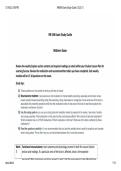
NR 546 Exam Study Guide


Midterm Exam


Review the weekly Explore section content and required readings as noted within your Student Lesson Plan for
Learning Success. Review the medication and neurotransmitter tables you have completed. Each weekly
module will be 17-18 questions on the exam.
Study tips:
1) These questions are very similar to what you will see on boards.
2) Neuroscience matters-. Neuroscience is the foundation for mental health prescribing, especially as the future moves
toward symptom-based prescribing rather than selecting a drug class based on a diagnosis. Know what area of the brain is
associated with presenting symptoms AND how the medication works on that area of the brain to treat that symptom (the
medication mechanism of action)
3) Use this study guide-As you use your study guide and medication sheets to prepare for the exams, take note of outliers
and unique properties. What medication in that class has the most adverse effects? Who should not take that medication?
Which medication has no CYP450 interactions? Which medication is first line? What area of the brain is affected by these
medications?
4) Read the questions carefully- It is my recommendation that you take the available time to read the questions and consider
what is being asked. This is often how you can discriminate between the 2 most likely answers.


Week Functional neuroanatomy- brain anatomy and physiology covered in both the course Explore
1 section and readings. If a particular area of the brain is affected, what is the expected

response? What symptoms would you expect to see? Link the assessment to the affected brain
about:blank 1/14

, 12/16/23, 8:09 PM NR546 Exam Study Guide 3.5.23 (1)
response? What symptoms would you expect to see? Link the assessment to the affected brain

12.22 CCK


about:blank 2/14

Document information

Uploaded on
July 31, 2026
Number of pages
14
Written in
2025/2026
Type
Exam (elaborations)
Contains
Questions & answers
$15.49

Wrong document? Swap it for free Within 14 days of purchase and before downloading, you can choose a different document. You can simply spend the amount again.
Written by students who passed
Immediately available after payment
Read online or as PDF

Seller avatar
Reputation scores are based on the amount of documents a seller has sold for a fee and the reviews they have received for those documents. There are three levels: Bronze, Silver and Gold. The better the reputation, the more your can rely on the quality of the sellers work.
MYNET
3.8
(44)
Sold
228
Followers
16
Items
1608
Last sold
1 day ago


Why students choose Stuvia

Created by fellow students, verified by reviews

Quality you can trust: written by students who passed their tests and reviewed by others who've used these notes.

Didn't get what you expected? Choose another document

No worries! You can instantly pick a different document that better fits what you're looking for.

Pay as you like, start learning right away

No subscription, no commitments. Pay the way you're used to via credit card and download your PDF document instantly.

Student with book image

“Bought, downloaded, and aced it. It really can be that simple.”

Alisha Student

Working on your references?

Create accurate citations in APA, MLA and Harvard with our free citation generator.

Working on your references?

Frequently asked questions

