

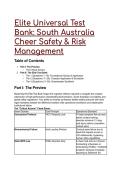
Elite Universal Test
Bank: South Australia
Cheer Safety & Risk
Management
Table of Contents
1. Part I: The Preview
○ The Critical Axioms
2. Part II: The Elite Test Bank
○ Tier 1 (Questions 1–10): Foundational Syntax & Application
○ Tier 2 (Questions 11–20): Complex Application & Simulation
○ Tier 3 (Questions 21–30): Grandmaster Synthesis
Part I: The Preview
Mastering this Elite Test Bank forges the cognitive reflexes required to navigate the complex
intersection of high-performance cheerleading biomechanics, South Australian civil liability, and
global safety regulations. Your ability to instantly synthesize athlete safety protocols with strict
legal mandates dictates the difference between elite operational excellence and catastrophic
institutional failure.
The "Critical Axioms" Cheat Sheet:
Axiom Domain Core Principle Operational Standard
Concussion Protocol 14/21 Temporal Lock 14 days symptom-free (at rest)
before contact training;
absolute minimum 21 days
post-injury before competitive
contact sport.
Biomechanical Failure Axial Loading Window Cervical spine failure due to
head-first impacts occurs in
<20 milliseconds, bypassing
human reflex capabilities.
State WHS Law PCBU Absolute Duty A cheer club acts as a Person
Conducting a Business or
Undertaking (PCBU); "notifiable
incidents" demand immediate
reporting to SafeWork SA.
,Axiom Domain Core Principle Operational Standard
Civil Liability Standard of Reasonable Care Negligence occurs when a
coach fails the "reasonable
person" test, causing
foreseeable harm within the
3-year statute of limitations for
personal injury.
IASF Kinematics Inversion & Spotter Syntax Downward inversions from
above prep level require ≥3
catchers; single-based
shoulder-level stunts require a
dedicated head-and-shoulders
spotter.
Part II: The Elite Test Bank
Tier 1: Foundational Syntax & Application
Q1: An athlete competing in an AASCF-sanctioned event in Adelaide sustains a suspected
concussion on a Saturday. Assuming the athlete rests for 48 hours and is entirely asymptomatic
thereafter, what is the EARLIEST day they may return to competitive contact sport under the
2024 Concussion in Sport Australia guidelines? A) 14 days from the date the athlete becomes
symptom-free, provided they clear a neurological test. B) 14 days from the date of the
concussive incident, allowing an immediate transition to competition. C) 21 days from the time of
the concussive incident, following a graded return to contact training. D) 24 days, accounting for
a mandatory 72-hour clinical observation window before the 21-day clock begins.
● Answer: C (21 days from the time of the concussive incident, following a graded return to
contact training.)
● Distractor Analysis:
○ A is incorrect: 14 days symptom-free is the benchmark for unlocking contact
training, not competitive contact sport.
○ B is incorrect: 14 days from the incident ignores the requirement that the 14-day
clock starts only after symptoms resolve, and violates the 21-day absolute minimum
for competition.
○ D is incorrect: There is no mandatory 24-day or 72-hour clinical observation window
defined in the 2024 protocols; initial relative rest is strictly 24-48 hours.
The Mentor's Analysis: Concussion management in youth and community sports relies on
rigid, unyielding timelines to prevent Second Impact Syndrome (SIS). When facing a suspected
mild traumatic brain injury, the immediate priority is absolute cognitive and physical rest,
followed by strict adherence to the dual-clock system established by the AIS and SMA. By
utilizing the Graded Return to Sport Framework, you bypass the common trap of returning an
athlete prematurely based on subjective symptom reporting.
Phase Minimum Timeframe Kinetic Allowance
Initial Rest 24 - 48 Hours Complete physical and
cognitive rest (no
screens/study).
Symptom-Free Window 14 Days Light exercise permitted; no
, Phase Minimum Timeframe Kinetic Allowance
contact/collision.
Competitive Clearance Day 21 (Post-Injury) Full competitive contact
permitted.
Professional/Academic Intuition: Day 0 is the day of injury; 14 days symptom-free
unlocks training, but 21 days absolute elapsed time unlocks competition.
Q2: Under South Australia's Work Health and Safety (WHS) laws, a cheerleading club is
defined as a PCBU. Which of the following injuries occurring at the training facility is considered
a "notifiable incident" that must be IMMEDIATELY reported to SafeWork SA? A) A deep muscle
strain requiring three weeks of intensive physical therapy. B) A minor concussion resulting in 24
hours of dizziness and a standard physician visit. C) The separation of skin from underlying
tissue (degloving) resulting from a caught uniform or ring. D) A severe Grade 3 ankle sprain
causing the athlete to miss the remainder of the competition season.
● Answer: C (The separation of skin from underlying tissue (degloving) resulting from a
caught uniform or ring.)
● Distractor Analysis:
○ A is incorrect: Strains, regardless of physical therapy duration, are explicitly
excluded from the statutory definition of a serious injury under WHS law.
○ B is incorrect: A minor concussion, while serious clinically, is not classified as an
immediately notifiable serious injury to SafeWork SA unless it involves hospital
admission or immediate emergency treatment.
○ D is incorrect: Sprains are explicitly excluded from the SafeWork SA definition of a
"serious injury or illness," regardless of the athletic downtime.
The Mentor's Analysis: WHS legislation distinguishes between standard athletic injuries and
industrial-grade trauma. When facing a severe facility incident, the immediate priority is securing
the site and determining if the trauma meets the statutory definition of a "serious injury" to alert
the regulator. By utilizing the SafeWork SA notification criteria, you bypass the common trap of
confusing a severe sports injury (like a sprain) with a legally notifiable event (like an amputation
or degloving). Professional/Academic Intuition: Immediate notification to the regulator is
triggered by structural tissue loss (scalping/degloving), spinal cord injury, or hospital
admission, not standard athletic musculoskeletal trauma.
Q3: According to the IASF Cheerleading Rules utilized by the Australian Cheer Union (ACU),
which structural support is MANDATORY for a single-base shoulder-level stunt where the feet of
the top person are in the hands of one base? A) A secondary base making continuous contact
with the primary base's wrists to stabilize the load. B) A separate continuous spotter focusing
exclusively on the top person's head and shoulders. C) A bracer holding the top person's arm
from an adjacent stunt to prevent lateral swaying. D) A front spotter maintaining contact with the
top person's shins to control the center of gravity.
● Answer: B (A separate continuous spotter focusing exclusively on the top person's head
and shoulders.)
● Distractor Analysis:
○ A is incorrect: Assisting the primary base's wrists is a valid technique, but the rules
mandate a spotter dedicated to the top person, not just the base's wrists.
○ C is incorrect: A bracer alters the classification of the stunt (making it a pyramid) but
does not replace the fundamental requirement for a spotter on a single-base
shoulder-level stunt.
○ D is incorrect: Spotters must be in a position to protect the head, neck, and
Bank: South Australia
Cheer Safety & Risk
Management
Table of Contents
1. Part I: The Preview
○ The Critical Axioms
2. Part II: The Elite Test Bank
○ Tier 1 (Questions 1–10): Foundational Syntax & Application
○ Tier 2 (Questions 11–20): Complex Application & Simulation
○ Tier 3 (Questions 21–30): Grandmaster Synthesis
Part I: The Preview
Mastering this Elite Test Bank forges the cognitive reflexes required to navigate the complex
intersection of high-performance cheerleading biomechanics, South Australian civil liability, and
global safety regulations. Your ability to instantly synthesize athlete safety protocols with strict
legal mandates dictates the difference between elite operational excellence and catastrophic
institutional failure.
The "Critical Axioms" Cheat Sheet:
Axiom Domain Core Principle Operational Standard
Concussion Protocol 14/21 Temporal Lock 14 days symptom-free (at rest)
before contact training;
absolute minimum 21 days
post-injury before competitive
contact sport.
Biomechanical Failure Axial Loading Window Cervical spine failure due to
head-first impacts occurs in
<20 milliseconds, bypassing
human reflex capabilities.
State WHS Law PCBU Absolute Duty A cheer club acts as a Person
Conducting a Business or
Undertaking (PCBU); "notifiable
incidents" demand immediate
reporting to SafeWork SA.
,Axiom Domain Core Principle Operational Standard
Civil Liability Standard of Reasonable Care Negligence occurs when a
coach fails the "reasonable
person" test, causing
foreseeable harm within the
3-year statute of limitations for
personal injury.
IASF Kinematics Inversion & Spotter Syntax Downward inversions from
above prep level require ≥3
catchers; single-based
shoulder-level stunts require a
dedicated head-and-shoulders
spotter.
Part II: The Elite Test Bank
Tier 1: Foundational Syntax & Application
Q1: An athlete competing in an AASCF-sanctioned event in Adelaide sustains a suspected
concussion on a Saturday. Assuming the athlete rests for 48 hours and is entirely asymptomatic
thereafter, what is the EARLIEST day they may return to competitive contact sport under the
2024 Concussion in Sport Australia guidelines? A) 14 days from the date the athlete becomes
symptom-free, provided they clear a neurological test. B) 14 days from the date of the
concussive incident, allowing an immediate transition to competition. C) 21 days from the time of
the concussive incident, following a graded return to contact training. D) 24 days, accounting for
a mandatory 72-hour clinical observation window before the 21-day clock begins.
● Answer: C (21 days from the time of the concussive incident, following a graded return to
contact training.)
● Distractor Analysis:
○ A is incorrect: 14 days symptom-free is the benchmark for unlocking contact
training, not competitive contact sport.
○ B is incorrect: 14 days from the incident ignores the requirement that the 14-day
clock starts only after symptoms resolve, and violates the 21-day absolute minimum
for competition.
○ D is incorrect: There is no mandatory 24-day or 72-hour clinical observation window
defined in the 2024 protocols; initial relative rest is strictly 24-48 hours.
The Mentor's Analysis: Concussion management in youth and community sports relies on
rigid, unyielding timelines to prevent Second Impact Syndrome (SIS). When facing a suspected
mild traumatic brain injury, the immediate priority is absolute cognitive and physical rest,
followed by strict adherence to the dual-clock system established by the AIS and SMA. By
utilizing the Graded Return to Sport Framework, you bypass the common trap of returning an
athlete prematurely based on subjective symptom reporting.
Phase Minimum Timeframe Kinetic Allowance
Initial Rest 24 - 48 Hours Complete physical and
cognitive rest (no
screens/study).
Symptom-Free Window 14 Days Light exercise permitted; no
, Phase Minimum Timeframe Kinetic Allowance
contact/collision.
Competitive Clearance Day 21 (Post-Injury) Full competitive contact
permitted.
Professional/Academic Intuition: Day 0 is the day of injury; 14 days symptom-free
unlocks training, but 21 days absolute elapsed time unlocks competition.
Q2: Under South Australia's Work Health and Safety (WHS) laws, a cheerleading club is
defined as a PCBU. Which of the following injuries occurring at the training facility is considered
a "notifiable incident" that must be IMMEDIATELY reported to SafeWork SA? A) A deep muscle
strain requiring three weeks of intensive physical therapy. B) A minor concussion resulting in 24
hours of dizziness and a standard physician visit. C) The separation of skin from underlying
tissue (degloving) resulting from a caught uniform or ring. D) A severe Grade 3 ankle sprain
causing the athlete to miss the remainder of the competition season.
● Answer: C (The separation of skin from underlying tissue (degloving) resulting from a
caught uniform or ring.)
● Distractor Analysis:
○ A is incorrect: Strains, regardless of physical therapy duration, are explicitly
excluded from the statutory definition of a serious injury under WHS law.
○ B is incorrect: A minor concussion, while serious clinically, is not classified as an
immediately notifiable serious injury to SafeWork SA unless it involves hospital
admission or immediate emergency treatment.
○ D is incorrect: Sprains are explicitly excluded from the SafeWork SA definition of a
"serious injury or illness," regardless of the athletic downtime.
The Mentor's Analysis: WHS legislation distinguishes between standard athletic injuries and
industrial-grade trauma. When facing a severe facility incident, the immediate priority is securing
the site and determining if the trauma meets the statutory definition of a "serious injury" to alert
the regulator. By utilizing the SafeWork SA notification criteria, you bypass the common trap of
confusing a severe sports injury (like a sprain) with a legally notifiable event (like an amputation
or degloving). Professional/Academic Intuition: Immediate notification to the regulator is
triggered by structural tissue loss (scalping/degloving), spinal cord injury, or hospital
admission, not standard athletic musculoskeletal trauma.
Q3: According to the IASF Cheerleading Rules utilized by the Australian Cheer Union (ACU),
which structural support is MANDATORY for a single-base shoulder-level stunt where the feet of
the top person are in the hands of one base? A) A secondary base making continuous contact
with the primary base's wrists to stabilize the load. B) A separate continuous spotter focusing
exclusively on the top person's head and shoulders. C) A bracer holding the top person's arm
from an adjacent stunt to prevent lateral swaying. D) A front spotter maintaining contact with the
top person's shins to control the center of gravity.
● Answer: B (A separate continuous spotter focusing exclusively on the top person's head
and shoulders.)
● Distractor Analysis:
○ A is incorrect: Assisting the primary base's wrists is a valid technique, but the rules
mandate a spotter dedicated to the top person, not just the base's wrists.
○ C is incorrect: A bracer alters the classification of the stunt (making it a pyramid) but
does not replace the fundamental requirement for a spotter on a single-base
shoulder-level stunt.
○ D is incorrect: Spotters must be in a position to protect the head, neck, and


