

Module :30
(.Kirchoff’s Laws.)
Kirchoff’s Laws.
(1) Kirchoff’s first law :
This law is also known as junction rule or current law (KCL). According to it the
algebraic sum of currents meeting at a junction is zero
i.e. i = 0.
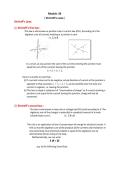
In a circuit, at any junction the sum of the currents entering the junction must
equal the sum of the currents leaving the junction.
i1 i3 i2 i4
Here it is worthy to note that :
(i) If a current comes out to be negative, actual direction of current at the junction is
opposite to that assumed, i1 i3 i2 i4 can be satisfied only if at least one
current is negative, i.e. leaving the junction.
(ii) This law is simply a statement of “conservation of charge” as if current reaching a
junction is not equal to the current leaving the junction, charge will not be
conserved.
(2) Kirchoff’s second law :
This law is also known as loop rule or voltage law (KVL) and according to it “the
algebraic sum of the changes in potential in complete traversal of a mesh
(closed loop) is zero”, i.e. V = 0
This rule is an application of law of conservation of energy for electrical circuits. It
tells us that the algebraic sum of the products of the currents and resistances in
any closed loop of an electrical network is equal to the algebraic sum of
electromotive forces acting in the loop.
Mathematically, we can write
Σ IR = ΣE
e.g. In the following closed loop
, .
Let us consider the electrical network shown in Fig. For closed loop (mesh)
ADCBA, we can write
-I1R1 + I2R2 + E1 - E2 = 0
Similarly, for the loop (mesh ) DHGCD
- I2R2 - (I1 + I2) R3 - E2 = 0
And for loop( mesh) AHGBA
- I1R1 - I3 R3 + E1 = 0
At point D I1 + I2 = I3
Here it is worthy to note that :
(i) This law represents “conservation of energy” as if the sum of potential changes
around a closed loop is not zero, unlimited energy could be gained by repeatedly
carrying a charge around a loop.
(ii) If there are n meshes in a circuit, the number of independent equations in
accordance with loop rule will be (n – 1).
(3) Sign convention for the application of Kirchoff’s law :
For the application of Kirchoff’s laws following sign convention are to be considered
(i) The change in potential in traversing a resistance in the direction of current is - iR
while in the opposite direction +iR
(ii) The change in potential in traversing an emf source from negative to positive
terminal is +E while in the opposite direction – E irrespective of the direction of
current in the circuit.
(.Kirchoff’s Laws.)
Kirchoff’s Laws.
(1) Kirchoff’s first law :
This law is also known as junction rule or current law (KCL). According to it the
algebraic sum of currents meeting at a junction is zero
i.e. i = 0.
In a circuit, at any junction the sum of the currents entering the junction must
equal the sum of the currents leaving the junction.
i1 i3 i2 i4
Here it is worthy to note that :
(i) If a current comes out to be negative, actual direction of current at the junction is
opposite to that assumed, i1 i3 i2 i4 can be satisfied only if at least one
current is negative, i.e. leaving the junction.
(ii) This law is simply a statement of “conservation of charge” as if current reaching a
junction is not equal to the current leaving the junction, charge will not be
conserved.
(2) Kirchoff’s second law :
This law is also known as loop rule or voltage law (KVL) and according to it “the
algebraic sum of the changes in potential in complete traversal of a mesh
(closed loop) is zero”, i.e. V = 0
This rule is an application of law of conservation of energy for electrical circuits. It
tells us that the algebraic sum of the products of the currents and resistances in
any closed loop of an electrical network is equal to the algebraic sum of
electromotive forces acting in the loop.
Mathematically, we can write
Σ IR = ΣE
e.g. In the following closed loop
, .
Let us consider the electrical network shown in Fig. For closed loop (mesh)
ADCBA, we can write
-I1R1 + I2R2 + E1 - E2 = 0
Similarly, for the loop (mesh ) DHGCD
- I2R2 - (I1 + I2) R3 - E2 = 0
And for loop( mesh) AHGBA
- I1R1 - I3 R3 + E1 = 0
At point D I1 + I2 = I3
Here it is worthy to note that :
(i) This law represents “conservation of energy” as if the sum of potential changes
around a closed loop is not zero, unlimited energy could be gained by repeatedly
carrying a charge around a loop.
(ii) If there are n meshes in a circuit, the number of independent equations in
accordance with loop rule will be (n – 1).
(3) Sign convention for the application of Kirchoff’s law :
For the application of Kirchoff’s laws following sign convention are to be considered
(i) The change in potential in traversing a resistance in the direction of current is - iR
while in the opposite direction +iR
(ii) The change in potential in traversing an emf source from negative to positive
terminal is +E while in the opposite direction – E irrespective of the direction of
current in the circuit.


