

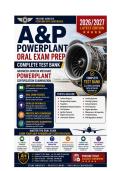
,A&P POWERPLANT ORAL EXAM PREP 2026/2027 – COMPLETE TEST BANK ADVANCED AVIATION
MECHANIC POWERPLANT CERTIFICATION EXAMINATION
FAA ACS-Aligned | Oral & Practical Exam Preparation | Updated for 2026–2027 Standards
EXAM OVERVIEW
Format: Oral examination questions with detailed model answers
Content Areas: Reciprocating Engines, Turbine Engines, Engine Systems & Components, Inspection &
Maintenance, Troubleshooting, FAA Regulations & Documentation
Target Audience: Aviation Maintenance Technician (AMT) candidates preparing for FAA A&P Powerplant
Oral & Practical (O&P) certification
Standards Alignment: FAA Airman Certification Standards (ACS), 14 CFR Part 147, AC 43.13-1B/2B
SECTION 1: RECIPROCATING ENGINE FUNDAMENTALS
Questions 1-50
1. What is the primary advantage of a horizontally opposed engine over a radial engine for powering
modern aircraft?
A) Higher power output per pound of engine weight
B) Smaller frontal area and easier streamlining
C) Superior cooling capabilities
D) Lower manufacturing costs
Answer: B
Rationale: The horizontally opposed engine has a much smaller frontal area than a radial engine, making
it easier to streamline and reducing drag. This aerodynamic advantage is why horizontally opposed
engines became the preferred configuration for most general aviation aircraft . Modern horizontally
opposed engines also benefit from better cooling airflow distribution, lower vibration levels due to
balanced firing order, and lower overall weight compared to equivalent radial engines.
Incorrect Options:
A: While horizontally opposed engines have good power-to-weight ratios, this is not the primary
advantage over radial engines.
C: Both engine types have effective cooling systems when properly designed.
D: Manufacturing cost is not the primary differentiator.
,2. How many throws are there in the crankshaft of a six-cylinder horizontally opposed engine?
A) Three
B) Four
C) Six
D) Twelve
Answer: C
Rationale: A six-cylinder horizontally opposed engine has six throws on the crankshaft, with one
connecting rod journal for each cylinder. This arrangement allows for the classic "flat" engine
configuration where opposing cylinders fire alternately, providing smooth operation. Each cylinder has
its own dedicated throw on the crankshaft .
Incorrect Options:
A: Three throws would be incorrect as each cylinder requires its own connecting rod journal.
B: Four throws is insufficient for a six-cylinder engine.
D: Twelve throws would be excessive and not mechanically feasible.
3. What kind of connecting rod arrangement is used in a radial engine?
A) Fork and blade rods
B) Master and articulating rod assembly
C) Individual connecting rods
D) Split connecting rods
Answer: B
Rationale: Radial engines use a master rod assembly where one cylinder (the master rod) connects
directly to a single throw on the crankshaft. All other pistons are connected to the master rod through
articulating (link) rods. This arrangement is necessary because radial engines have multiple cylinders
arranged around a single crankshaft throw .
Incorrect Options:
A: Fork and blade rods are used in V-type engines.
C: Individual connecting rods would not work with a radial engine's configuration.
D: Split rods are used in some other engine configurations.
4. What types of bearings are generally found in reciprocating engines?
A) Plain, ball, and roller bearings
B) Tapered and thrust bearings only
, C) Needle and roller bearings only
D) Plain and tapered bearings only
Answer: A
Rationale: Reciprocating engines use three main types of bearings: plain bearings (also called journal
bearings) for main and connecting rod bearing surfaces, ball bearings for thrust loads and some
accessory drives, and roller bearings for heavy radial loads in crankshaft and camshaft applications. Each
type serves specific purposes in engine operation .
Incorrect Options:
B: This is an incomplete list; plain bearings are essential.
C: This omits plain bearings, which are the most common type.
D: This omits ball and roller bearings.
5. Where should piston ring gaps be installed relative to each other, and why?
A) Randomly; ring gap position does not affect engine operation
B) Staggered around the piston circumference to prevent blow-by and oil consumption
C) Aligned to allow easier piston installation
D) Opposite each other to balance weight distribution
Answer: B
Rationale: Piston ring gaps must be staggered around the piston circumference (typically 120° apart) to
prevent gas blow-by from passing through aligned gaps and to reduce oil consumption. If the gaps are
aligned, combustion gases can pass directly through the gaps, reducing compression and allowing oil to
enter the combustion chamber .
Incorrect Options:
A: Ring gap position significantly affects engine performance.
C: Aligning gaps does not aid installation.
D: Weight balance is not the primary concern.
6. Name the different types of piston rings used in reciprocating engines.
A) Compression and oil rings only
B) Oil control, compression, and oil scraper rings
C) Sealing and scraper rings only
D) Compression, scraper, and spacer rings
Answer: B
MECHANIC POWERPLANT CERTIFICATION EXAMINATION
FAA ACS-Aligned | Oral & Practical Exam Preparation | Updated for 2026–2027 Standards
EXAM OVERVIEW
Format: Oral examination questions with detailed model answers
Content Areas: Reciprocating Engines, Turbine Engines, Engine Systems & Components, Inspection &
Maintenance, Troubleshooting, FAA Regulations & Documentation
Target Audience: Aviation Maintenance Technician (AMT) candidates preparing for FAA A&P Powerplant
Oral & Practical (O&P) certification
Standards Alignment: FAA Airman Certification Standards (ACS), 14 CFR Part 147, AC 43.13-1B/2B
SECTION 1: RECIPROCATING ENGINE FUNDAMENTALS
Questions 1-50
1. What is the primary advantage of a horizontally opposed engine over a radial engine for powering
modern aircraft?
A) Higher power output per pound of engine weight
B) Smaller frontal area and easier streamlining
C) Superior cooling capabilities
D) Lower manufacturing costs
Answer: B
Rationale: The horizontally opposed engine has a much smaller frontal area than a radial engine, making
it easier to streamline and reducing drag. This aerodynamic advantage is why horizontally opposed
engines became the preferred configuration for most general aviation aircraft . Modern horizontally
opposed engines also benefit from better cooling airflow distribution, lower vibration levels due to
balanced firing order, and lower overall weight compared to equivalent radial engines.
Incorrect Options:
A: While horizontally opposed engines have good power-to-weight ratios, this is not the primary
advantage over radial engines.
C: Both engine types have effective cooling systems when properly designed.
D: Manufacturing cost is not the primary differentiator.
,2. How many throws are there in the crankshaft of a six-cylinder horizontally opposed engine?
A) Three
B) Four
C) Six
D) Twelve
Answer: C
Rationale: A six-cylinder horizontally opposed engine has six throws on the crankshaft, with one
connecting rod journal for each cylinder. This arrangement allows for the classic "flat" engine
configuration where opposing cylinders fire alternately, providing smooth operation. Each cylinder has
its own dedicated throw on the crankshaft .
Incorrect Options:
A: Three throws would be incorrect as each cylinder requires its own connecting rod journal.
B: Four throws is insufficient for a six-cylinder engine.
D: Twelve throws would be excessive and not mechanically feasible.
3. What kind of connecting rod arrangement is used in a radial engine?
A) Fork and blade rods
B) Master and articulating rod assembly
C) Individual connecting rods
D) Split connecting rods
Answer: B
Rationale: Radial engines use a master rod assembly where one cylinder (the master rod) connects
directly to a single throw on the crankshaft. All other pistons are connected to the master rod through
articulating (link) rods. This arrangement is necessary because radial engines have multiple cylinders
arranged around a single crankshaft throw .
Incorrect Options:
A: Fork and blade rods are used in V-type engines.
C: Individual connecting rods would not work with a radial engine's configuration.
D: Split rods are used in some other engine configurations.
4. What types of bearings are generally found in reciprocating engines?
A) Plain, ball, and roller bearings
B) Tapered and thrust bearings only
, C) Needle and roller bearings only
D) Plain and tapered bearings only
Answer: A
Rationale: Reciprocating engines use three main types of bearings: plain bearings (also called journal
bearings) for main and connecting rod bearing surfaces, ball bearings for thrust loads and some
accessory drives, and roller bearings for heavy radial loads in crankshaft and camshaft applications. Each
type serves specific purposes in engine operation .
Incorrect Options:
B: This is an incomplete list; plain bearings are essential.
C: This omits plain bearings, which are the most common type.
D: This omits ball and roller bearings.
5. Where should piston ring gaps be installed relative to each other, and why?
A) Randomly; ring gap position does not affect engine operation
B) Staggered around the piston circumference to prevent blow-by and oil consumption
C) Aligned to allow easier piston installation
D) Opposite each other to balance weight distribution
Answer: B
Rationale: Piston ring gaps must be staggered around the piston circumference (typically 120° apart) to
prevent gas blow-by from passing through aligned gaps and to reduce oil consumption. If the gaps are
aligned, combustion gases can pass directly through the gaps, reducing compression and allowing oil to
enter the combustion chamber .
Incorrect Options:
A: Ring gap position significantly affects engine performance.
C: Aligning gaps does not aid installation.
D: Weight balance is not the primary concern.
6. Name the different types of piston rings used in reciprocating engines.
A) Compression and oil rings only
B) Oil control, compression, and oil scraper rings
C) Sealing and scraper rings only
D) Compression, scraper, and spacer rings
Answer: B



