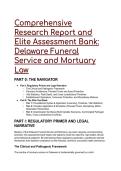
Comprehensive
Research Report and
Elite Assessment Bank:
Delaware Funeral
Service and Mortuary
Law
PART 0: THE NAVIGATOR
● Part I: Regulatory Primer and Legal Narrative
○ The Clinical and Pathogenic Framework
○ Fiduciary Architecture: Preneed Trusts and Asset Protection
○ Vital Statistics, Fetal Death, and Cross-Jurisdictional Timelines
○ Establishment Operations, Consumer Protection, and Disciplinary Matrices
● Part II: The Elite Test Bank
○ Tier 1: Foundational Syntax & Application (Licensing, Timelines, Vital Statistics)
○ Tier 2: Complex Application & Simulation (Preneed Trusts, Disciplinary Matrix,
Disposition Hierarchies)
○ Tier 3: Grandmaster Synthesis (Multi-Variable Scenarios, Commingled Pathogen
Risks, Cross-Jurisdictional Conflicts)
PART I: REGULATORY PRIMER AND LEGAL
NARRATIVE
Mastery of the Delaware Funeral Service and Mortuary Law exam requires uncompromising
precision; this assessment bank forges rote statutory recall into rapid-fire, high-stakes clinical
and professional judgment. By internalizing these regulatory parameters, practitioners elevate
themselves from baseline compliance to elite fiduciary, technical, and public health dominance.
The Clinical and Pathogenic Framework
The practice of mortuary science in Delaware is fundamentally governed by a strict
,chronobiology mandated by the State Board of Funeral Services and the Department of Health
and Social Services. The core of this regulatory structure is the dual-stage temporal constraint
placed on human remains. The statutory 24-hour rule dictates that any dead human body kept
longer than 24 hours must be embalmed, placed in an industry-standard refrigerator, or placed
in a hermetically sealed casket that will not be opened again. This initial threshold is designed to
combat immediate putrefaction and secure public health within the facility. However, this is
superseded by the 5-day rule, which serves as an absolute backstop, mandating that the body
must be buried or cremated within five days of death. The intersection of these two timelines
ensures that funeral establishments act as temporary staging grounds rather than indefinite
holding facilities.
When transport logistics extend beyond standard parameters, the physical casing of the
remains becomes the primary vector for regulatory enforcement. If an unembalmed body is to
be transported by common carrier and the destination cannot be reached within 24 hours, the
state mandates that the casket or outside case must be constructed of metal or be metal-lined,
and it must be permanently sealed. This prevents pathogenic leakage across state lines,
neutralizing the environmental risks associated with delayed interstate transit.
Ecological disposition methods, specifically Natural Organic Reduction (NOR) and cremation,
carry their own severe pathogenic restrictions. Delaware law expressly forbids the admission of
human remains into an NOR facility if the decedent contained radioactive implants, died from a
radiological incident, or harbored infectious diseases such as Prion disease, Mycobacterium
tuberculosis, or the Ebola virus. The rationale is that the lower thermal thresholds of NOR
(which must maintain a minimum of 131 degrees Fahrenheit for 72 hours) are insufficient to
denature these specific highly resilient pathogens, whereas traditional cremation offers total
biological destruction. Furthermore, the transport of remains designated for NOR or cremation
strictly prohibits the use of metal or polyethylene containers, as these materials disrupt the
organic reduction process and create toxic environmental emissions.
Pathogenic / Clinical Condition Statutory Mandate / Restriction Source
Remains held > 24 hours Must be embalmed,
refrigerated, or hermetically
sealed.
Final Disposition Timeline Burial or cremation must occur
within 5 days of death.
Unembalmed Transit > 24 Requires a metal or
hours metal-lined, permanently
sealed case.
High-Risk Communicable Prompt burial, hermetically
Disease sealed, no public viewing
permitted.
Prion / Ebola / Tuberculosis Absolute ban from Natural
Organic Reduction (NOR)
facilities.
NOR Transport Containers Must be leak-resistant; strictly
no metal or polyethylene.
Fiduciary Architecture: Preneed Trusts and Asset Protection
Delaware's preneed funeral contract laws, governed by Title 5, Chapter 34, establish funeral
directors not merely as service providers, but as highly regulated financial trustees. The
, fiduciary architecture is designed to prevent the commingling of consumer trust assets with the
operational cash flow of the funeral establishment. All payments made under a preneed contract
for funeral services or merchandise must be treated as trust funds and deposited into an insured
institution (FDIC or NCUA) within 30 days of receipt.
The state recognizes two classifications of these trusts: revocable and irrevocable. Revocable
trusts prioritize consumer liquidity, allowing the payor to demand a full refund of the principal and
all accrued accretions upon providing 15 days' written notice. Conversely, irrevocable trusts are
heavily utilized by consumers seeking to protect assets during Medicaid spend-down
procedures. To prevent the abusive sheltering of unlimited wealth, Delaware imposes a strict
ceiling on irrevocable preneed trusts, capping them at $15,000. Any funds exceeding this
threshold must legally remain revocable and subject to standard asset recovery.
To further insulate the public against insolvency or fraud, the State Bank Commissioner requires
every licensee accepting preneed funds to maintain a corporate surety bond or an irrevocable
letter of credit ranging from $50,000 to $200,000. In the event of a funeral home's collapse or
the surrender of its license, this financial safety net is not immediately dissolved. The
Commissioner retains the authority to hold an irrevocable letter of credit for up to two years
post-surrender, ensuring a sufficient window for defrauded consumers to discover the breach
and file claims.
Vital Statistics, Fetal Death, and Cross-Jurisdictional Timelines
The Office of Vital Statistics demands rapid, accurate reporting to facilitate legal and
epidemiological continuity. The standard death certificate must be filed within 3 days after death,
and crucially, prior to the final disposition of the body. In instances where the exact parameters
of death are obscured—such as a body discovered in a state park—the law defaults to
pragmatic approximations to prevent bureaucratic paralysis; the place where the body is found
legally becomes the place of death, and the date of death may be estimated. If a physician or
medical examiner is unable to definitively determine the cause of death within 48 hours, they
are required to file a "pending" certificate of death, which allows the family to proceed with
funeral arrangements while forensic or toxicological investigations continue.
Fetal death registration in Delaware introduces a dual-metric threshold designed to capture
clinically significant losses while excluding early-stage miscarriages. A spontaneous fetal death
must be reported within 3 days of delivery if the fetus weighs 350 grams or more, or, in the
absence of weight, if it reaches 20 completed weeks of gestation. This binary statutory trigger
ensures that late-term losses are formally recognized by the state, while induced terminations of
pregnancy are explicitly excluded from spontaneous fetal death reporting.
When dealing with the disposition of remains, funeral directors must adhere to the strict
hierarchy established in Title 12, Chapter 2. The right to control disposition devolves
sequentially: starting with the decedent (if they executed a declaration instrument), followed by
the surviving spouse (provided they are not legally separated), then the appointed personal
representative of the estate, and finally descending through the classes of next-of-kin. This
codified hierarchy eliminates ambiguity and protects the funeral director from liability during
intra-family disputes. Furthermore, when families abandon remains, the state provides a legal
off-ramp to clear inventory: cremated remains may be disposed of in a cemetery after 12
months of abandonment, while NOR remains may be disposed of in a protected natural area
after only 2 months.
Research Report and
Elite Assessment Bank:
Delaware Funeral
Service and Mortuary
Law
PART 0: THE NAVIGATOR
● Part I: Regulatory Primer and Legal Narrative
○ The Clinical and Pathogenic Framework
○ Fiduciary Architecture: Preneed Trusts and Asset Protection
○ Vital Statistics, Fetal Death, and Cross-Jurisdictional Timelines
○ Establishment Operations, Consumer Protection, and Disciplinary Matrices
● Part II: The Elite Test Bank
○ Tier 1: Foundational Syntax & Application (Licensing, Timelines, Vital Statistics)
○ Tier 2: Complex Application & Simulation (Preneed Trusts, Disciplinary Matrix,
Disposition Hierarchies)
○ Tier 3: Grandmaster Synthesis (Multi-Variable Scenarios, Commingled Pathogen
Risks, Cross-Jurisdictional Conflicts)
PART I: REGULATORY PRIMER AND LEGAL
NARRATIVE
Mastery of the Delaware Funeral Service and Mortuary Law exam requires uncompromising
precision; this assessment bank forges rote statutory recall into rapid-fire, high-stakes clinical
and professional judgment. By internalizing these regulatory parameters, practitioners elevate
themselves from baseline compliance to elite fiduciary, technical, and public health dominance.
The Clinical and Pathogenic Framework
The practice of mortuary science in Delaware is fundamentally governed by a strict
,chronobiology mandated by the State Board of Funeral Services and the Department of Health
and Social Services. The core of this regulatory structure is the dual-stage temporal constraint
placed on human remains. The statutory 24-hour rule dictates that any dead human body kept
longer than 24 hours must be embalmed, placed in an industry-standard refrigerator, or placed
in a hermetically sealed casket that will not be opened again. This initial threshold is designed to
combat immediate putrefaction and secure public health within the facility. However, this is
superseded by the 5-day rule, which serves as an absolute backstop, mandating that the body
must be buried or cremated within five days of death. The intersection of these two timelines
ensures that funeral establishments act as temporary staging grounds rather than indefinite
holding facilities.
When transport logistics extend beyond standard parameters, the physical casing of the
remains becomes the primary vector for regulatory enforcement. If an unembalmed body is to
be transported by common carrier and the destination cannot be reached within 24 hours, the
state mandates that the casket or outside case must be constructed of metal or be metal-lined,
and it must be permanently sealed. This prevents pathogenic leakage across state lines,
neutralizing the environmental risks associated with delayed interstate transit.
Ecological disposition methods, specifically Natural Organic Reduction (NOR) and cremation,
carry their own severe pathogenic restrictions. Delaware law expressly forbids the admission of
human remains into an NOR facility if the decedent contained radioactive implants, died from a
radiological incident, or harbored infectious diseases such as Prion disease, Mycobacterium
tuberculosis, or the Ebola virus. The rationale is that the lower thermal thresholds of NOR
(which must maintain a minimum of 131 degrees Fahrenheit for 72 hours) are insufficient to
denature these specific highly resilient pathogens, whereas traditional cremation offers total
biological destruction. Furthermore, the transport of remains designated for NOR or cremation
strictly prohibits the use of metal or polyethylene containers, as these materials disrupt the
organic reduction process and create toxic environmental emissions.
Pathogenic / Clinical Condition Statutory Mandate / Restriction Source
Remains held > 24 hours Must be embalmed,
refrigerated, or hermetically
sealed.
Final Disposition Timeline Burial or cremation must occur
within 5 days of death.
Unembalmed Transit > 24 Requires a metal or
hours metal-lined, permanently
sealed case.
High-Risk Communicable Prompt burial, hermetically
Disease sealed, no public viewing
permitted.
Prion / Ebola / Tuberculosis Absolute ban from Natural
Organic Reduction (NOR)
facilities.
NOR Transport Containers Must be leak-resistant; strictly
no metal or polyethylene.
Fiduciary Architecture: Preneed Trusts and Asset Protection
Delaware's preneed funeral contract laws, governed by Title 5, Chapter 34, establish funeral
directors not merely as service providers, but as highly regulated financial trustees. The
, fiduciary architecture is designed to prevent the commingling of consumer trust assets with the
operational cash flow of the funeral establishment. All payments made under a preneed contract
for funeral services or merchandise must be treated as trust funds and deposited into an insured
institution (FDIC or NCUA) within 30 days of receipt.
The state recognizes two classifications of these trusts: revocable and irrevocable. Revocable
trusts prioritize consumer liquidity, allowing the payor to demand a full refund of the principal and
all accrued accretions upon providing 15 days' written notice. Conversely, irrevocable trusts are
heavily utilized by consumers seeking to protect assets during Medicaid spend-down
procedures. To prevent the abusive sheltering of unlimited wealth, Delaware imposes a strict
ceiling on irrevocable preneed trusts, capping them at $15,000. Any funds exceeding this
threshold must legally remain revocable and subject to standard asset recovery.
To further insulate the public against insolvency or fraud, the State Bank Commissioner requires
every licensee accepting preneed funds to maintain a corporate surety bond or an irrevocable
letter of credit ranging from $50,000 to $200,000. In the event of a funeral home's collapse or
the surrender of its license, this financial safety net is not immediately dissolved. The
Commissioner retains the authority to hold an irrevocable letter of credit for up to two years
post-surrender, ensuring a sufficient window for defrauded consumers to discover the breach
and file claims.
Vital Statistics, Fetal Death, and Cross-Jurisdictional Timelines
The Office of Vital Statistics demands rapid, accurate reporting to facilitate legal and
epidemiological continuity. The standard death certificate must be filed within 3 days after death,
and crucially, prior to the final disposition of the body. In instances where the exact parameters
of death are obscured—such as a body discovered in a state park—the law defaults to
pragmatic approximations to prevent bureaucratic paralysis; the place where the body is found
legally becomes the place of death, and the date of death may be estimated. If a physician or
medical examiner is unable to definitively determine the cause of death within 48 hours, they
are required to file a "pending" certificate of death, which allows the family to proceed with
funeral arrangements while forensic or toxicological investigations continue.
Fetal death registration in Delaware introduces a dual-metric threshold designed to capture
clinically significant losses while excluding early-stage miscarriages. A spontaneous fetal death
must be reported within 3 days of delivery if the fetus weighs 350 grams or more, or, in the
absence of weight, if it reaches 20 completed weeks of gestation. This binary statutory trigger
ensures that late-term losses are formally recognized by the state, while induced terminations of
pregnancy are explicitly excluded from spontaneous fetal death reporting.
When dealing with the disposition of remains, funeral directors must adhere to the strict
hierarchy established in Title 12, Chapter 2. The right to control disposition devolves
sequentially: starting with the decedent (if they executed a declaration instrument), followed by
the surviving spouse (provided they are not legally separated), then the appointed personal
representative of the estate, and finally descending through the classes of next-of-kin. This
codified hierarchy eliminates ambiguity and protects the funeral director from liability during
intra-family disputes. Furthermore, when families abandon remains, the state provides a legal
off-ramp to clear inventory: cremated remains may be disposed of in a cemetery after 12
months of abandonment, while NOR remains may be disposed of in a protected natural area
after only 2 months.