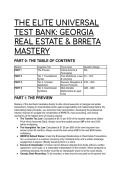
THE ELITE UNIVERSAL
TEST BANK: GEORGIA
REAL ESTATE & BRRETA
MASTERY
PART 0: THE TABLE OF CONTENTS
Section Cognitive Tier Focus Area Question Range
PART I The Preview Critical Axioms & N/A
Formularies
PART II Tier 1: Foundational Core Definitions, Laws, Q1 – Q15
Syntax & Licensing
PART II Tier 2: Complex Scenario Navigation & Q16 – Q35
Application Escrow Protocols
PART II Tier 3: Grandmaster Multi-Variable Q36 – Q60
Synthesis Mathematics & Legal
Crisis
PART I: THE PREVIEW
Mastery of this test bank translates directly to elite clinical execution in Georgia real estate
transactions, forging an impenetrable barrier against legal liability and mathematical failure. By
internalizing these principles, you transcend rote memorization, developing the professional
intuition required to navigate the complexities of BRRETA, trust accounting, and closing
mechanics at the highest level of industry practice.
● The Transfer Tax Law: Calculated at $0.10 per $100 of the taxable sales price (Sales
Price minus Assumed Debt). Always round the taxable amount UP to the next $100
before multiplying.
● The Intangibles Tax Law: Calculated at $1.50 per $500 of the new long-term loan
amount (over 62 months). Always round the loan amount UP to the next $500 before
multiplying.
● BRRETA Default Status: Under the Brokerage Relationships in Real Estate Transactions
Act, a consumer is a customer (receiving only ministerial acts) until a written brokerage
engagement is signed, officially elevating them to a client.
● Escrow & Interpleader: A broker cannot disburse disputed trust funds without a written
agreement, court order, or a reasonable interpretation of the contract. When paralyzed by
conflicting demands, the broker must file an interpleader action to let the court decide.
● Georgia Deed Recording: To be recorded, a deed must be executed by the grantor and
, attested by exactly two witnesses: one unofficial witness and one official notary public.
PART II: THE ELITE TEST BANK
Tier 1: Foundational Syntax & Application
Q1: A new applicant recently passed the Georgia real estate licensing exam. According to the
Georgia Real Estate Commission (GREC), which combination of requirements MUST the
applicant meet to activate their salesperson license? A) Be at least 21 years old, possess a high
school diploma, and complete a 75-hour pre-licensing course. B) Be at least 18 years old,
possess a bachelor’s degree, and complete a 60-hour pre-licensing course. C) Be at least 18
years old, possess a high school diploma or equivalent, and complete a 75-hour pre-licensing
course. D) Be at least 18 years old, possess a high school diploma or equivalent, and pass a
background check with a zero-tolerance policy for any prior misdemeanors.
● The Answer: C (Be at least 18 years old, possess a high school diploma or equivalent,
and complete a 75-hour pre-licensing course.)
● Distractor Analysis:
○ A is incorrect: The minimum age requirement for a salesperson is 18, not 21 (which
is the requirement for a broker).
○ B is incorrect: A bachelor's degree is not required, and the course must be exactly
75 hours, not 60.
○ D is incorrect: While a background check is required, prior misdemeanors do not
automatically result in a zero-tolerance denial; GREC evaluates criminal histories
via specific disclosures.
The Mentor's Analysis: Foundational licensing parameters establish the baseline of
professional entry. Master the minimum statutory thresholds to avoid administrative delays.
Professional/Academic Intuition: Age 18, high school equivalence, and 75 hours of
state-approved education form the non-negotiable triad for Georgia salesperson
licensure.
Q2: Under the Brokerage Relationships in Real Estate Transactions Act (BRRETA), providing a
prospective buyer with pre-printed real estate form contracts without advising them on offer
price is BEST classified as which of the following? A) A fiduciary duty B) A designated agency
task C) A ministerial act D) An implied agency function
● The Answer: C (A ministerial act)
● Distractor Analysis:
○ A is incorrect: Fiduciary duties require a signed client agreement and involve
professional judgment, not just providing blank forms.
○ B is incorrect: Designated agency involves representing a client, whereas providing
blank forms does not constitute active representation.
○ D is incorrect: BRRETA strictly prohibits implied agency in Georgia; all agency
relationships must be express and in writing.
The Mentor's Analysis: Supplying forms, identifying properties, and acting as a scribe require
no professional judgment or discretion. These are administrative functions permitted prior to
establishing a formal agency relationship. Professional/Academic Intuition: Any action that
does not require the broker's professional judgment or discretion is strictly a ministerial
act suitable for a customer.
Q3: The Real Estate Education, Research, and Recovery Fund is designed to compensate
, consumers harmed by licensee misconduct. What is the MAXIMUM liability of the fund for the
acts of a single licensee, regardless of the number of transactions or victims? A) $25,000 B)
$75,000 C) $100,000 D) $1,000,000
● The Answer: B ($75,000)
● Distractor Analysis:
○ A is incorrect: $25,000 is the maximum payout for a single transaction, not the
lifetime cap for a single licensee.
○ C is incorrect: $100,000 represents an arbitrary insurance figure, not the statutory
cap of the Georgia fund.
○ D is incorrect: $1,000,000 is the minimum balance the Commission must maintain
in the fund, not the payout limit.
The Mentor's Analysis: The Recovery Fund exists solely to protect the public from
uncollectible judgments against rogue agents. The statute caps exposure to prevent rapid
depletion of the fund by a single bad actor. Professional/Academic Intuition: The Recovery
Fund limits payouts to $25,000 per transaction and caps total lifetime liability for any one
licensee at $75,000.
Q4: A Georgia real estate broker wishes to manage properties and hold security deposits for
several landlords. According to GREC trust account regulations, which action is STRICTLY
PROHIBITED? A) Maintaining multiple designated trust or escrow accounts. B) Utilizing a
portion of a tenant's security deposit to pay the broker's monthly office utilities. C) Keeping
broker funds in the trust account specifically to satisfy the bank's minimum balance
requirements. D) Disbursing trust funds upon the filing of an interpleader action.
● The Answer: B (Utilizing a portion of a tenant's security deposit to pay the broker's
monthly office utilities.)
● Distractor Analysis:
○ A is incorrect: Brokers are legally permitted to maintain multiple trust accounts for
different purposes (e.g., sales vs. property management).
○ C is incorrect: Brokers may keep their own funds in a trust account exclusively to
cover bank fees or minimum balance requirements, provided they are clearly
identified.
○ D is incorrect: Filing an interpleader is a legally protected and mandated trigger for
disbursing disputed funds to a court.
The Mentor's Analysis: Using client funds for operational expenses is the definition of
conversion, a severe violation of trust account laws. Client funds must remain entirely isolated
from business operations. Professional/Academic Intuition: The unauthorized use of trust
funds for a broker’s personal or business expenses constitutes conversion and warrants
immediate license revocation.
Q5: In Georgia, real estate closings are routinely conducted by which of the following
professionals? A) A licensed real estate broker acting as the escrow agent B) A title insurance
underwriter C) A licensed Georgia attorney D) A notary public employed by a national lender
● The Answer: C (A licensed Georgia attorney)
● Distractor Analysis:
○ A is incorrect: While brokers manage trust accounts prior to closing, the Georgia
Supreme Court dictates that conducting the actual closing is the practice of law.
○ B is incorrect: Title underwriters provide the insurance policy but do not legally
conduct the closing ceremony in Georgia.
○ D is incorrect: A notary public cannot conduct a closing in Georgia, as this
constitutes the unauthorized practice of law.
TEST BANK: GEORGIA
REAL ESTATE & BRRETA
MASTERY
PART 0: THE TABLE OF CONTENTS
Section Cognitive Tier Focus Area Question Range
PART I The Preview Critical Axioms & N/A
Formularies
PART II Tier 1: Foundational Core Definitions, Laws, Q1 – Q15
Syntax & Licensing
PART II Tier 2: Complex Scenario Navigation & Q16 – Q35
Application Escrow Protocols
PART II Tier 3: Grandmaster Multi-Variable Q36 – Q60
Synthesis Mathematics & Legal
Crisis
PART I: THE PREVIEW
Mastery of this test bank translates directly to elite clinical execution in Georgia real estate
transactions, forging an impenetrable barrier against legal liability and mathematical failure. By
internalizing these principles, you transcend rote memorization, developing the professional
intuition required to navigate the complexities of BRRETA, trust accounting, and closing
mechanics at the highest level of industry practice.
● The Transfer Tax Law: Calculated at $0.10 per $100 of the taxable sales price (Sales
Price minus Assumed Debt). Always round the taxable amount UP to the next $100
before multiplying.
● The Intangibles Tax Law: Calculated at $1.50 per $500 of the new long-term loan
amount (over 62 months). Always round the loan amount UP to the next $500 before
multiplying.
● BRRETA Default Status: Under the Brokerage Relationships in Real Estate Transactions
Act, a consumer is a customer (receiving only ministerial acts) until a written brokerage
engagement is signed, officially elevating them to a client.
● Escrow & Interpleader: A broker cannot disburse disputed trust funds without a written
agreement, court order, or a reasonable interpretation of the contract. When paralyzed by
conflicting demands, the broker must file an interpleader action to let the court decide.
● Georgia Deed Recording: To be recorded, a deed must be executed by the grantor and
, attested by exactly two witnesses: one unofficial witness and one official notary public.
PART II: THE ELITE TEST BANK
Tier 1: Foundational Syntax & Application
Q1: A new applicant recently passed the Georgia real estate licensing exam. According to the
Georgia Real Estate Commission (GREC), which combination of requirements MUST the
applicant meet to activate their salesperson license? A) Be at least 21 years old, possess a high
school diploma, and complete a 75-hour pre-licensing course. B) Be at least 18 years old,
possess a bachelor’s degree, and complete a 60-hour pre-licensing course. C) Be at least 18
years old, possess a high school diploma or equivalent, and complete a 75-hour pre-licensing
course. D) Be at least 18 years old, possess a high school diploma or equivalent, and pass a
background check with a zero-tolerance policy for any prior misdemeanors.
● The Answer: C (Be at least 18 years old, possess a high school diploma or equivalent,
and complete a 75-hour pre-licensing course.)
● Distractor Analysis:
○ A is incorrect: The minimum age requirement for a salesperson is 18, not 21 (which
is the requirement for a broker).
○ B is incorrect: A bachelor's degree is not required, and the course must be exactly
75 hours, not 60.
○ D is incorrect: While a background check is required, prior misdemeanors do not
automatically result in a zero-tolerance denial; GREC evaluates criminal histories
via specific disclosures.
The Mentor's Analysis: Foundational licensing parameters establish the baseline of
professional entry. Master the minimum statutory thresholds to avoid administrative delays.
Professional/Academic Intuition: Age 18, high school equivalence, and 75 hours of
state-approved education form the non-negotiable triad for Georgia salesperson
licensure.
Q2: Under the Brokerage Relationships in Real Estate Transactions Act (BRRETA), providing a
prospective buyer with pre-printed real estate form contracts without advising them on offer
price is BEST classified as which of the following? A) A fiduciary duty B) A designated agency
task C) A ministerial act D) An implied agency function
● The Answer: C (A ministerial act)
● Distractor Analysis:
○ A is incorrect: Fiduciary duties require a signed client agreement and involve
professional judgment, not just providing blank forms.
○ B is incorrect: Designated agency involves representing a client, whereas providing
blank forms does not constitute active representation.
○ D is incorrect: BRRETA strictly prohibits implied agency in Georgia; all agency
relationships must be express and in writing.
The Mentor's Analysis: Supplying forms, identifying properties, and acting as a scribe require
no professional judgment or discretion. These are administrative functions permitted prior to
establishing a formal agency relationship. Professional/Academic Intuition: Any action that
does not require the broker's professional judgment or discretion is strictly a ministerial
act suitable for a customer.
Q3: The Real Estate Education, Research, and Recovery Fund is designed to compensate
, consumers harmed by licensee misconduct. What is the MAXIMUM liability of the fund for the
acts of a single licensee, regardless of the number of transactions or victims? A) $25,000 B)
$75,000 C) $100,000 D) $1,000,000
● The Answer: B ($75,000)
● Distractor Analysis:
○ A is incorrect: $25,000 is the maximum payout for a single transaction, not the
lifetime cap for a single licensee.
○ C is incorrect: $100,000 represents an arbitrary insurance figure, not the statutory
cap of the Georgia fund.
○ D is incorrect: $1,000,000 is the minimum balance the Commission must maintain
in the fund, not the payout limit.
The Mentor's Analysis: The Recovery Fund exists solely to protect the public from
uncollectible judgments against rogue agents. The statute caps exposure to prevent rapid
depletion of the fund by a single bad actor. Professional/Academic Intuition: The Recovery
Fund limits payouts to $25,000 per transaction and caps total lifetime liability for any one
licensee at $75,000.
Q4: A Georgia real estate broker wishes to manage properties and hold security deposits for
several landlords. According to GREC trust account regulations, which action is STRICTLY
PROHIBITED? A) Maintaining multiple designated trust or escrow accounts. B) Utilizing a
portion of a tenant's security deposit to pay the broker's monthly office utilities. C) Keeping
broker funds in the trust account specifically to satisfy the bank's minimum balance
requirements. D) Disbursing trust funds upon the filing of an interpleader action.
● The Answer: B (Utilizing a portion of a tenant's security deposit to pay the broker's
monthly office utilities.)
● Distractor Analysis:
○ A is incorrect: Brokers are legally permitted to maintain multiple trust accounts for
different purposes (e.g., sales vs. property management).
○ C is incorrect: Brokers may keep their own funds in a trust account exclusively to
cover bank fees or minimum balance requirements, provided they are clearly
identified.
○ D is incorrect: Filing an interpleader is a legally protected and mandated trigger for
disbursing disputed funds to a court.
The Mentor's Analysis: Using client funds for operational expenses is the definition of
conversion, a severe violation of trust account laws. Client funds must remain entirely isolated
from business operations. Professional/Academic Intuition: The unauthorized use of trust
funds for a broker’s personal or business expenses constitutes conversion and warrants
immediate license revocation.
Q5: In Georgia, real estate closings are routinely conducted by which of the following
professionals? A) A licensed real estate broker acting as the escrow agent B) A title insurance
underwriter C) A licensed Georgia attorney D) A notary public employed by a national lender
● The Answer: C (A licensed Georgia attorney)
● Distractor Analysis:
○ A is incorrect: While brokers manage trust accounts prior to closing, the Georgia
Supreme Court dictates that conducting the actual closing is the practice of law.
○ B is incorrect: Title underwriters provide the insurance policy but do not legally
conduct the closing ceremony in Georgia.
○ D is incorrect: A notary public cannot conduct a closing in Georgia, as this
constitutes the unauthorized practice of law.