

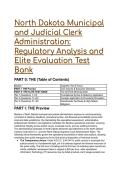
North Dakota Municipal
and Judicial Clerk
Administration:
Regulatory Analysis and
Elite Evaluation Test
Bank
PART 0: THE (Table of Contents)
Section Cognitive Tier & Focus
PART I: THE Preview Core Axioms & Executive Directives
PART II: THE ELITE TEST BANK The 30-Point MCQ Gauntlet
Tier 1 (Questions 1–10) Foundational Syntax & Statutory Application
Tier 2 (Questions 11–20) Complex Application & Procedural Simulation
Tier 3 (Questions 21–30) Grandmaster Synthesis & High-Stakes
Mitigation
PART I: THE Preview
Mastery of North Dakota municipal and judicial administration requires an uncompromising
command of statutory deadlines, procedural syntax, and financial accountability across both
local and state jurisdictions. By internalizing this specialized assessment, administrative
professionals transform raw legislative mandates into flawless operational execution, ensuring
institutional integrity across district courts, municipal courts, and city auditing functions.
The administrative landscape in North Dakota demands rigid adherence to the North Dakota
Century Code (N.D.C.C.) and the North Dakota Supreme Court Administrative Rules. The
following critical frameworks govern the operational boundaries of clerks and auditors, dictating
everything from public transparency to the final archival disposition of historical records.
● The Transparency Axiom: Under N.D.C.C. § 44-04-18, public access to municipal and
judicial records is a fundamental right, yet it is balanced against the financial resources of
the public entity. The first hour of locating and the first hour of redacting open records are
strictly unbillable; subsequent labor is capped at $25 per hour, while specialized
Information Technology (IT) resources may be billed at actual cost if usage exceeds one
, hour.
● The Archival Mandate: North Dakota Supreme Court Administrative Rule 19 dictates
that the disposition of case records requires a meticulous tracking protocol.
Non-confidential records may be sent to a landfill, whereas confidential records must be
strictly shredded or burned. Archival materials must be transferred to the State Archivist
within 60 days of notice.
● The Redaction Shield: Rule 3.4 of the North Dakota Rules of Court strictly mandates the
redaction of social security numbers (retaining the last four digits), financial accounts,
specific birth dates (retaining the year), and minor identities (retaining initials). These
specific data points must be isolated in a separate Confidential Information Form.
● The Fiduciary Clock: A City Auditor operates under uncompromising statutory deadlines.
The auditor must secure their specialized certification within 365 days of assuming office.
Furthermore, the auditor is strictly bound to deliver the annual financial statement by
March 1 and must coordinate the preliminary budget hearing notice with the county
auditor no later than August 10.
Core Regulatory Data Matrix
Domain Statutory/Rule Authority Core Directive Primary Consequence
of Failure
Open Records Fees N.D.C.C. § 44-04-18 First hour free Administrative violation;
(locating/redacting); Attorney General
$25/hr thereafter. sanction.
Auditor Certification N.D.C.C. § 40-16-03.18 Mandatory certification Forfeiture of office;
within 1 year of vacancy.
appointment.
Court Redaction N.D.R.Ct. 3.4 Redact SSNs, Court rejection of filing;
financials, birth dates, privacy breach.
minor names.
Records Disposal Admin Rule 19 Log disposition; Archival corruption;
shred/burn confidential unauthorized
records. disclosure.
Clerk Duties Admin Rule 46 Enter money judgments Invalidated liens;
with exact time; fiduciary corruption.
financial controls.
PART II: THE ELITE TEST BANK
Tier 1: Foundational Syntax & Application
Q1: A newly appointed North Dakota City Auditor assumes office on January 1. Under N.D.C.C.
§ 40-16-03.18, which action regarding professional certification is the FIRST non-negotiable
statutory requirement the auditor must fulfill? A) Complete the North Dakota League of Cities
Auditor’s Certification Program within 36 months of appointment. B) Submit proof of a valid
Certified Public Accountant (CPA) license to the State Auditor prior to taking the oath of office.
C) Complete the designated Auditor's Certification Program within one year of assuming office.
D) Request an exemption from certification if the municipality's annual receipts are below
$750,000.
, ● The Answer: C (Complete the designated Auditor's Certification Program within one year
of assuming office.)
● Distractor Analysis:
○ A is incorrect: The statutory timeframe is strictly one year, not three years. Allowing
a 36-month window is a common novice misconception borrowed from general
continuing education cycles in other administrative disciplines.
○ B is incorrect: A CPA license is not legally mandated to serve as a City Auditor in
North Dakota, nor does it replace the specific curriculum required by state law,
which focuses on municipal meetings, records, and human resources.
○ D is incorrect: While municipalities with receipts under $2 million may submit an
annual financial report in lieu of a full biennial audit, this financial threshold applies
to the audit process itself, and does not exempt the human auditor from mandatory
professional certification.
The Mentor's Analysis: Statutory deadlines for administrative competence are absolute and
immune to municipal size. When facing appointment, the immediate priority is establishing the
legal right to operate through statutory education. By utilizing the Auditor's Certification Program
within the first 365 days, you bypass the common trap of operating out of compliance, which
invalidates municipal financial authority. Professional/Academic Intuition: Certification
validates authority; operating past the one-year mark without it constitutes a fatal breach of
statutory duty.
Q2: A citizen submits a broad public records request to a North Dakota municipal clerk that
requires three hours of locating files and two hours of redacting confidential information. Based
on the principles of N.D.C.C. § 44-04-18, what is the MOST ACCURATE maximum labor fee the
clerk may legally assess? A) $125 (Five total hours billed at $25 per hour). B) $75 (Two hours of
locating and one hour of redacting billed at $25 per hour). C) $100 (Two hours of locating and
two hours of redacting billed at $25 per hour). D) $0 (Public records labor cannot be billed to
citizens under state law).
● The Answer: B ($75 (Two hours of locating and one hour of redacting billed at $25 per
hour).)
● Distractor Analysis:
○ A is incorrect: This calculation illegally bills the requester for the first hour of locating
and the first hour of redacting, both of which are mandated as entirely free under
North Dakota law to protect public access rights.
○ C is incorrect: This calculation correctly provides the free hour for locating, but fails
to provide the separate free hour designated specifically for redaction labor,
effectively overcharging the citizen.
○ D is incorrect: While transparency is heavily prioritized, state law explicitly allows for
cost recovery up to $25 per hour after the initial free hours are exhausted to prevent
undue financial and administrative burdens on the municipality.
The Mentor's Analysis: Open records laws balance public transparency with municipal
resource protection. When facing labor-intensive requests, the immediate priority is bifurcating
the labor into two distinct tracks: locating and redacting. By utilizing the Initial Hour Exemption
for both separate tracks, you bypass the common trap of overbilling citizens and violating state
transparency mandates. Professional/Academic Intuition: The first hour of the search and the
first hour of the redaction belong to the public; subsequent hours belong to the municipality.
Q3: During a highly publicized criminal trial, a witness refuses to swear an oath invoking "God"
due to their secular beliefs. Under North Dakota Rules of Court 6.10, what is the IMMEDIATELY
required action by the court clerk or judge? A) Dismiss the witness, as all testimony in a North
and Judicial Clerk
Administration:
Regulatory Analysis and
Elite Evaluation Test
Bank
PART 0: THE (Table of Contents)
Section Cognitive Tier & Focus
PART I: THE Preview Core Axioms & Executive Directives
PART II: THE ELITE TEST BANK The 30-Point MCQ Gauntlet
Tier 1 (Questions 1–10) Foundational Syntax & Statutory Application
Tier 2 (Questions 11–20) Complex Application & Procedural Simulation
Tier 3 (Questions 21–30) Grandmaster Synthesis & High-Stakes
Mitigation
PART I: THE Preview
Mastery of North Dakota municipal and judicial administration requires an uncompromising
command of statutory deadlines, procedural syntax, and financial accountability across both
local and state jurisdictions. By internalizing this specialized assessment, administrative
professionals transform raw legislative mandates into flawless operational execution, ensuring
institutional integrity across district courts, municipal courts, and city auditing functions.
The administrative landscape in North Dakota demands rigid adherence to the North Dakota
Century Code (N.D.C.C.) and the North Dakota Supreme Court Administrative Rules. The
following critical frameworks govern the operational boundaries of clerks and auditors, dictating
everything from public transparency to the final archival disposition of historical records.
● The Transparency Axiom: Under N.D.C.C. § 44-04-18, public access to municipal and
judicial records is a fundamental right, yet it is balanced against the financial resources of
the public entity. The first hour of locating and the first hour of redacting open records are
strictly unbillable; subsequent labor is capped at $25 per hour, while specialized
Information Technology (IT) resources may be billed at actual cost if usage exceeds one
, hour.
● The Archival Mandate: North Dakota Supreme Court Administrative Rule 19 dictates
that the disposition of case records requires a meticulous tracking protocol.
Non-confidential records may be sent to a landfill, whereas confidential records must be
strictly shredded or burned. Archival materials must be transferred to the State Archivist
within 60 days of notice.
● The Redaction Shield: Rule 3.4 of the North Dakota Rules of Court strictly mandates the
redaction of social security numbers (retaining the last four digits), financial accounts,
specific birth dates (retaining the year), and minor identities (retaining initials). These
specific data points must be isolated in a separate Confidential Information Form.
● The Fiduciary Clock: A City Auditor operates under uncompromising statutory deadlines.
The auditor must secure their specialized certification within 365 days of assuming office.
Furthermore, the auditor is strictly bound to deliver the annual financial statement by
March 1 and must coordinate the preliminary budget hearing notice with the county
auditor no later than August 10.
Core Regulatory Data Matrix
Domain Statutory/Rule Authority Core Directive Primary Consequence
of Failure
Open Records Fees N.D.C.C. § 44-04-18 First hour free Administrative violation;
(locating/redacting); Attorney General
$25/hr thereafter. sanction.
Auditor Certification N.D.C.C. § 40-16-03.18 Mandatory certification Forfeiture of office;
within 1 year of vacancy.
appointment.
Court Redaction N.D.R.Ct. 3.4 Redact SSNs, Court rejection of filing;
financials, birth dates, privacy breach.
minor names.
Records Disposal Admin Rule 19 Log disposition; Archival corruption;
shred/burn confidential unauthorized
records. disclosure.
Clerk Duties Admin Rule 46 Enter money judgments Invalidated liens;
with exact time; fiduciary corruption.
financial controls.
PART II: THE ELITE TEST BANK
Tier 1: Foundational Syntax & Application
Q1: A newly appointed North Dakota City Auditor assumes office on January 1. Under N.D.C.C.
§ 40-16-03.18, which action regarding professional certification is the FIRST non-negotiable
statutory requirement the auditor must fulfill? A) Complete the North Dakota League of Cities
Auditor’s Certification Program within 36 months of appointment. B) Submit proof of a valid
Certified Public Accountant (CPA) license to the State Auditor prior to taking the oath of office.
C) Complete the designated Auditor's Certification Program within one year of assuming office.
D) Request an exemption from certification if the municipality's annual receipts are below
$750,000.
, ● The Answer: C (Complete the designated Auditor's Certification Program within one year
of assuming office.)
● Distractor Analysis:
○ A is incorrect: The statutory timeframe is strictly one year, not three years. Allowing
a 36-month window is a common novice misconception borrowed from general
continuing education cycles in other administrative disciplines.
○ B is incorrect: A CPA license is not legally mandated to serve as a City Auditor in
North Dakota, nor does it replace the specific curriculum required by state law,
which focuses on municipal meetings, records, and human resources.
○ D is incorrect: While municipalities with receipts under $2 million may submit an
annual financial report in lieu of a full biennial audit, this financial threshold applies
to the audit process itself, and does not exempt the human auditor from mandatory
professional certification.
The Mentor's Analysis: Statutory deadlines for administrative competence are absolute and
immune to municipal size. When facing appointment, the immediate priority is establishing the
legal right to operate through statutory education. By utilizing the Auditor's Certification Program
within the first 365 days, you bypass the common trap of operating out of compliance, which
invalidates municipal financial authority. Professional/Academic Intuition: Certification
validates authority; operating past the one-year mark without it constitutes a fatal breach of
statutory duty.
Q2: A citizen submits a broad public records request to a North Dakota municipal clerk that
requires three hours of locating files and two hours of redacting confidential information. Based
on the principles of N.D.C.C. § 44-04-18, what is the MOST ACCURATE maximum labor fee the
clerk may legally assess? A) $125 (Five total hours billed at $25 per hour). B) $75 (Two hours of
locating and one hour of redacting billed at $25 per hour). C) $100 (Two hours of locating and
two hours of redacting billed at $25 per hour). D) $0 (Public records labor cannot be billed to
citizens under state law).
● The Answer: B ($75 (Two hours of locating and one hour of redacting billed at $25 per
hour).)
● Distractor Analysis:
○ A is incorrect: This calculation illegally bills the requester for the first hour of locating
and the first hour of redacting, both of which are mandated as entirely free under
North Dakota law to protect public access rights.
○ C is incorrect: This calculation correctly provides the free hour for locating, but fails
to provide the separate free hour designated specifically for redaction labor,
effectively overcharging the citizen.
○ D is incorrect: While transparency is heavily prioritized, state law explicitly allows for
cost recovery up to $25 per hour after the initial free hours are exhausted to prevent
undue financial and administrative burdens on the municipality.
The Mentor's Analysis: Open records laws balance public transparency with municipal
resource protection. When facing labor-intensive requests, the immediate priority is bifurcating
the labor into two distinct tracks: locating and redacting. By utilizing the Initial Hour Exemption
for both separate tracks, you bypass the common trap of overbilling citizens and violating state
transparency mandates. Professional/Academic Intuition: The first hour of the search and the
first hour of the redaction belong to the public; subsequent hours belong to the municipality.
Q3: During a highly publicized criminal trial, a witness refuses to swear an oath invoking "God"
due to their secular beliefs. Under North Dakota Rules of Court 6.10, what is the IMMEDIATELY
required action by the court clerk or judge? A) Dismiss the witness, as all testimony in a North


