NOT FOR RESALE
ECOP101B_REVISION
UNITS 1 → 11
ALWAYS ASSUME CETERIS PARIBUS (ADD TO ANSWERS IN EXAM)
The Foreign Sector
Net Exports: The annual difference between a country’s exports and imports.
Negative = Trade Deficit (not necessarily a bad thing)
Protectionism: Placing high tariffs on imports and limiting the number of foreign goods, to
protect local businesses.
I.e import taxes on clothes from Shein & Temu
Exchange Rate: How much your currency is worth when you trade it for another country’s
currency.
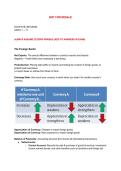
Appreciation of Currency: Cheaper to import foreign goods
Depreciation of Currency: More expensive to import foreign goods
Balance of Payments: Accounting structure that records all international transactions.
● Subaccounts:
○ Current Account: Records the sale & purchase of goods & services, investment
income earned abroad, and other transfers such as donations and foreign aid.
, ○ Financial Account / Capital Account: Records the sale & purchase of financial
assets to and from abroad, like stocks and bonds.
Absolute Advantage & Comparative Advantage
Absolute Advantage: When a country uses less resources than another, to manufacture a
specific product.
● It is manufactured more efficiently
● Who is better at producing each good or service?
Comparative Advantage: One country holds the absolute advantage in both products, but one
of the countries can manufacture said product at a lower opportunity cost than the other.
● Each country specializes in a good or service and then trades it at a lower opportunity
cost than if they had produced it themself.
Opportunity Cost: The loss of potential gain from other alternatives when one alternative is
chosen.
Trade & Comparative Advantage
Trade: A mutually beneficial exchange (freemarket).
Terms of Trade: Comparative Advantage and Opportunity Costs determine the terms of trade
for exchange, under which mutually beneficial trade can occur.
Acceptable Terms: Can only happen when trading costs less (<) than opportunity costs for one
country, but more than (>) opportunity loss for another country.
International Trade
Malcolm McLean invented containers in 1956, now referred to as containerization.
Demand & Supply
Demand: Influenced by Buyers & Consumers
The Law of Demand: Inverse relationship between price and quantity demanded.
● Price decreases ↓ = Quantity Demanded increases ↑
Demand Curve: Downward sloping because of
1. Substitution Effect: An increase in price for product A leads to an increase in demand
for product B and a decrease in demand for product A.
● P↑ (product A) = D↑ (product B) = D↓ (product A)
, 2. Income Effect: A decrease in price for product A leads to an increase in demand for
product A, as consumers purchasing power increases. This is also true for the opposite.
● P↓ (product A) = D↑ (product A)
● P↑ (product A) = D↓ (product A)
3. Law of Diminishing Marginal Utility: As you continue to consume a given product, you
will eventually get less additional satisfaction each time. (Marginal = Additional). Thus
when marginal utility increases, consumer demand decreases.
● Marginal Utility ↑ = Qd ↓
A change in price (P) will always move along the demand (D) curve.
If anything other than price (P) changes, it will shift the entire demand (D) curve.
↓Qd = Shift to left
↑Qd = Shift to right
5 Determinants of Demand
1. Tastes & Preferences
● Negative or Positive relationship
2. Number of Consumers
● Changes in size of consumer households (N)
● N ↑ = D ↑
● Positive relationship
3. Price of related goods
● Substitutes: If the price for good A increases, the demand for good B will
increase, and vice versa.
○ P↑ (good A) = Qd↑ (good B)
○ P↓ (good A) = Qd↓ (good B)
○ Positive relationship
● Complimentary Goods: If the price for good A decreases, the quantity
demanded for both products will increase
○ P↓ (good A) = Qd↑ (good A) = Qd↑ (good B)
○ Negative relationship
4. Income
● Normal Goods: Income and Quantity demanded are directly related.
○ ↑ income = ↑ Qd
○ ↓ income = ↓ Qd
○ Positive relationship
● Inferior Goods: Income and Quantity demanded are inversely related.
○ ↑ income = ↓ Qd
○ ↓ income = ↑ Qd
○ Negative relationship
5. Expectations
● Expected future prices (Pe)
ECOP101B_REVISION
UNITS 1 → 11
ALWAYS ASSUME CETERIS PARIBUS (ADD TO ANSWERS IN EXAM)
The Foreign Sector
Net Exports: The annual difference between a country’s exports and imports.
Negative = Trade Deficit (not necessarily a bad thing)
Protectionism: Placing high tariffs on imports and limiting the number of foreign goods, to
protect local businesses.
I.e import taxes on clothes from Shein & Temu
Exchange Rate: How much your currency is worth when you trade it for another country’s
currency.
Appreciation of Currency: Cheaper to import foreign goods
Depreciation of Currency: More expensive to import foreign goods
Balance of Payments: Accounting structure that records all international transactions.
● Subaccounts:
○ Current Account: Records the sale & purchase of goods & services, investment
income earned abroad, and other transfers such as donations and foreign aid.
, ○ Financial Account / Capital Account: Records the sale & purchase of financial
assets to and from abroad, like stocks and bonds.
Absolute Advantage & Comparative Advantage
Absolute Advantage: When a country uses less resources than another, to manufacture a
specific product.
● It is manufactured more efficiently
● Who is better at producing each good or service?
Comparative Advantage: One country holds the absolute advantage in both products, but one
of the countries can manufacture said product at a lower opportunity cost than the other.
● Each country specializes in a good or service and then trades it at a lower opportunity
cost than if they had produced it themself.
Opportunity Cost: The loss of potential gain from other alternatives when one alternative is
chosen.
Trade & Comparative Advantage
Trade: A mutually beneficial exchange (freemarket).
Terms of Trade: Comparative Advantage and Opportunity Costs determine the terms of trade
for exchange, under which mutually beneficial trade can occur.
Acceptable Terms: Can only happen when trading costs less (<) than opportunity costs for one
country, but more than (>) opportunity loss for another country.
International Trade
Malcolm McLean invented containers in 1956, now referred to as containerization.
Demand & Supply
Demand: Influenced by Buyers & Consumers
The Law of Demand: Inverse relationship between price and quantity demanded.
● Price decreases ↓ = Quantity Demanded increases ↑
Demand Curve: Downward sloping because of
1. Substitution Effect: An increase in price for product A leads to an increase in demand
for product B and a decrease in demand for product A.
● P↑ (product A) = D↑ (product B) = D↓ (product A)
, 2. Income Effect: A decrease in price for product A leads to an increase in demand for
product A, as consumers purchasing power increases. This is also true for the opposite.
● P↓ (product A) = D↑ (product A)
● P↑ (product A) = D↓ (product A)
3. Law of Diminishing Marginal Utility: As you continue to consume a given product, you
will eventually get less additional satisfaction each time. (Marginal = Additional). Thus
when marginal utility increases, consumer demand decreases.
● Marginal Utility ↑ = Qd ↓
A change in price (P) will always move along the demand (D) curve.
If anything other than price (P) changes, it will shift the entire demand (D) curve.
↓Qd = Shift to left
↑Qd = Shift to right
5 Determinants of Demand
1. Tastes & Preferences
● Negative or Positive relationship
2. Number of Consumers
● Changes in size of consumer households (N)
● N ↑ = D ↑
● Positive relationship
3. Price of related goods
● Substitutes: If the price for good A increases, the demand for good B will
increase, and vice versa.
○ P↑ (good A) = Qd↑ (good B)
○ P↓ (good A) = Qd↓ (good B)
○ Positive relationship
● Complimentary Goods: If the price for good A decreases, the quantity
demanded for both products will increase
○ P↓ (good A) = Qd↑ (good A) = Qd↑ (good B)
○ Negative relationship
4. Income
● Normal Goods: Income and Quantity demanded are directly related.
○ ↑ income = ↑ Qd
○ ↓ income = ↓ Qd
○ Positive relationship
● Inferior Goods: Income and Quantity demanded are inversely related.
○ ↑ income = ↓ Qd
○ ↓ income = ↑ Qd
○ Negative relationship
5. Expectations
● Expected future prices (Pe)