NOT FOR RESALE
PRM101B: Exam Study Material
Study Unit 1 – Week 1 & 2
1. Defining a Project
A project is a temporary endeavour undertaken to create a unique product, service,
or result. According to Hobbs (2021), it is designed to bring about an agreed
beneficial change within a fixed timeframe using specified resources, involving
coordinated activity and an element of risk.
Key characteristics of a project include:
• Uniqueness: Every project is different in some distinguishing way from similar
services or products.
• Time-bound: Projects have a clearly defined start and end date.
• Specific Objectives: They are driven by goals aimed at an intended outcome.
• Stakeholder Focus: They are typically funded by a sponsor or customer to
meet specific needs.
,Additional Characteristics of a Project:
• Uniqueness of deliverables
• Defined start & end dates
• Cross-functional collaboration from multiple departments
• Progressive collaboration (planned stages)
• Resource constraints
• Risk & uncertainty
• Customer / Stakeholder focus
• Life cycle phases (initiation, planning, execution, monitoring & closing)
• Change-driven nature
You’ll find Project Management in:
• Organisations developing new products, launching new initiatives and
improving existing processes.
o New e-store launch.
• Governments building or improving infrastructure like roads and community
initiatives.
o New roads being built, or new water structures.
• Non-profit organisations arranging fundraising events.
o Events for SPCA or CANSA.
Why Project Management is Popular:
• Execution of Strategy: By implementing formal project management
methodologies, organisations are experiencing the benefits of using projects
to achieve their strategic goals (Crawford, 2010).
o This contributes to reducing wastage by ensuring resources are
invested in specific projects that execute strategic goals.
• Shortening of Product Life Cycles: The products of today have much shorter
life cycles compared to the products of years gone by; therefore,
organisations need to be more flexible and adaptable to change (Larson &
Gray, 2021).
• Increased Customer Focus: Consumers want to stand out and have their
products and services personalised to suit their needs (Larson & Gray, 2021).
o Consequently, implementing project management methodologies
enables organisations to adapt and provide for specific customer
tastes and needs.
• Career Opportunities: The formalisation of project management as a
profession and the development of organisations like the PMI that provide for
certifications have enabled the growth and advancement of professional
careers (Hoffman, Boyle & Maturo, 2004).
,2. Projects vs. Operational Processes
It is vital to distinguish projects from the ongoing work of an organization:
• Projects: Support innovation, growth, and organizational improvements; they
are unique, novel, and challenge the status quo.
• Processes: Ensure stable operations; they are repetitive, routine, ongoing
activities designed to maintain the status quo.
PROJECTS PROCESSES
Temporary Ongoing
• Launching new mobile banking • Processing daily customer
app for Capitec transactions at Capitec
• Developing a new curriculum for • Managing student records and
NQF Level 6 Project academic transcripts
Management • Performing monthly
• Organising a university maintenance on municipal
graduation ceremony infrastructure
Unique product, service or outcome Repetitive outcomes
One objective Can have several objectives
Uncertainty re: costs, schedules and Certainty re: costs, schedules and
performance performance
Challenge the status quo Maintain the status quo
Require multi-functional teams of Supports homogenous groups of people
people
, 3. The Strategic Hierarchy
Organizations manage initiatives through a tiered structure to ensure they align with
strategic goals:
• Portfolio: A high-level collection of programmes, projects, and operations
managed collectively to achieve strategic objectives.
• Programme: A group of related projects managed in a coordinated way to
achieve a common goal or benefit that wouldn't be possible if managed
individually.
• Project: The individual, temporary initiative feeding into the larger programme
or portfolio.
4. Constraints and the Iron Triangle
Projects are governed by the Iron Triangle (or Triple Constraint), which represents the
interdependent relationship between Time, Cost, and Scope (Quality). Adjusting one
side—such as shortening the time—inevitably impacts the others, such as increasing
costs or reducing quality.
To manage these trade-offs, project managers use a Project Priority Matrix:
• Constraint: The #1 priority with no flexibility for change.
• Optimize: An area where minimal change can be accommodated to meet
goals.
• Accept: An area with flexibility where change is accepted to balance the
other constraints.
PRM101B: Exam Study Material
Study Unit 1 – Week 1 & 2
1. Defining a Project
A project is a temporary endeavour undertaken to create a unique product, service,
or result. According to Hobbs (2021), it is designed to bring about an agreed
beneficial change within a fixed timeframe using specified resources, involving
coordinated activity and an element of risk.
Key characteristics of a project include:
• Uniqueness: Every project is different in some distinguishing way from similar
services or products.
• Time-bound: Projects have a clearly defined start and end date.
• Specific Objectives: They are driven by goals aimed at an intended outcome.
• Stakeholder Focus: They are typically funded by a sponsor or customer to
meet specific needs.
,Additional Characteristics of a Project:
• Uniqueness of deliverables
• Defined start & end dates
• Cross-functional collaboration from multiple departments
• Progressive collaboration (planned stages)
• Resource constraints
• Risk & uncertainty
• Customer / Stakeholder focus
• Life cycle phases (initiation, planning, execution, monitoring & closing)
• Change-driven nature
You’ll find Project Management in:
• Organisations developing new products, launching new initiatives and
improving existing processes.
o New e-store launch.
• Governments building or improving infrastructure like roads and community
initiatives.
o New roads being built, or new water structures.
• Non-profit organisations arranging fundraising events.
o Events for SPCA or CANSA.
Why Project Management is Popular:
• Execution of Strategy: By implementing formal project management
methodologies, organisations are experiencing the benefits of using projects
to achieve their strategic goals (Crawford, 2010).
o This contributes to reducing wastage by ensuring resources are
invested in specific projects that execute strategic goals.
• Shortening of Product Life Cycles: The products of today have much shorter
life cycles compared to the products of years gone by; therefore,
organisations need to be more flexible and adaptable to change (Larson &
Gray, 2021).
• Increased Customer Focus: Consumers want to stand out and have their
products and services personalised to suit their needs (Larson & Gray, 2021).
o Consequently, implementing project management methodologies
enables organisations to adapt and provide for specific customer
tastes and needs.
• Career Opportunities: The formalisation of project management as a
profession and the development of organisations like the PMI that provide for
certifications have enabled the growth and advancement of professional
careers (Hoffman, Boyle & Maturo, 2004).
,2. Projects vs. Operational Processes
It is vital to distinguish projects from the ongoing work of an organization:
• Projects: Support innovation, growth, and organizational improvements; they
are unique, novel, and challenge the status quo.
• Processes: Ensure stable operations; they are repetitive, routine, ongoing
activities designed to maintain the status quo.
PROJECTS PROCESSES
Temporary Ongoing
• Launching new mobile banking • Processing daily customer
app for Capitec transactions at Capitec
• Developing a new curriculum for • Managing student records and
NQF Level 6 Project academic transcripts
Management • Performing monthly
• Organising a university maintenance on municipal
graduation ceremony infrastructure
Unique product, service or outcome Repetitive outcomes
One objective Can have several objectives
Uncertainty re: costs, schedules and Certainty re: costs, schedules and
performance performance
Challenge the status quo Maintain the status quo
Require multi-functional teams of Supports homogenous groups of people
people
, 3. The Strategic Hierarchy
Organizations manage initiatives through a tiered structure to ensure they align with
strategic goals:
• Portfolio: A high-level collection of programmes, projects, and operations
managed collectively to achieve strategic objectives.
• Programme: A group of related projects managed in a coordinated way to
achieve a common goal or benefit that wouldn't be possible if managed
individually.
• Project: The individual, temporary initiative feeding into the larger programme
or portfolio.
4. Constraints and the Iron Triangle
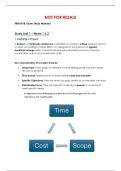
Projects are governed by the Iron Triangle (or Triple Constraint), which represents the
interdependent relationship between Time, Cost, and Scope (Quality). Adjusting one
side—such as shortening the time—inevitably impacts the others, such as increasing
costs or reducing quality.
To manage these trade-offs, project managers use a Project Priority Matrix:
• Constraint: The #1 priority with no flexibility for change.
• Optimize: An area where minimal change can be accommodated to meet
goals.
• Accept: An area with flexibility where change is accepted to balance the
other constraints.