

1
WORK, HEALTH & PSYCHOLOGY(WHP9 EXAM
PREPARATION 2026 VERSION STUDY GUIDE
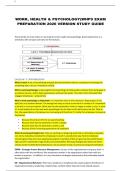
These will be my main notes on my study for work, health and psychology. Down below there is a
schematic with an topic-overview for the lectures.
Lecture 1: Introduction
What is work: A set of coordinated and goal-directed activities that are conducted in exchange for
something else, such as a monetary reward.
What is work psychology: Using insights from psychology to help workers achieve their work-goals in
an optima manner, and to help organizations achieve their goals. This stems from the belief that
engaged employees = productivity
Why is work psychology so important: it is important since it tries improve a large aspect of our
daily lives in a positive manner. On average we sleep as much as we work in a week so it’s important
to do this in a correct manner. Work also has the potential to make us happy or make us sick, in short
it’s a vital aspect of our live and work psychology tries to show us the best way to do this. Next to
this, the expectations of employes are increasing and therefore it’s harder for employees to keep up
themselves.
• Because the amount of time we spend working
• Because work has the potential to make us happy
• Because work has the potential to make us sick
• Because of the increasing expectations of employers
What do work psychologists do: They are working on designing work that is motivating, enjoyable,
non-stress inducible and allow the employees to work in a productive way. Next to employee
oriented goals they also have organizational goals. Examples of this are good service performance,
high customer satisfaction, high profits and sustainability. Work psychologist dive deep into when
certain workers exhibit desired behaviors such as positive mood, no pressure and good motivation.
SHRM - Strategic Human Resource Management: focuses at the organizational and group level. It
often deals with the workforce/ the anonymous worker in an organization rather than with the
worker as a person . In addition, it is very focused on strategies and practices that ultimately benefit
the organization.
OB - Organizational Behavior: often has a tendency to emphasize the socials aspects of behavior in
organizations (teams, leadership, relationships, conflict) rather than job / task related aspects
,2
Context of Work Health and Psychology: WHP deals with the individual worker and his/her work,
well-being and performance. It mainly deals with literature in the area of job design, work
psychology and occupational health psychology
The history of work health psychology: WHP started as psychotechnics / applied psychology with
the pioneers being Jean Marie Lahy from France & Munsterberg from Germany. These entail the
practical or technological application of psychology as in analysis of social or economic problems.
Scientific Management
Another big founder of WHP is Frederick Winslow Taylor with his scientific management. He said “As
the importance of obtaining the maximum output of each man and each machine, it is only through
the adoption of modern scientific management that this great problem can finally be solved.
Scientific management didn’t focus on the match between worker and tasks but mostly on the task
at hand. In short Scientific Management focuses on the task (simplification of tasks).
Why doesn’t scientific management focus on the workers? Well this is because of two assumptions
that Taylor had about the workers with the first being that workers are lazy and the second being
that workers are stupid. With this mindset in mind Taylor had a solution for this. To maximize
productivity you need to:
• Simplify tasks as much as possible
• Examine the best way to conduct the tasks
• Training workers in the one best way to conduct the tasks (high control)
• Separating the planning of tasks from their execution
Hawthorne Studies: A series of workplace experiments conducted at Western Electric's Hawthorne
Works in the 1920s and 1930s. These studies revealed that worker productivity and performance
improved when they believed they were being observed and that their supervisors cared about their
well-being. The findings highlighted the significant impact of social and psychological factors on
employee behavior, leading to the development of the Human Relations Movement in management.
An example of the experiments they performed during these studies are:
• Effects of lightning intensity on productivity
• Relay Assembly Test Room (5 woman in a secluded room, variations in the number and
duration of rest breaks and the length of the work day and work week
• 2nd Relay assembly test (incentive schemes) (team based)
• Mica Splitting Test Room (incentive schemes team based)
• Interviews (Importance of empathic listening an participation
• Bank Wiring Observation Room (14 workers, informal system and group norms
Human Relations Movement:
From the time of the publication of the results of the Hawthorne Studies onward, no one interest in
the behavior of employees could consider them as isolated individuals. Rather, such factors and
concepts as group influences, social status, Informal communication, roles, norms and the like were
draw upon to explain and Interpret the voluminous data from these studies and other fields of
investigation that followed them.
It is important to have a balanced approach. This meaning performance but also wellbeing
, 3
Performance: The action or process of performing a task or function
Action: Performance is what the organization hires one to do, and do well
Outcome: The consequence or the result of the individual workers behavior
Dimensions of individual job performance:
• Task performance
• Organizational citizenship behaviors (going the extra mile)
• Counterproductive work behaviors
• Employee withdrawal behaviors
Wellbeing: Healthy is a state of complete physical, mental and social well being and not merely the
absence of disease or infirmity. In the context of work this means:
• Health (physical well-being): decrease disease and injuries, stress and increase health
benefits.
• Relationships (social well-being): increase trust, support, decrease exploitation and power
abuse
• Happiness (psychological well-being) : increase pleasure, satisfaction and fulfillment /
engagement, and decrease the opposite thereof
Lecture 2: Theoretical Perspectives on work part 1
“We all make use of theory (constantly).
Theory:
• Helps us to make sense of the complex world around us
• Summaries the knowledge of the field, and provides us with a framework for understanding
and explaining complex phenomena
• Often allows for accurate predictions about future events or outcomes
Design: the art or action of producing a plan or drawing of something before it is made | Purpose or
planning that exists behind an action, fact or object.
What is job design:
Specification of the contents, methods and relationships of jobs in order to satisfy technological and
organizational requirements as well as the social and personal requirements of the job holder. In
other words:
Job Design is all about planning and organizing a job to make sure it meets the needs of the company
and the person doing the job. This includes deciding what tasks the job involves, how they're done,
and how they fit into the company's goals. It's about making sure the job works for both the
company and the person doing it.
From theory X to Theory Y
This describes the transition from Scientific management (theory X) where we talked about earlier
to Job design (theory Y). Down below is a recap of both theories:
Theory X (Scientific Management):
WORK, HEALTH & PSYCHOLOGY(WHP9 EXAM
PREPARATION 2026 VERSION STUDY GUIDE
These will be my main notes on my study for work, health and psychology. Down below there is a
schematic with an topic-overview for the lectures.
Lecture 1: Introduction
What is work: A set of coordinated and goal-directed activities that are conducted in exchange for
something else, such as a monetary reward.
What is work psychology: Using insights from psychology to help workers achieve their work-goals in
an optima manner, and to help organizations achieve their goals. This stems from the belief that
engaged employees = productivity
Why is work psychology so important: it is important since it tries improve a large aspect of our
daily lives in a positive manner. On average we sleep as much as we work in a week so it’s important
to do this in a correct manner. Work also has the potential to make us happy or make us sick, in short
it’s a vital aspect of our live and work psychology tries to show us the best way to do this. Next to
this, the expectations of employes are increasing and therefore it’s harder for employees to keep up
themselves.
• Because the amount of time we spend working
• Because work has the potential to make us happy
• Because work has the potential to make us sick
• Because of the increasing expectations of employers
What do work psychologists do: They are working on designing work that is motivating, enjoyable,
non-stress inducible and allow the employees to work in a productive way. Next to employee
oriented goals they also have organizational goals. Examples of this are good service performance,
high customer satisfaction, high profits and sustainability. Work psychologist dive deep into when
certain workers exhibit desired behaviors such as positive mood, no pressure and good motivation.
SHRM - Strategic Human Resource Management: focuses at the organizational and group level. It
often deals with the workforce/ the anonymous worker in an organization rather than with the
worker as a person . In addition, it is very focused on strategies and practices that ultimately benefit
the organization.
OB - Organizational Behavior: often has a tendency to emphasize the socials aspects of behavior in
organizations (teams, leadership, relationships, conflict) rather than job / task related aspects
,2
Context of Work Health and Psychology: WHP deals with the individual worker and his/her work,
well-being and performance. It mainly deals with literature in the area of job design, work
psychology and occupational health psychology
The history of work health psychology: WHP started as psychotechnics / applied psychology with
the pioneers being Jean Marie Lahy from France & Munsterberg from Germany. These entail the
practical or technological application of psychology as in analysis of social or economic problems.
Scientific Management
Another big founder of WHP is Frederick Winslow Taylor with his scientific management. He said “As
the importance of obtaining the maximum output of each man and each machine, it is only through
the adoption of modern scientific management that this great problem can finally be solved.
Scientific management didn’t focus on the match between worker and tasks but mostly on the task
at hand. In short Scientific Management focuses on the task (simplification of tasks).
Why doesn’t scientific management focus on the workers? Well this is because of two assumptions
that Taylor had about the workers with the first being that workers are lazy and the second being
that workers are stupid. With this mindset in mind Taylor had a solution for this. To maximize
productivity you need to:
• Simplify tasks as much as possible
• Examine the best way to conduct the tasks
• Training workers in the one best way to conduct the tasks (high control)
• Separating the planning of tasks from their execution
Hawthorne Studies: A series of workplace experiments conducted at Western Electric's Hawthorne
Works in the 1920s and 1930s. These studies revealed that worker productivity and performance
improved when they believed they were being observed and that their supervisors cared about their
well-being. The findings highlighted the significant impact of social and psychological factors on
employee behavior, leading to the development of the Human Relations Movement in management.
An example of the experiments they performed during these studies are:
• Effects of lightning intensity on productivity
• Relay Assembly Test Room (5 woman in a secluded room, variations in the number and
duration of rest breaks and the length of the work day and work week
• 2nd Relay assembly test (incentive schemes) (team based)
• Mica Splitting Test Room (incentive schemes team based)
• Interviews (Importance of empathic listening an participation
• Bank Wiring Observation Room (14 workers, informal system and group norms
Human Relations Movement:
From the time of the publication of the results of the Hawthorne Studies onward, no one interest in
the behavior of employees could consider them as isolated individuals. Rather, such factors and
concepts as group influences, social status, Informal communication, roles, norms and the like were
draw upon to explain and Interpret the voluminous data from these studies and other fields of
investigation that followed them.
It is important to have a balanced approach. This meaning performance but also wellbeing
, 3
Performance: The action or process of performing a task or function
Action: Performance is what the organization hires one to do, and do well
Outcome: The consequence or the result of the individual workers behavior
Dimensions of individual job performance:
• Task performance
• Organizational citizenship behaviors (going the extra mile)
• Counterproductive work behaviors
• Employee withdrawal behaviors
Wellbeing: Healthy is a state of complete physical, mental and social well being and not merely the
absence of disease or infirmity. In the context of work this means:
• Health (physical well-being): decrease disease and injuries, stress and increase health
benefits.
• Relationships (social well-being): increase trust, support, decrease exploitation and power
abuse
• Happiness (psychological well-being) : increase pleasure, satisfaction and fulfillment /
engagement, and decrease the opposite thereof
Lecture 2: Theoretical Perspectives on work part 1
“We all make use of theory (constantly).
Theory:
• Helps us to make sense of the complex world around us
• Summaries the knowledge of the field, and provides us with a framework for understanding
and explaining complex phenomena
• Often allows for accurate predictions about future events or outcomes
Design: the art or action of producing a plan or drawing of something before it is made | Purpose or
planning that exists behind an action, fact or object.
What is job design:
Specification of the contents, methods and relationships of jobs in order to satisfy technological and
organizational requirements as well as the social and personal requirements of the job holder. In
other words:
Job Design is all about planning and organizing a job to make sure it meets the needs of the company
and the person doing the job. This includes deciding what tasks the job involves, how they're done,
and how they fit into the company's goals. It's about making sure the job works for both the
company and the person doing it.
From theory X to Theory Y
This describes the transition from Scientific management (theory X) where we talked about earlier
to Job design (theory Y). Down below is a recap of both theories:
Theory X (Scientific Management):


