

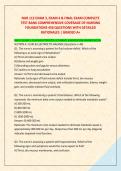
NUR 112 EXAM 3, EXAM 4 & FINAL EXAM COMPLETE
TEST BANK COMPREHENSIVE COVERAGE OF NURSING
FOUNDATIONS 450 QUESTIONS WITH DETAILED
RATIONALES | GRADED A+
NUR 112 EXAM 3: FLUID & ELECTROLYTES, IV THERAPY, & MEDICATION ADMINISTRATION
SECTION A: FLUID & ELECTROLYTE BALANCE (Questions 1-40)
Q1. The nurse is assessing a patient for fluid volume deficit. Which of the
following is an early sign of dehydration?
A) Thirst and decreased urine output
B) Edema and weight gain
C) Bounding pulses and jugular venous distention
D) Crackles on lung auscultation
Answer: A) Thirst and decreased urine output
Rationale: Early signs of fluid volume deficit include thirst, dry mucous
membranes, decreased urine output, and orthostatic hypotension. Edema, weight
gain, and crackles indicate fluid overload.
Q2. The nurse is monitoring a patient's fluid balance. Which of the following
represents the minimum daily urine output needed to eliminate metabolic waste?
A) 100-200 mL
B) 400-500 mL
C) 800-1000 mL
D) 1500-2000 mL
Answer: B) 400-500 mL
Rationale: The minimum urine output needed to eliminate metabolic waste is
approximately 400-500 mL per day. Output less than 400 mL per day (oliguria)
indicates impaired renal function.
Q3. The nurse is assessing a patient with hyponatremia. Which of the
following signs and symptoms would the nurse expect to find?
A) Thirst, dry mucous membranes, and confusion
1
,B) Headache, confusion, and muscle weakness
C) Edema and crackles
D) Muscle cramping and cardiac arrhythmias
Answer: B) Headache, confusion, and muscle weakness
Rationale: Hyponatremia (serum sodium <135 mEq/L) causes cellular swelling
and presents with headache, confusion, lethargy, muscle weakness, and
seizures. Thirst is associated with hypernatremia.
Q4. The nurse is assessing a patient with hypernatremia. Which of the
following signs and symptoms would the nurse expect to find?
A) Thirst, dry mucous membranes, and confusion
B) Headache, confusion, and muscle weakness
C) Edema and crackles
D) Muscle cramping and cardiac arrhythmias
Answer: A) Thirst, dry mucous membranes, and confusion
Rationale: Hypernatremia (serum sodium >145 mEq/L) causes cellular
dehydration and presents with intense thirst, dry mucous membranes,
confusion, and lethargy. Muscle weakness is associated with hyponatremia.
Q5. The nurse is assessing a patient with hypokalemia. Which of the
following signs and symptoms would the nurse expect to find?
A) Muscle weakness, fatigue, and cardiac arrhythmias
B) Muscle twitching and hyperreflexia
C) Edema and weight gain
D) Thirst and dry mucous membranes
Answer: A) Muscle weakness, fatigue, and cardiac arrhythmias
Rationale: Hypokalemia (serum potassium <3.5 mEq/L) causes muscle weakness,
fatigue, constipation, and cardiac arrhythmias. It can be life-threatening
due to cardiac arrest.
Q6. The nurse is assessing a patient with hyperkalemia. Which of the
following signs and symptoms would the nurse expect to find?
A) Muscle weakness and cardiac arrhythmias
2
,B) Muscle twitching and cramps
C) Edema and weight gain
D) Thirst and dry mucous membranes
Answer: A) Muscle weakness and cardiac arrhythmias
Rationale: Hyperkalemia (serum potassium >5.0 mEq/L) can cause muscle
weakness, paresthesia, and life-threatening cardiac arrhythmias. It is a
medical emergency.
Q7. The nurse is caring for a patient with hypocalcemia. Which of the
following signs would the nurse expect to find?
A) Muscle twitching, positive Trousseau's sign, and positive Chvostek's sign
B) Muscle weakness and fatigue
C) Edema and weight gain
D) Thirst and dry mucous membranes
Answer: A) Muscle twitching, positive Trousseau's sign, and positive
Chvostek's sign
Rationale: Hypocalcemia causes neuromuscular irritability, including muscle
twitching, positive Trousseau's sign (carpal spasm with BP cuff inflation),
and positive Chvostek's sign (facial twitching with tapping of the facial
nerve).
Q8. The nurse is caring for a patient with hypercalcemia. Which of the
following signs would the nurse expect to find?
A) Muscle weakness, lethargy, and constipation
B) Muscle twitching and spasms
C) Edema and weight gain
D) Thirst and dry mucous membranes
Answer: A) Muscle weakness, lethargy, and constipation
Rationale: Hypercalcemia causes muscle weakness, lethargy, confusion,
constipation, and kidney stones. Neuromuscular irritability is seen in
hypocalcemia.
Q9. The nurse is assessing a patient for signs of fluid overload. Which of
3
, the following findings indicates fluid overload?
A) Crackles on lung auscultation, edema, and jugular venous distention
B) Orthostatic hypotension and tachycardia
C) Decreased urine output and dry mucous membranes
D) Thirst and weight loss
Answer: A) Crackles on lung auscultation, edema, and jugular venous
distention
Rationale: Fluid overload (hypervolemia) presents with crackles, edema,
jugular venous distention, and weight gain. Signs of dehydration include
orthostatic hypotension, tachycardia, and decreased urine output.
Q10. The nurse is calculating a patient's fluid intake and output. Which of
the following is included in the intake calculation?
A) Oral fluids, IV fluids, and tube feedings
B) Urine, emesis, and wound drainage
C) Blood loss and perspiration
D) Insensible losses
Answer: A) Oral fluids, IV fluids, and tube feedings
Rationale: Intake includes all fluids entering the body: oral fluids, IV
fluids, and tube feedings. Output includes urine, emesis, and wound drainage.
Q11. The nurse is assessing a patient's daily weight. A weight gain of 2 kg
in 24 hours indicates fluid retention of approximately:
A) 1 liter
B) 2 liters
C) 3 liters
D) 4 liters
Answer: B) 2 liters
Rationale: 1 kg of weight gain is approximately equal to 1 liter of retained
fluid. A 2 kg gain in 24 hours indicates significant fluid retention and
requires further assessment.
Q12. The nurse is caring for a patient with a serum sodium level of 128
4
TEST BANK COMPREHENSIVE COVERAGE OF NURSING
FOUNDATIONS 450 QUESTIONS WITH DETAILED
RATIONALES | GRADED A+
NUR 112 EXAM 3: FLUID & ELECTROLYTES, IV THERAPY, & MEDICATION ADMINISTRATION
SECTION A: FLUID & ELECTROLYTE BALANCE (Questions 1-40)
Q1. The nurse is assessing a patient for fluid volume deficit. Which of the
following is an early sign of dehydration?
A) Thirst and decreased urine output
B) Edema and weight gain
C) Bounding pulses and jugular venous distention
D) Crackles on lung auscultation
Answer: A) Thirst and decreased urine output
Rationale: Early signs of fluid volume deficit include thirst, dry mucous
membranes, decreased urine output, and orthostatic hypotension. Edema, weight
gain, and crackles indicate fluid overload.
Q2. The nurse is monitoring a patient's fluid balance. Which of the following
represents the minimum daily urine output needed to eliminate metabolic waste?
A) 100-200 mL
B) 400-500 mL
C) 800-1000 mL
D) 1500-2000 mL
Answer: B) 400-500 mL
Rationale: The minimum urine output needed to eliminate metabolic waste is
approximately 400-500 mL per day. Output less than 400 mL per day (oliguria)
indicates impaired renal function.
Q3. The nurse is assessing a patient with hyponatremia. Which of the
following signs and symptoms would the nurse expect to find?
A) Thirst, dry mucous membranes, and confusion
1
,B) Headache, confusion, and muscle weakness
C) Edema and crackles
D) Muscle cramping and cardiac arrhythmias
Answer: B) Headache, confusion, and muscle weakness
Rationale: Hyponatremia (serum sodium <135 mEq/L) causes cellular swelling
and presents with headache, confusion, lethargy, muscle weakness, and
seizures. Thirst is associated with hypernatremia.
Q4. The nurse is assessing a patient with hypernatremia. Which of the
following signs and symptoms would the nurse expect to find?
A) Thirst, dry mucous membranes, and confusion
B) Headache, confusion, and muscle weakness
C) Edema and crackles
D) Muscle cramping and cardiac arrhythmias
Answer: A) Thirst, dry mucous membranes, and confusion
Rationale: Hypernatremia (serum sodium >145 mEq/L) causes cellular
dehydration and presents with intense thirst, dry mucous membranes,
confusion, and lethargy. Muscle weakness is associated with hyponatremia.
Q5. The nurse is assessing a patient with hypokalemia. Which of the
following signs and symptoms would the nurse expect to find?
A) Muscle weakness, fatigue, and cardiac arrhythmias
B) Muscle twitching and hyperreflexia
C) Edema and weight gain
D) Thirst and dry mucous membranes
Answer: A) Muscle weakness, fatigue, and cardiac arrhythmias
Rationale: Hypokalemia (serum potassium <3.5 mEq/L) causes muscle weakness,
fatigue, constipation, and cardiac arrhythmias. It can be life-threatening
due to cardiac arrest.
Q6. The nurse is assessing a patient with hyperkalemia. Which of the
following signs and symptoms would the nurse expect to find?
A) Muscle weakness and cardiac arrhythmias
2
,B) Muscle twitching and cramps
C) Edema and weight gain
D) Thirst and dry mucous membranes
Answer: A) Muscle weakness and cardiac arrhythmias
Rationale: Hyperkalemia (serum potassium >5.0 mEq/L) can cause muscle
weakness, paresthesia, and life-threatening cardiac arrhythmias. It is a
medical emergency.
Q7. The nurse is caring for a patient with hypocalcemia. Which of the
following signs would the nurse expect to find?
A) Muscle twitching, positive Trousseau's sign, and positive Chvostek's sign
B) Muscle weakness and fatigue
C) Edema and weight gain
D) Thirst and dry mucous membranes
Answer: A) Muscle twitching, positive Trousseau's sign, and positive
Chvostek's sign
Rationale: Hypocalcemia causes neuromuscular irritability, including muscle
twitching, positive Trousseau's sign (carpal spasm with BP cuff inflation),
and positive Chvostek's sign (facial twitching with tapping of the facial
nerve).
Q8. The nurse is caring for a patient with hypercalcemia. Which of the
following signs would the nurse expect to find?
A) Muscle weakness, lethargy, and constipation
B) Muscle twitching and spasms
C) Edema and weight gain
D) Thirst and dry mucous membranes
Answer: A) Muscle weakness, lethargy, and constipation
Rationale: Hypercalcemia causes muscle weakness, lethargy, confusion,
constipation, and kidney stones. Neuromuscular irritability is seen in
hypocalcemia.
Q9. The nurse is assessing a patient for signs of fluid overload. Which of
3
, the following findings indicates fluid overload?
A) Crackles on lung auscultation, edema, and jugular venous distention
B) Orthostatic hypotension and tachycardia
C) Decreased urine output and dry mucous membranes
D) Thirst and weight loss
Answer: A) Crackles on lung auscultation, edema, and jugular venous
distention
Rationale: Fluid overload (hypervolemia) presents with crackles, edema,
jugular venous distention, and weight gain. Signs of dehydration include
orthostatic hypotension, tachycardia, and decreased urine output.
Q10. The nurse is calculating a patient's fluid intake and output. Which of
the following is included in the intake calculation?
A) Oral fluids, IV fluids, and tube feedings
B) Urine, emesis, and wound drainage
C) Blood loss and perspiration
D) Insensible losses
Answer: A) Oral fluids, IV fluids, and tube feedings
Rationale: Intake includes all fluids entering the body: oral fluids, IV
fluids, and tube feedings. Output includes urine, emesis, and wound drainage.
Q11. The nurse is assessing a patient's daily weight. A weight gain of 2 kg
in 24 hours indicates fluid retention of approximately:
A) 1 liter
B) 2 liters
C) 3 liters
D) 4 liters
Answer: B) 2 liters
Rationale: 1 kg of weight gain is approximately equal to 1 liter of retained
fluid. A 2 kg gain in 24 hours indicates significant fluid retention and
requires further assessment.
Q12. The nurse is caring for a patient with a serum sodium level of 128
4


