

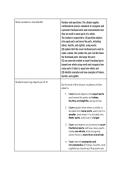
State academic standard(s) Number and operations. The student applies
mathematical process standards to recognize and
represent fractional units and communicates how
they are used to name parts of a whole.
The student is expected to: (A) partition objects
into equal parts and name the parts, including
halves, fourths, and eighths, using words;
(B) explain that the more fractional parts used to
make a whole, the smaller the part; and the fewer
the fractional parts, the larger the part;
(C) use concrete models to count fractional parts
beyond one whole using words and recognize how
many parts it takes to equal one whole; and
(D) identify examples and non-examples of halves,
fourths, and eighths
Student learning objectives (3-5)
By the end of the lesson, students will be
able to:
1. I can break objects into equal parts
and name the parts as halves,
fourths, and eighths using words.
2. I can explain that when a whole is
divided into more parts, each part is
smaller, and when it is divided into
fewer parts, each part is larger.
3. I can use objects or pictures to count
fractional parts, tell how many parts
make one whole, and recognize
when there is more than one whole.
4. I can identify examples and
non-examples of halves, fourths, and
eighths by checking if the parts are
, equal.
Learning theory
Primary Learning Theory: Constructivism
Constructivism holds that students build
their own understanding through active
engagement and experiences.
Type of lesson cycle (see-say-do, 5E,
Madeline Hunter, etc.) Concept Development / Conceptual Lesson
● Focus: Students understand the idea
of fractions (halves, fourths, eighths)
conceptually, not just procedurally.
● Approach: Hands-on and visual;
students manipulate materials to
discover patterns and relationships.
● Characteristics:
○ Uses concrete materials
(paper shapes, fraction
strips).
○ Includes teacher modeling
and guided practice.
○ Students explain and reason
about what they see (Turn
and Talk,
examples/non-examples).
○ Builds from exploration to
formal understanding.
mathematical process standards to recognize and
represent fractional units and communicates how
they are used to name parts of a whole.
The student is expected to: (A) partition objects
into equal parts and name the parts, including
halves, fourths, and eighths, using words;
(B) explain that the more fractional parts used to
make a whole, the smaller the part; and the fewer
the fractional parts, the larger the part;
(C) use concrete models to count fractional parts
beyond one whole using words and recognize how
many parts it takes to equal one whole; and
(D) identify examples and non-examples of halves,
fourths, and eighths
Student learning objectives (3-5)
By the end of the lesson, students will be
able to:
1. I can break objects into equal parts
and name the parts as halves,
fourths, and eighths using words.
2. I can explain that when a whole is
divided into more parts, each part is
smaller, and when it is divided into
fewer parts, each part is larger.
3. I can use objects or pictures to count
fractional parts, tell how many parts
make one whole, and recognize
when there is more than one whole.
4. I can identify examples and
non-examples of halves, fourths, and
eighths by checking if the parts are
, equal.
Learning theory
Primary Learning Theory: Constructivism
Constructivism holds that students build
their own understanding through active
engagement and experiences.
Type of lesson cycle (see-say-do, 5E,
Madeline Hunter, etc.) Concept Development / Conceptual Lesson
● Focus: Students understand the idea
of fractions (halves, fourths, eighths)
conceptually, not just procedurally.
● Approach: Hands-on and visual;
students manipulate materials to
discover patterns and relationships.
● Characteristics:
○ Uses concrete materials
(paper shapes, fraction
strips).
○ Includes teacher modeling
and guided practice.
○ Students explain and reason
about what they see (Turn
and Talk,
examples/non-examples).
○ Builds from exploration to
formal understanding.


