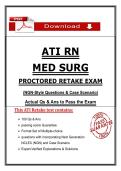
ATI RN
MED SURG
PROCTORED RETAKE EXAM
(NGN-Style Questions & Case Scenario)
Actual Qs & Ans to Pass the Exam
This ATI Retake test contains:
100 Qs & Ans
passing score Guarantee
Format Set of Multiple-choice
questions with incorporating Next Generation
NCLEX (NGN) and Case Scenario
Expert-Verified Explanations & Solutions
,### 1.
A nurse is caring for a client who is 12 hours postoperative after a colon resection. The
nurse assesses the following vital signs and laboratory values:
- Heart rate: 90/min
- Absent bowel sounds
- Hemoglobin: 8.2 g/dL
- Gastric pH: 3.0
Question:
Which finding should the nurse report immediately to the surgeon?
Answer choices:
A. Heart rate 90/min
B. Absent bowel sounds
C. Hemoglobin 8.2 g/dL
D. Gastric pH 3.0
Correct Answer: C
Rationale: A hemoglobin of 8.2 g/dL suggests significant blood loss or anemia
requiring prompt attention. Heart rate 90/min is within normal limits, absence of
,bowel sounds can be normal early post-op, and gastric pH of 3 is normal gastric
acidity. Immediate notification is required for low hemoglobin.
---
### 2.
You are caring for a client diagnosed with diabetes insipidus who reports excessive
thirst and frequent urination.
Question:
Which medication should the nurse expect to administer?
Answer choices:
A. Desmopressin
B. Regular insulin
C. Furosemide
D. Lithium carbonate
Correct Answer: A
Rationale: Desmopressin, a synthetic ADH analog, reduces urine output by promoting
water reabsorption in kidneys. Furosemide is a diuretic and insulin or lithium are not
appropriate management for DI.
, ---
### 3.
A client with chronic arthritis reports taking ibuprofen several times daily for 3 years.
The nurse is preparing to order baseline and routine lab tests.
Question:
Which test should the nurse prioritize in this client's monitoring?
Answer choices:
A. Fasting blood glucose
B. Stool test for occult blood
C. Urine analysis for white blood cells
D. Serum calcium
Correct Answer: B
Rationale: Long-term NSAID use increases risk for gastrointestinal bleeding and ulcers.
Monitoring stool for occult blood detects occult bleeding early. Blood glucose and
serum calcium are unrelated, and urinary WBCs indicate infection, not NSAID side
effects.
MED SURG
PROCTORED RETAKE EXAM
(NGN-Style Questions & Case Scenario)
Actual Qs & Ans to Pass the Exam
This ATI Retake test contains:
100 Qs & Ans
passing score Guarantee
Format Set of Multiple-choice
questions with incorporating Next Generation
NCLEX (NGN) and Case Scenario
Expert-Verified Explanations & Solutions
,### 1.
A nurse is caring for a client who is 12 hours postoperative after a colon resection. The
nurse assesses the following vital signs and laboratory values:
- Heart rate: 90/min
- Absent bowel sounds
- Hemoglobin: 8.2 g/dL
- Gastric pH: 3.0
Question:
Which finding should the nurse report immediately to the surgeon?
Answer choices:
A. Heart rate 90/min
B. Absent bowel sounds
C. Hemoglobin 8.2 g/dL
D. Gastric pH 3.0
Correct Answer: C
Rationale: A hemoglobin of 8.2 g/dL suggests significant blood loss or anemia
requiring prompt attention. Heart rate 90/min is within normal limits, absence of
,bowel sounds can be normal early post-op, and gastric pH of 3 is normal gastric
acidity. Immediate notification is required for low hemoglobin.
---
### 2.
You are caring for a client diagnosed with diabetes insipidus who reports excessive
thirst and frequent urination.
Question:
Which medication should the nurse expect to administer?
Answer choices:
A. Desmopressin
B. Regular insulin
C. Furosemide
D. Lithium carbonate
Correct Answer: A
Rationale: Desmopressin, a synthetic ADH analog, reduces urine output by promoting
water reabsorption in kidneys. Furosemide is a diuretic and insulin or lithium are not
appropriate management for DI.
, ---
### 3.
A client with chronic arthritis reports taking ibuprofen several times daily for 3 years.
The nurse is preparing to order baseline and routine lab tests.
Question:
Which test should the nurse prioritize in this client's monitoring?
Answer choices:
A. Fasting blood glucose
B. Stool test for occult blood
C. Urine analysis for white blood cells
D. Serum calcium
Correct Answer: B
Rationale: Long-term NSAID use increases risk for gastrointestinal bleeding and ulcers.
Monitoring stool for occult blood detects occult bleeding early. Blood glucose and
serum calcium are unrelated, and urinary WBCs indicate infection, not NSAID side
effects.