

Written by students who passed Immediately available after payment Read online or as PDF Wrong document? Swap it for free 4.6 TrustPilot
logo-home
Document preview thumbnail
Preview 2 out of 8 pages
Exam (elaborations)

BIO 182 Lab Quiz 1 | 150+ Expert-Verified Questions & Answers | Taxonomy, Phylogenetics, Cladograms, Algae Classification & Plant Evolution

Document preview thumbnail
Preview 2 out of 8 pages

Prepare for BIO 182 Lab Quiz 1 with this comprehensive collection of 150+ expert-verified exam questions and detailed answers, designed to help students master the essential laboratory concepts in taxonomy, phylogenetics, algal diversity, and introductory plant evolution. This study guide provides extensive coverage of taxonomy, biological classification, phylogenetics, cladograms, common ancestry, homologous and analogous traits, ancestral and derived characteristics, convergent evolution, evolutionary relationships, and the seven taxonomic ranks (Kingdom, Phylum, Class, Order, Family, Genus, and Species). It also explores the defining characteristics of algae, including growth forms, pigmentation, storage compounds, cell wall composition, life cycles, ecological significance, and economic importance, while reinforcing laboratory identification skills through structured question-and-answer practice. The material is presented in an organized exam-style format that strengthens conceptual understanding, specimen recognition, and biological terminology commonly assessed in undergraduate biology laboratory courses. This laboratory review also delivers an in-depth examination of the major algal phyla, including Chlorophyta (green algae), Phaeophyta (brown algae), Rhodophyta (red algae), Bacillariophyta (diatoms), and Dinozoa (dinoflagellates). Students will review representative organisms such as Chlamydomonas, Spirogyra, Volvox, Ulva, Fucus, Polysiphonia, Peridinium, and diatoms, while learning their habitats, life cycles, reproductive strategies, cellular organization, ecological functions, and distinguishing anatomical features. The guide also covers unicellular, filamentous, colonial, and multicellular algal forms, conjugation, oogamy, zygospores, conceptacles, holdfasts, stipes, blades, cystocarps, silica cell walls, phytoplankton, bioluminescence, red tides, kelp forests, and the evolutionary relationship between green algae and land plants. These topics are emphasized through laboratory-focused questions that prepare students for practical identification exams and reinforce key concepts in evolutionary biology and plant diversity. Organized in a clear question-and-answer format, this resource is ideal for active recall, laboratory preparation, specimen identification, self-assessment, quizzes, practical examinations, midterm reviews, cumulative final exams, and independent study. It strengthens understanding of biological classification, evolutionary relationships, algal diversity, and laboratory terminology while improving long-term retention of concepts essential for success in introductory biology laboratory courses. The topics covered closely align with the learning objectives presented in leading undergraduate biology references, including Campbell Biology by Urry, Cain, Wasserman, Minorsky, and Orr (Pearson, 12th Edition), Biology by Raven, Johnson, Mason, Losos, and Singer (McGraw-Hill), Plant Systematics by Michael G. Simpson (Academic Press), Algae by Graham, Graham, and Wilcox (Cambridge University Press), and OpenStax Biology 2e. These authoritative academic resources provide comprehensive coverage of taxonomy, phylogenetics, algal biology, plant evolution, biodiversity, and organismal classification, closely matching the laboratory concepts reviewed throughout this BIO 182 Lab Quiz 1 study guide. Recommended for Students: BIO 182 Students, General Biology Students, Introductory Biology Students, Biology Laboratory Students, Botany Students, Plant Biology Students, Evolutionary Biology Students, Taxonomy Students, Biological Science Majors, Environmental Science Students, Life Science Students, Biomedical Science Students, Biotechnology Students, Pre-Med Students, Pre-Nursing Students, Health Science Students, Undergraduate Biology Majors, College Biology Laboratory Students, Lab Practical Exam Candidates. Keywords: BIO 182, BIO 182 Lab Quiz 1, Biology Lab Quiz, Taxonomy, Classification, Phylogenetics, Cladograms, Common Ancestor, Evolutionary Relationships, Ancestral Traits, Derived Traits, Homologous Structures, Analogous Structures, Convergent Evolution, Kingdom, Phylum, Class, Order, Family, Genus, Species, Algae, Algal Diversity, Chlorophyta, Green Algae, Phaeophyta, Brown Algae, Rhodophyta, Red Algae, Bacillariophyta, Diatoms, Dinozoa, Dinoflagellates, Chlamydomonas, Spirogyra, Volvox, Ulva, Fucus, Polysiphonia, Peridinium, Kelp, Seaweed, Phytoplankton, Conceptacles, Oogamy, Conjugation, Zygospore, Holdfast, Stipe, Blade, Cystocarp, Silica Cell Wall, Bioluminescence, Red Tide, Kelp Forest, Plant Evolution, Plant Diversity, Laboratory Practical, Biology Lab Study Guide, Undergraduate Biology, Exam Questions and Answers, Biology Revision, Lab Exam Preparation

Content preview

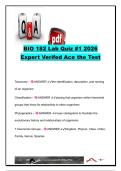
BIO 182 Lab Quiz #1 2026
Expert Verifed Ace the Test


Taxonomy - ANSWER ✔✔the identification, description, and naming

of an organism


Classification - ANSWER ✔✔placing that organism within hierarchal

groups that show its relationship to other organisms


Phylogenetics - ANSWER ✔✔uses cladograms to illustrate the

evolutionary history and relationships of organisms


7 Taxonomic Groups - ANSWER ✔✔Kingdom, Phylum, Class, Order,

Family, Genus, Species

, Cladogram - ANSWER ✔✔A tree diagram showing the evolutionary

relationships among organisms through time based on the Darwinian

principle of common descent


Node - ANSWER ✔✔Common ancestor


Ancestral Trait - ANSWER ✔✔an "old" trait that evolved before the

common ancestor of the group being considered


Derived Trait - ANSWER ✔✔a "new" trait that appeared for the 1st

time in a group, thereby helping to define that group (taxon)


Homologous Trait - ANSWER ✔✔feature shared by two or more

species that has been inherited from a common ancestor


Analogous Trait - ANSWER ✔✔feature shared by two or more

species that serves a similar function, but is not derived from a common

ancestor


Example of Homologous Trait - ANSWER ✔✔Bat wing, mouse

forelimb, human arm


Example of Analogous Trait - ANSWER ✔✔Bat wing, butterfly wing,

bird wing

Document information

Uploaded on
July 27, 2026
Number of pages
8
Written in
2025/2026
Type
Exam (elaborations)
Contains
Questions & answers
$18.99

Wrong document? Swap it for free Within 14 days of purchase and before downloading, you can choose a different document. You can simply spend the amount again.
Written by students who passed
Immediately available after payment
Read online or as PDF

Seller avatar
Reputation scores are based on the amount of documents a seller has sold for a fee and the reviews they have received for those documents. There are three levels: Bronze, Silver and Gold. The better the reputation, the more your can rely on the quality of the sellers work.
NinjaNerd
3.5
(75)
Sold
389
Followers
6
Items
15052
Last sold
3 hours ago


Why students choose Stuvia

Created by fellow students, verified by reviews

Quality you can trust: written by students who passed their tests and reviewed by others who've used these notes.

Didn't get what you expected? Choose another document

No worries! You can instantly pick a different document that better fits what you're looking for.

Pay as you like, start learning right away

No subscription, no commitments. Pay the way you're used to via credit card and download your PDF document instantly.

Student with book image

“Bought, downloaded, and aced it. It really can be that simple.”

Alisha Student

Working on your references?

Create accurate citations in APA, MLA and Harvard with our free citation generator.

Working on your references?

Frequently asked questions

