

Q1
7.12
clear,
clc
gammab_dB = 0:.1:20;
gammab = db2pow(gammab_dB);
Gamma=sqrt(gammab./(gammab+1));
pb_mrc =(((1-Gamma)/2).^2).*(((1+Gamma)/2).^0+2*((1+Gamma)/2).^1);
pb_egc = .5*(1-sqrt(1-(1./(1+gammab)).^2));
semilogy(gammab_dB,pb_mrc,'b')
hold on
semilogy(gammab_dB,pb_egc,'r')
legend('MRC','EGC')
grid on
𝑃̅𝑏
𝛾̅𝑏 (dB)
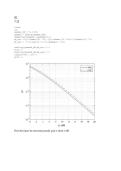
From the figure the maximum penalty gain is about .6 dB.
, Q2
7.20
For MRC, since the = ∑𝑀
𝑖=1 𝛾𝑖 where the path SNR 𝛾𝑖 are independent, it follows that for the
MGF of 𝛾Σ , we have
𝑀
ℳ𝛾Σ (𝑠) = ∏ ℳ𝛾𝑖 (𝑠)
𝑖=1
The rest of the proof is a simple application of the MGF presented in Sections 6.3.3 and 7.4:
2
-
-
7.12
clear,
clc
gammab_dB = 0:.1:20;
gammab = db2pow(gammab_dB);
Gamma=sqrt(gammab./(gammab+1));
pb_mrc =(((1-Gamma)/2).^2).*(((1+Gamma)/2).^0+2*((1+Gamma)/2).^1);
pb_egc = .5*(1-sqrt(1-(1./(1+gammab)).^2));
semilogy(gammab_dB,pb_mrc,'b')
hold on
semilogy(gammab_dB,pb_egc,'r')
legend('MRC','EGC')
grid on
𝑃̅𝑏
𝛾̅𝑏 (dB)
From the figure the maximum penalty gain is about .6 dB.
, Q2
7.20
For MRC, since the = ∑𝑀
𝑖=1 𝛾𝑖 where the path SNR 𝛾𝑖 are independent, it follows that for the
MGF of 𝛾Σ , we have
𝑀
ℳ𝛾Σ (𝑠) = ∏ ℳ𝛾𝑖 (𝑠)
𝑖=1
The rest of the proof is a simple application of the MGF presented in Sections 6.3.3 and 7.4:
2
-
-


