

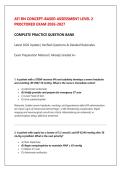
ATI RN CONCEPT-BASED ASSESSMENT LEVEL 2
PROCTORED EXAM 2026-2027
COMPLETE PRACTICE QUESTION BANK
Latest 2026 Update | Verified Questions & Detailed Rationales
Exam Preparation Material | Already Graded A+
1. A patient with a STEMI receives tPA and suddenly develops a severe headache
and vomiting. BP 200/110 mmHg. What is the nurse's immediate action?
• A) Administer antiemetic
• B) Notify provider and prepare for emergency CT scan
• C) Lower head of bed
• D) Give acetaminophen
Rationale: Sudden severe headache, vomiting, and hypertension after tPA administration
are classic signs of intracranial hemorrhage—a life-threatening complication. Rapid
imaging and neurosurgical consult are critical. Administering an antiemetic or
acetaminophen delays definitive treatment.
2. A patient with sepsis has a lactate of 5.2 mmol/L and BP 82/48 mmHg after 30
mL/kg crystalloid. What is the next priority?
• A) Start dopamine
• B) Begin norepinephrine to maintain MAP ≥ 65 mmHg
• C) Obtain CT scan
• D) Administer antibiotics
,Rationale: Fluid-refractory septic shock requires vasopressor support. According to the
Surviving Sepsis Campaign Guidelines, norepinephrine is the first-line vasopressor to
maintain mean arterial pressure (MAP) ≥ 65 mmHg. Antibiotics should have been given
within the first hour of recognition.
3. A patient post-craniotomy has a sudden decrease in LOC and blown pupil. What
is the nurse's first action?
• A) Obtain CT order
• B) Raise head of bed 30° and hyperventilate
• C) Give mannitol
• D) Call family
Rationale: Sudden decreased LOC and blown pupil indicate herniation from increased ICP.
Immediate interventions include elevating the head of bed (HOB) to 30° to promote
venous drainage and hyperventilating to reduce PaCO₂, which causes cerebral
vasoconstriction. These actions buy time while preparing for mannitol or hypertonic saline.
4. A nurse receives report on four patients. Which patient should be assessed first?
• A) Post-op day 2 with incisional pain 5/10
• B) Diabetes with blood glucose 180 mg/dL
• C) COPD with SpO2 88% on 2 L/min oxygen
• D) Heart failure with 1+ pitting edema
Rationale: SpO2 < 90% indicates hypoxemia, which is life-threatening (ABC priority). The
COPD patient requires immediate assessment and intervention to prevent respiratory
failure. Pain, elevated glucose, and mild edema are important but not immediately life-
threatening.
5. A patient with chest pain is prescribed sublingual nitroglycerin. Which finding
indicates the medication is effective?
, • A) Heart rate decreases from 110 to 80
• B) Chest pain decreases from 8/10 to 3/10
• C) Blood pressure increases from 90/60 to 110/70
• D) Respiratory rate decreases from 24 to 16
Rationale: The primary therapeutic effect of nitroglycerin is relief of chest pain by dilating
coronary arteries and reducing myocardial oxygen demand. Pain relief indicates
effectiveness. Heart rate and blood pressure changes may occur but are not the primary
indicators of effectiveness.
6. A patient with heart failure receiving furosemide has a potassium level of 2.8
mEq/L. What is the nurse's priority action?
• A) Administer potassium supplement as ordered
• B) Document the finding and continue monitoring
• C) Increase the furosemide dose
• D) Place the patient on a cardiac monitor and notify the provider
Rationale: Hypokalemia (potassium < 3.5 mEq/L) from loop diuretics can cause life-
threatening cardiac dysrhythmias. The priority is to initiate cardiac monitoring and notify
the provider for potassium replacement orders. Documentation alone is insufficient, and
increasing furosemide would worsen hypokalemia.
7. A patient with diabetes has a blood glucose of 45 mg/dL and is unconscious.
Which action should the nurse take?
• A) Administer 15 g of oral glucose
• B) Give 4 oz of orange juice
• C) Administer glucagon 1 mg IM or IV dextrose 50%
• D) Recheck blood glucose in 15 minutes
Rationale: An unconscious patient cannot safely receive oral glucose due to aspiration risk.
Glucagon IM or IV dextrose is the appropriate treatment for severe hypoglycemia with
altered consciousness. After administration, the patient should be monitored for
improvement and glucose rechecked.
, 8. A patient with COPD is receiving oxygen at 2 L/min via nasal cannula. The nurse
notes the patient is lethargic with a respiratory rate of 8/min. What should the
nurse do first?
• A) Increase oxygen to 4 L/min
• B) Administer a bronchodilator
• C) Decrease the oxygen flow rate and assess ABGs
• D) Prepare for intubation
Rationale: Patients with COPD may have a hypoxic respiratory drive. Excessive oxygen can
suppress this drive, leading to hypoventilation, CO₂ retention, and respiratory acidosis.
Decreasing oxygen and assessing ABGs are priority actions to determine appropriate
oxygenation levels.
9. A patient with a chest tube has continuous bubbling in the water seal chamber.
What is the nurse's priority action?
• A) Document as normal
• B) Increase suction
• C) Assess for an air leak
• D) Clamp the chest tube
Rationale: Continuous bubbling in the water seal chamber indicates an air leak. The nurse
should systematically assess the system for leaks (loose connections, cracks, or site issues).
Intermittent bubbling is normal. Clamping is not the first action and can cause tension
pneumothorax.
10. A patient receiving a blood transfusion develops hives, itching, and shortness
of breath. What is the nurse's priority action?
• A) Slow the infusion rate
• B) Administer diphenhydramine
• C) Stop the transfusion immediately
PROCTORED EXAM 2026-2027
COMPLETE PRACTICE QUESTION BANK
Latest 2026 Update | Verified Questions & Detailed Rationales
Exam Preparation Material | Already Graded A+
1. A patient with a STEMI receives tPA and suddenly develops a severe headache
and vomiting. BP 200/110 mmHg. What is the nurse's immediate action?
• A) Administer antiemetic
• B) Notify provider and prepare for emergency CT scan
• C) Lower head of bed
• D) Give acetaminophen
Rationale: Sudden severe headache, vomiting, and hypertension after tPA administration
are classic signs of intracranial hemorrhage—a life-threatening complication. Rapid
imaging and neurosurgical consult are critical. Administering an antiemetic or
acetaminophen delays definitive treatment.
2. A patient with sepsis has a lactate of 5.2 mmol/L and BP 82/48 mmHg after 30
mL/kg crystalloid. What is the next priority?
• A) Start dopamine
• B) Begin norepinephrine to maintain MAP ≥ 65 mmHg
• C) Obtain CT scan
• D) Administer antibiotics
,Rationale: Fluid-refractory septic shock requires vasopressor support. According to the
Surviving Sepsis Campaign Guidelines, norepinephrine is the first-line vasopressor to
maintain mean arterial pressure (MAP) ≥ 65 mmHg. Antibiotics should have been given
within the first hour of recognition.
3. A patient post-craniotomy has a sudden decrease in LOC and blown pupil. What
is the nurse's first action?
• A) Obtain CT order
• B) Raise head of bed 30° and hyperventilate
• C) Give mannitol
• D) Call family
Rationale: Sudden decreased LOC and blown pupil indicate herniation from increased ICP.
Immediate interventions include elevating the head of bed (HOB) to 30° to promote
venous drainage and hyperventilating to reduce PaCO₂, which causes cerebral
vasoconstriction. These actions buy time while preparing for mannitol or hypertonic saline.
4. A nurse receives report on four patients. Which patient should be assessed first?
• A) Post-op day 2 with incisional pain 5/10
• B) Diabetes with blood glucose 180 mg/dL
• C) COPD with SpO2 88% on 2 L/min oxygen
• D) Heart failure with 1+ pitting edema
Rationale: SpO2 < 90% indicates hypoxemia, which is life-threatening (ABC priority). The
COPD patient requires immediate assessment and intervention to prevent respiratory
failure. Pain, elevated glucose, and mild edema are important but not immediately life-
threatening.
5. A patient with chest pain is prescribed sublingual nitroglycerin. Which finding
indicates the medication is effective?
, • A) Heart rate decreases from 110 to 80
• B) Chest pain decreases from 8/10 to 3/10
• C) Blood pressure increases from 90/60 to 110/70
• D) Respiratory rate decreases from 24 to 16
Rationale: The primary therapeutic effect of nitroglycerin is relief of chest pain by dilating
coronary arteries and reducing myocardial oxygen demand. Pain relief indicates
effectiveness. Heart rate and blood pressure changes may occur but are not the primary
indicators of effectiveness.
6. A patient with heart failure receiving furosemide has a potassium level of 2.8
mEq/L. What is the nurse's priority action?
• A) Administer potassium supplement as ordered
• B) Document the finding and continue monitoring
• C) Increase the furosemide dose
• D) Place the patient on a cardiac monitor and notify the provider
Rationale: Hypokalemia (potassium < 3.5 mEq/L) from loop diuretics can cause life-
threatening cardiac dysrhythmias. The priority is to initiate cardiac monitoring and notify
the provider for potassium replacement orders. Documentation alone is insufficient, and
increasing furosemide would worsen hypokalemia.
7. A patient with diabetes has a blood glucose of 45 mg/dL and is unconscious.
Which action should the nurse take?
• A) Administer 15 g of oral glucose
• B) Give 4 oz of orange juice
• C) Administer glucagon 1 mg IM or IV dextrose 50%
• D) Recheck blood glucose in 15 minutes
Rationale: An unconscious patient cannot safely receive oral glucose due to aspiration risk.
Glucagon IM or IV dextrose is the appropriate treatment for severe hypoglycemia with
altered consciousness. After administration, the patient should be monitored for
improvement and glucose rechecked.
, 8. A patient with COPD is receiving oxygen at 2 L/min via nasal cannula. The nurse
notes the patient is lethargic with a respiratory rate of 8/min. What should the
nurse do first?
• A) Increase oxygen to 4 L/min
• B) Administer a bronchodilator
• C) Decrease the oxygen flow rate and assess ABGs
• D) Prepare for intubation
Rationale: Patients with COPD may have a hypoxic respiratory drive. Excessive oxygen can
suppress this drive, leading to hypoventilation, CO₂ retention, and respiratory acidosis.
Decreasing oxygen and assessing ABGs are priority actions to determine appropriate
oxygenation levels.
9. A patient with a chest tube has continuous bubbling in the water seal chamber.
What is the nurse's priority action?
• A) Document as normal
• B) Increase suction
• C) Assess for an air leak
• D) Clamp the chest tube
Rationale: Continuous bubbling in the water seal chamber indicates an air leak. The nurse
should systematically assess the system for leaks (loose connections, cracks, or site issues).
Intermittent bubbling is normal. Clamping is not the first action and can cause tension
pneumothorax.
10. A patient receiving a blood transfusion develops hives, itching, and shortness
of breath. What is the nurse's priority action?
• A) Slow the infusion rate
• B) Administer diphenhydramine
• C) Stop the transfusion immediately


