

Written by students who passed Immediately available after payment Read online or as PDF Wrong document? Swap it for free 4.6 TrustPilot
logo-home
Document preview thumbnail
Preview 2 out of 5 pages
Exam (elaborations)

Davis Advantage Postpartum Physiological Assessments | 15+ Postpartum Nursing Practice Questions & Answers | Fundal Assessment, Lochia, Uterine Involution, Postpartum Hemorrhage

Document preview thumbnail
Preview 2 out of 5 pages

Prepare for maternal-newborn nursing examinations with this comprehensive Davis Advantage Postpartum Physiological Assessments study guide featuring 15+ NCLEX-style practice questions and verified answers focused on postpartum assessment, maternal physiological adaptation, nursing interventions, and evidence-based postpartum care. This resource reinforces essential concepts through realistic clinical scenarios commonly tested in nursing school exams, ATI Maternal Newborn, HESI Maternity, and the NCLEX-RN. The material provides an in-depth review of postpartum physiological assessments, fundal assessment, uterine involution, lochia evaluation, postpartum hemorrhage recognition and management, uterine atony, oxytocin administration, Rho(D) immune globulin (RhoGAM), postpartum nursing priorities, breastfeeding and non-breastfeeding education, contraception counseling, postpartum pain management, perineal care, sitz bath education, fundal massage, postpartum temperature changes, postpartum thromboembolism assessment, maternal discharge teaching, postpartum complications, vital sign monitoring, postpartum recovery, and priority nursing interventions during the immediate postpartum period. The case-based questions strengthen clinical judgment by emphasizing early recognition of maternal complications, appropriate nursing actions, patient education, medication administration, and safe postpartum care consistent with current nursing standards. Students will enhance their ability to perform systematic postpartum assessments, identify abnormal maternal findings requiring immediate intervention, prioritize evidence-based nursing care, educate postpartum clients and families, and safely manage common postpartum conditions. The content supports mastery of maternal-newborn nursing concepts while preparing learners for classroom examinations, simulation experiences, clinical rotations, standardized testing, and professional licensure. The concepts presented in this study guide align with current maternal-newborn nursing practice standards and evidence-based postpartum care recommendations described in leading obstetric nursing textbooks and professional guidelines published by the Association of Women's Health, Obstetric and Neonatal Nurses (AWHONN) and the American College of Obstetricians and Gynecologists (ACOG). References (APA 7th Edition) Perry, S. E., Hockenberry, M. J., Lowdermilk, D. L., Wilson, D., & Cashion, K. (2025). Maternal Child Nursing Care (8th ed.). Elsevier. Lowdermilk, D. L., Perry, S. E., Cashion, K., & Alden, K. R. (2025). Maternity & Women's Health Care (13th ed.). Elsevier. Association of Women's Health, Obstetric and Neonatal Nurses. (2024). Guidelines for Professional Registered Nurse Staffing for Perinatal Units. AWHONN. American College of Obstetricians and Gynecologists. (2024). Optimizing Postpartum Care. Obstetrics & Gynecology. This study guide is highly recommended for BSN students, ADN/ASN nursing students, accelerated BSN (ABSN) students, maternal-newborn nursing students, obstetric nursing students, maternity nursing students, women's health nursing students, labor and delivery students, postpartum nursing students, NCLEX-RN candidates, ATI Maternal Newborn students, HESI Maternity students, nursing educators, and healthcare professionals preparing for maternal-child nursing examinations, postpartum clinical rotations, competency assessments, and nursing licensure examinations. Keywords Davis Advantage, Davis Advantage Chapter, Postpartum Physiological Assessments, Postpartum Nursing, Maternal Newborn Nursing, Maternity Nursing, Obstetric Nursing, Postpartum Assessment, Fundal Assessment, Fundus Assessment, Lochia Assessment, Uterine Involution, Uterine Atony, Postpartum Hemorrhage, PPH, Fundal Massage, Oxytocin, RhoGAM, Rho D Immune Globulin, Breastfeeding Education, Non-Breastfeeding Care, Postpartum Care, Immediate Postpartum, Postpartum Recovery, Maternal Assessment, Postpartum Complications, Perineal Care, Sitz Bath, Contraception Counseling, Copper IUD, Postpartum Temperature, Thromboembolism, Maternal Health, ATI Maternal Newborn, HESI Maternity, NCLEX Maternity, Women's Health Nursing, Nursing Practice Questions, Nursing Study Guide

Content preview

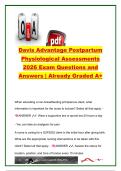
Davis Advantage Postpartum
Physiological Assessments
2026 Exam Questions and
Answers | Already Graded A+


When educating a non-breastfeeding primiparous client, what

information is important for the nurse to include? Select all that apply. -

ANSWER ✔✔- Wear a supportive bra or sports bra 24 hours a day


- You can take an analgesic for pain

A nurse is caring for a G2P2002 client in the initial hour after giving birth.

What are the appropriate nursing interventions to be taken with this

client? Select all that apply. - ANSWER ✔✔- Assess the uterus for

location, position, and tone of fundus every 15 minutes

, - titrate IV oxytocin infusion rate to uterine tone

- Provide information regarding afterpains

- assess lochia for color, amount, and odor

Immediately after birth, the nurse notes the client's fundus is palpated

midway between the umbilicus and symphysis pubis. What is the priority

nursing action? - ANSWER ✔✔Document the findings as within

normal limits

A postpartum nurse is caring for a client who gave birth 1 hour ago

following a 24-hour long induction. The client had an epidural for pain

control during labor. What assessment finding should immediately be

reported to the health-care provider? - ANSWER ✔✔uterine atony


The postpartum nurse is preparing to administer Rho (D) immune

globulin (RhoGAM) to a post-cesarean section client on the mother-baby

unit. What statements made by the client indicate an understanding of

RhoGAM? Select all that apply. - ANSWER ✔✔-"I need this because

my blood type is negative and my baby is positive"

- "This medication will help protect my future babies"

The nurse is reviewing discharge instructions and discussing

contraceptives with a multiparous couple who have a 2-day-old infant.

Document information

Uploaded on
July 27, 2026
Number of pages
5
Written in
2025/2026
Type
Exam (elaborations)
Contains
Questions & answers
$18.99

Wrong document? Swap it for free Within 14 days of purchase and before downloading, you can choose a different document. You can simply spend the amount again.
Written by students who passed
Immediately available after payment
Read online or as PDF

Seller avatar
Reputation scores are based on the amount of documents a seller has sold for a fee and the reviews they have received for those documents. There are three levels: Bronze, Silver and Gold. The better the reputation, the more your can rely on the quality of the sellers work.
PROFFKERRYMARTIN
3.4
(53)
Sold
267
Followers
9
Items
10856
Last sold
1 day ago


Why students choose Stuvia

Created by fellow students, verified by reviews

Quality you can trust: written by students who passed their tests and reviewed by others who've used these notes.

Didn't get what you expected? Choose another document

No worries! You can instantly pick a different document that better fits what you're looking for.

Pay as you like, start learning right away

No subscription, no commitments. Pay the way you're used to via credit card and download your PDF document instantly.

Student with book image

“Bought, downloaded, and aced it. It really can be that simple.”

Alisha Student

Working on your references?

Create accurate citations in APA, MLA and Harvard with our free citation generator.

Working on your references?

Frequently asked questions

