

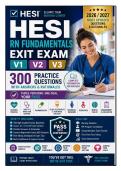
,HESI RN Fundamentals Exit Exam V1 V2 V3: 300 Practice Questions with Answers &
Rationales
Exam Overview
Feature Details
Exam Name HESI RN Fundamentals Exit Exam
Versions Version 1, Version 2, Version 3 (100 questions each)
Total 300
Questions
Format Multiple Choice & NGN-Style
Key Patient safety, infection control, medication administration, nursing
Content process, prioritization (ABCs), fluid/electrolyte balance, mobility,
Areas hygiene, therapeutic communication, documentation, legal/ethical
issues, postoperative care, and fundamentals of nursing
VERSION 1: Fundamentals of Nursing (Questions 1-100)
Patient Safety & Infection Control (1-20)
,1. A nurse is preparing to administer medications to a client. Which action is
most important for ensuring client safety?
A) Check the client's identification using two identifiers
B) Verify the medication dose with another nurse
C) Review the client's allergies before administration
D) Document the medication after administration
Answer: A. The most important action is to check the client's identification using
two client identifiers (e.g., name and date of birth) to ensure the right client
receives the medication. This is a critical safety step per The Joint Commission and
NCLEX standards.
2. A client is placed in restraints after exhibiting violent behavior. Which
intervention should the nurse implement to ensure client safety?
A) Tie the restraints to the bed frame using a quick-release knot
B) Check the restraints every 4 hours
C) Provide a regular diet
D) Remove the restraints every 8 hours
, Answer: A. Restraints should be tied to the bed frame (not the side rails) using a
quick-release knot to allow for rapid removal in an emergency. Restraints must be
checked every 2 hours (not 4), and the client should be offered fluids, nutrition,
and toileting every 2 hours.
3. A nurse is caring for a client on contact precautions. Which personal
protective equipment (PPE) should the nurse wear when entering the client's
room?
A) Gown and gloves
B) N95 respirator and gown
C) Surgical mask and gloves
D) Gloves only
Answer: A. Contact precautions require a gown and gloves. An N95 respirator is
required for airborne precautions; a surgical mask is for droplet precautions.
4. A client is admitted with a suspected Clostridium difficile infection. Which
type of precaution should the nurse implement?
A) Standard precautions
B) Droplet precautions
Rationales
Exam Overview
Feature Details
Exam Name HESI RN Fundamentals Exit Exam
Versions Version 1, Version 2, Version 3 (100 questions each)
Total 300
Questions
Format Multiple Choice & NGN-Style
Key Patient safety, infection control, medication administration, nursing
Content process, prioritization (ABCs), fluid/electrolyte balance, mobility,
Areas hygiene, therapeutic communication, documentation, legal/ethical
issues, postoperative care, and fundamentals of nursing
VERSION 1: Fundamentals of Nursing (Questions 1-100)
Patient Safety & Infection Control (1-20)
,1. A nurse is preparing to administer medications to a client. Which action is
most important for ensuring client safety?
A) Check the client's identification using two identifiers
B) Verify the medication dose with another nurse
C) Review the client's allergies before administration
D) Document the medication after administration
Answer: A. The most important action is to check the client's identification using
two client identifiers (e.g., name and date of birth) to ensure the right client
receives the medication. This is a critical safety step per The Joint Commission and
NCLEX standards.
2. A client is placed in restraints after exhibiting violent behavior. Which
intervention should the nurse implement to ensure client safety?
A) Tie the restraints to the bed frame using a quick-release knot
B) Check the restraints every 4 hours
C) Provide a regular diet
D) Remove the restraints every 8 hours
, Answer: A. Restraints should be tied to the bed frame (not the side rails) using a
quick-release knot to allow for rapid removal in an emergency. Restraints must be
checked every 2 hours (not 4), and the client should be offered fluids, nutrition,
and toileting every 2 hours.
3. A nurse is caring for a client on contact precautions. Which personal
protective equipment (PPE) should the nurse wear when entering the client's
room?
A) Gown and gloves
B) N95 respirator and gown
C) Surgical mask and gloves
D) Gloves only
Answer: A. Contact precautions require a gown and gloves. An N95 respirator is
required for airborne precautions; a surgical mask is for droplet precautions.
4. A client is admitted with a suspected Clostridium difficile infection. Which
type of precaution should the nurse implement?
A) Standard precautions
B) Droplet precautions


