

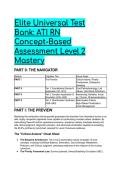
Elite Universal Test
Bank: ATI RN
Concept-Based
Assessment Level 2
Mastery
PART 0: THE NAVIGATOR
Section Cognitive Tier Focus Areas
PART I The Preview Critical Axioms, Priority
Frameworks, & Blueprint
Variables
PART II Tier 1: Foundational Syntax & Core Pathophysiology, Lab
Application (Q1–Q15) Values, Hard Deck Definitions
PART II Tier 2: Complex Application & Intersecting Variables, Acute
Simulation (Q16–Q35) vs. Chronic, Pharmacokinetics
PART II Tier 3: Grandmaster Synthesis Multi-System Failure,
(Q36–Q60) High-Stakes Prioritization,
Crisis Management
PART I: THE PREVIEW
Mastering this exhaustive clinical gauntlet guarantees the transition from theoretical novice to an
elite, highly competent registered nurse capable of synthesizing complex patient variables. By
internalizing these 60 distinct operational scenarios, academic mastery translates directly into
elite clinical judgment, diagnostic precision, and advanced prioritization capable of exceeding
the 60.0% proficiency benchmark required for Level 2 licensure readiness.
The "Critical Axioms" Cheat Sheet
● The Blueprint Architecture: The Level 2 examination strictly evaluates 16 core
concepts, including Acid-Base Balance, Elimination, Gas Exchange, Metabolism,
Perfusion, and Clinical Judgment, assessing readiness at the midpoint of the nursing
curriculum.
● The Priority Framework Law: Survival potential, Airway-Breathing-Circulation (ABC),
, and Safety/Risk Reduction universally supersede all chronic, psychosocial, or standard
physiological concerns.
● The Clinical Judgment Action Model (CJMM): The clinical process dictates that
recognizing cues (assessment) must explicitly precede analyzing cues, prioritizing
hypotheses, and generating solutions (intervention).
● The Electrolyte & Acid-Base Axiom: Cellular stability relies strictly on narrow reference
ranges; magnesium (1.3-2.1 mEq/L) and potassium (3.5-5.0 mEq/L) shifts directly dictate
cardiac stability, while pH (7.35-7.45) dictates systemic enzymatic survival.
● The Delegation Directive: The nursing process, clinical judgment, and initial patient
education can never be delegated to unlicensed assistive personnel (UAP) under any
circumstances.
PART II: THE ELITE TEST BANK
Q1: A client presents to the emergency department with a respiratory rate of 8 breaths per
minute, a PaCO2 of 55 mm Hg, a pH of 7.31, and an HCO3 of 24 mEq/L. Based on the
principles of Acid-Base Balance, which physiological state is the MOST ACCURATE
representation of this clinical picture? A) Uncompensated metabolic acidosis. B) Partially
compensated respiratory acidosis. C) Uncompensated respiratory acidosis. D) Fully
compensated metabolic alkalosis.
● The Answer: C (Uncompensated respiratory acidosis.)
● Distractor Analysis:
○ A is incorrect: Metabolic acidosis is defined by a primary deficit in bicarbonate
(HCO3), which is currently within the expected reference range of 22-26 mEq/L.
○ B is incorrect: Partial compensation strictly requires an elevated bicarbonate level
as the kidneys attempt to buffer the acidotic state, which has not yet occurred.
○ D is incorrect: Alkalosis requires a pH strictly greater than 7.45.
The Mentor's Analysis: The clinical presentation indicates an excess of carbon dioxide due to
profound hypoventilation. Because the bicarbonate level remains within the normal reference
range, the renal system has not yet initiated a compensatory metabolic response.
Professional/Academic Intuition: Elevated PaCO2 coupled with a low pH unequivocally
indicates an acute respiratory failure to ventilate, demanding immediate airway management.
Q2: A nurse is assessing a client who has been ingesting magnesium-based antacids frequently
for severe gastrointestinal distress. The assessment findings include profound drowsiness,
muscle weakness, bradycardia, and hypotension. Based on the principles of Fluid & Electrolyte
Balance, which electrolyte imbalance is the MOST ACCURATE suspicion? A)
Hypophosphatemia B) Hypernatremia C) Hypomagnesemia D) Hypermagnesemia
● The Answer: D (Hypermagnesemia)
● Distractor Analysis:
○ A is incorrect: Hypophosphatemia typically presents with neurologic depression but
is unrelated to the exogenous consumption of magnesium antacids.
○ B is incorrect: Hypernatremia presents with extreme thirst, cellular dehydration, and
hyperreflexia, not hyporeflexia and weakness.
○ C is incorrect: Hypomagnesemia is characterized by neuromuscular excitability,
including hyperactive deep tendon reflexes, tremors, and tachycardia, not
bradycardia and weakness.
The Mentor's Analysis: Excessive ingestion of exogenous magnesium overtakes the renal
,excretion threshold, leading to an accumulation of extracellular magnesium. When evaluating
central nervous system and cardiac depression, hypermagnesemia suppresses neuromuscular
transmission. By recognizing the exogenous source, the clinician bypasses the common trap of
assuming a deficit. Professional/Academic Intuition: Magnesium acts as a physiological
sedative; elevated levels predictably slow the heart, drop the blood pressure, and abolish deep
tendon reflexes.
Q3: A school-age child with diabetes mellitus presents to the clinic exhibiting a blood glucose
level of 250 mg/dL. Based on the principles of Metabolism, which assessment finding is the
MOST ACCURATE expectation? A) Hyperreflexia B) A fruity, acetone breath odor C) Profuse
diaphoresis D) Shallow, depressed respirations
● The Answer: B (A fruity, acetone breath odor)
● Distractor Analysis:
○ A is incorrect: Hyperreflexia is typically associated with electrolyte derangements
such as hypocalcemia, not isolated hyperglycemia.
○ C is incorrect: Profuse diaphoresis is a classic autonomic manifestation of
hypoglycemia, whereas hyperglycemia typically causes osmotic diuresis and
subsequent cellular dehydration.
○ D is incorrect: Shallow respirations occur in alkalotic states; diabetic ketoacidosis
triggers Kussmaul respirations to blow off excess carbon dioxide.
The Mentor's Analysis: In the absence of insulin, the body rapidly shifts to lipid metabolism,
resulting in the byproduct formation of circulating ketones. When facing diabetic ketoacidosis,
the respiratory system compensates by attempting to expel volatile acids via the lungs, creating
the characteristic fruity odor. Professional/Academic Intuition: A fruity breath odor in the
presence of hyperglycemia is the cardinal clinical marker of systemic ketosis requiring
immediate insulin and fluid resuscitation.
Q4: A client with a documented history of peptic ulcer disease reports feeling dizzy and
fatigued. The nurse reviews the daily laboratory values and notes a hemoglobin level of 7.6
g/dL. Based on the principles of Inflammation and Tissue Integrity, which manifestation should
the nurse proactively assess for FIRST? A) Hyperactive, high-pitched bowel sounds. B)
Frequent episodes of dyspepsia during the morning hours. C) The presence of melena in the
stool. D) A recent weight gain of 1.4 kg over the past two weeks.
● The Answer: C (The presence of melena in the stool.)
● Distractor Analysis:
○ A is incorrect: Hyperactive bowel sounds are associated with early mechanical
obstruction or gastroenteritis, not primarily with the sequelae of a bleeding ulcer.
○ B is incorrect: Dyspepsia is a symptom of the ulcer itself, but it does not
independently explain the acute, severe drop in hemoglobin.
○ D is incorrect: Weight gain is indicative of fluid retention or caloric surplus, whereas
chronic blood loss typically causes weakness and potential weight loss over time.
The Mentor's Analysis: A significantly diminished hemoglobin level (expected reference range
12-18 g/dL) in the presence of peptic ulcer disease strongly suggests active or subacute
gastrointestinal bleeding. When facing a low oxygen-carrying capacity, the immediate priority is
identifying the source of the hemorrhage. By assessing for melena (black, tarry stools), the
clinician confirms upper gastrointestinal blood digestion. Professional/Academic Intuition:
Anemia in a patient with a gastric ulcer is a hemorrhage until proven otherwise; always inspect
the stool for digested blood.
Q5: A client newly diagnosed with asthma receives a prescription for an albuterol metered-dose
inhaler. Based on the principles of Gas Exchange and Pharmacology, which instruction
, regarding the use of this medication is the MOST ACCURATE? A) "Utilize this inhaler daily to
prevent the inflammatory response in your airways." B) "Use this inhaler strictly during an acute
attack or prior to engaging in strenuous exercise." C) "Administer this medication immediately
after using your fluticasone inhaler." D) "Expect a decrease in your heart rate for several
minutes following administration."
● The Answer: B ("Use this inhaler strictly during an acute attack or prior to engaging in
strenuous exercise.")
● Distractor Analysis:
○ A is incorrect: Albuterol is a short-acting beta-2 agonist (SABA) with zero
anti-inflammatory properties; it is a rescue drug, not a daily prophylactic controller.
○ C is incorrect: Bronchodilators must always be administered before corticosteroids
to open the airways, maximizing the surface area for the subsequent steroid
deposition.
○ D is incorrect: Beta-2 agonists inherently trigger cross-receptor sympathetic
stimulation, causing tachycardia and tremors, not bradycardia.
The Mentor's Analysis: Short-acting beta-agonists act rapidly on the smooth muscle of the
bronchioles to reverse acute bronchospasm. When facing acute airway constriction, the
immediate priority is rapid smooth muscle relaxation. By isolating albuterol as a rescue
medication, the common novice error of confusing it with long-term inhaled corticosteroids is
bypassed. Professional/Academic Intuition: Albuterol is the definitive rescue agent; it dilates
the airways rapidly but does absolutely nothing to cure the underlying inflammation.
Q6: A nurse is reviewing the laboratory results of an adult client admitted with profound lethargy.
The serum sodium level is 120 mEq/L. Based on the principles of Fluid & Electrolyte Balance,
which clinical intervention is IMMEDIATELY indicated? A) Initiate a rapid infusion of 3% Sodium
Chloride. B) Encourage ad libitum oral water intake. C) Implement strict seizure precautions and
neuro-monitoring. D) Administer a high-dose loop diuretic to excrete sodium.
● The Answer: C (Implement strict seizure precautions and neuro-monitoring.)
● Distractor Analysis:
○ A is incorrect: While hypertonic saline may be indicated, rapid infusion causes
osmotic demyelination syndrome (central pontine myelinolysis); it must be titrated
precisely via a central line.
○ B is incorrect: Free water intake will further dilute the vascular space, exacerbating
the hyponatremia and precipitating cerebral edema.
○ D is incorrect: Loop diuretics excrete sodium alongside water, which would
indiscriminately worsen the total body sodium deficit.
The Mentor's Analysis: Severe hyponatremia creates a hypotonic extracellular environment,
causing fluid to shift rapidly into the intracellular space, particularly the neurons. When facing a
sodium level of 120 mEq/L (expected range 135-145 mEq/L) , the immediate priority is
anticipating cerebral edema. By initiating seizure precautions, the clinician prioritizes
Safety/Risk Reduction frameworks. Professional/Academic Intuition: Sodium dictates brain
volume. Severe hyponatremia equals a swollen brain, mandating absolute vigilance for seizure
activity.
Q7: A client is undergoing teaching regarding a newly prescribed extended-release metformin
tablet for type 2 diabetes mellitus. Based on the principles of Pharmacology and
Teaching/Learning, which client statement indicates a CRITICAL misunderstanding requiring
immediate correction? A) "I will monitor my blood sugar closely if I feel shaky or sweaty." B) "I
will crush the tablet and mix it in applesauce if it is too large to swallow." C) "I will take this
medication consistently with my evening meal." D) "I am aware that this medication might
Bank: ATI RN
Concept-Based
Assessment Level 2
Mastery
PART 0: THE NAVIGATOR
Section Cognitive Tier Focus Areas
PART I The Preview Critical Axioms, Priority
Frameworks, & Blueprint
Variables
PART II Tier 1: Foundational Syntax & Core Pathophysiology, Lab
Application (Q1–Q15) Values, Hard Deck Definitions
PART II Tier 2: Complex Application & Intersecting Variables, Acute
Simulation (Q16–Q35) vs. Chronic, Pharmacokinetics
PART II Tier 3: Grandmaster Synthesis Multi-System Failure,
(Q36–Q60) High-Stakes Prioritization,
Crisis Management
PART I: THE PREVIEW
Mastering this exhaustive clinical gauntlet guarantees the transition from theoretical novice to an
elite, highly competent registered nurse capable of synthesizing complex patient variables. By
internalizing these 60 distinct operational scenarios, academic mastery translates directly into
elite clinical judgment, diagnostic precision, and advanced prioritization capable of exceeding
the 60.0% proficiency benchmark required for Level 2 licensure readiness.
The "Critical Axioms" Cheat Sheet
● The Blueprint Architecture: The Level 2 examination strictly evaluates 16 core
concepts, including Acid-Base Balance, Elimination, Gas Exchange, Metabolism,
Perfusion, and Clinical Judgment, assessing readiness at the midpoint of the nursing
curriculum.
● The Priority Framework Law: Survival potential, Airway-Breathing-Circulation (ABC),
, and Safety/Risk Reduction universally supersede all chronic, psychosocial, or standard
physiological concerns.
● The Clinical Judgment Action Model (CJMM): The clinical process dictates that
recognizing cues (assessment) must explicitly precede analyzing cues, prioritizing
hypotheses, and generating solutions (intervention).
● The Electrolyte & Acid-Base Axiom: Cellular stability relies strictly on narrow reference
ranges; magnesium (1.3-2.1 mEq/L) and potassium (3.5-5.0 mEq/L) shifts directly dictate
cardiac stability, while pH (7.35-7.45) dictates systemic enzymatic survival.
● The Delegation Directive: The nursing process, clinical judgment, and initial patient
education can never be delegated to unlicensed assistive personnel (UAP) under any
circumstances.
PART II: THE ELITE TEST BANK
Q1: A client presents to the emergency department with a respiratory rate of 8 breaths per
minute, a PaCO2 of 55 mm Hg, a pH of 7.31, and an HCO3 of 24 mEq/L. Based on the
principles of Acid-Base Balance, which physiological state is the MOST ACCURATE
representation of this clinical picture? A) Uncompensated metabolic acidosis. B) Partially
compensated respiratory acidosis. C) Uncompensated respiratory acidosis. D) Fully
compensated metabolic alkalosis.
● The Answer: C (Uncompensated respiratory acidosis.)
● Distractor Analysis:
○ A is incorrect: Metabolic acidosis is defined by a primary deficit in bicarbonate
(HCO3), which is currently within the expected reference range of 22-26 mEq/L.
○ B is incorrect: Partial compensation strictly requires an elevated bicarbonate level
as the kidneys attempt to buffer the acidotic state, which has not yet occurred.
○ D is incorrect: Alkalosis requires a pH strictly greater than 7.45.
The Mentor's Analysis: The clinical presentation indicates an excess of carbon dioxide due to
profound hypoventilation. Because the bicarbonate level remains within the normal reference
range, the renal system has not yet initiated a compensatory metabolic response.
Professional/Academic Intuition: Elevated PaCO2 coupled with a low pH unequivocally
indicates an acute respiratory failure to ventilate, demanding immediate airway management.
Q2: A nurse is assessing a client who has been ingesting magnesium-based antacids frequently
for severe gastrointestinal distress. The assessment findings include profound drowsiness,
muscle weakness, bradycardia, and hypotension. Based on the principles of Fluid & Electrolyte
Balance, which electrolyte imbalance is the MOST ACCURATE suspicion? A)
Hypophosphatemia B) Hypernatremia C) Hypomagnesemia D) Hypermagnesemia
● The Answer: D (Hypermagnesemia)
● Distractor Analysis:
○ A is incorrect: Hypophosphatemia typically presents with neurologic depression but
is unrelated to the exogenous consumption of magnesium antacids.
○ B is incorrect: Hypernatremia presents with extreme thirst, cellular dehydration, and
hyperreflexia, not hyporeflexia and weakness.
○ C is incorrect: Hypomagnesemia is characterized by neuromuscular excitability,
including hyperactive deep tendon reflexes, tremors, and tachycardia, not
bradycardia and weakness.
The Mentor's Analysis: Excessive ingestion of exogenous magnesium overtakes the renal
,excretion threshold, leading to an accumulation of extracellular magnesium. When evaluating
central nervous system and cardiac depression, hypermagnesemia suppresses neuromuscular
transmission. By recognizing the exogenous source, the clinician bypasses the common trap of
assuming a deficit. Professional/Academic Intuition: Magnesium acts as a physiological
sedative; elevated levels predictably slow the heart, drop the blood pressure, and abolish deep
tendon reflexes.
Q3: A school-age child with diabetes mellitus presents to the clinic exhibiting a blood glucose
level of 250 mg/dL. Based on the principles of Metabolism, which assessment finding is the
MOST ACCURATE expectation? A) Hyperreflexia B) A fruity, acetone breath odor C) Profuse
diaphoresis D) Shallow, depressed respirations
● The Answer: B (A fruity, acetone breath odor)
● Distractor Analysis:
○ A is incorrect: Hyperreflexia is typically associated with electrolyte derangements
such as hypocalcemia, not isolated hyperglycemia.
○ C is incorrect: Profuse diaphoresis is a classic autonomic manifestation of
hypoglycemia, whereas hyperglycemia typically causes osmotic diuresis and
subsequent cellular dehydration.
○ D is incorrect: Shallow respirations occur in alkalotic states; diabetic ketoacidosis
triggers Kussmaul respirations to blow off excess carbon dioxide.
The Mentor's Analysis: In the absence of insulin, the body rapidly shifts to lipid metabolism,
resulting in the byproduct formation of circulating ketones. When facing diabetic ketoacidosis,
the respiratory system compensates by attempting to expel volatile acids via the lungs, creating
the characteristic fruity odor. Professional/Academic Intuition: A fruity breath odor in the
presence of hyperglycemia is the cardinal clinical marker of systemic ketosis requiring
immediate insulin and fluid resuscitation.
Q4: A client with a documented history of peptic ulcer disease reports feeling dizzy and
fatigued. The nurse reviews the daily laboratory values and notes a hemoglobin level of 7.6
g/dL. Based on the principles of Inflammation and Tissue Integrity, which manifestation should
the nurse proactively assess for FIRST? A) Hyperactive, high-pitched bowel sounds. B)
Frequent episodes of dyspepsia during the morning hours. C) The presence of melena in the
stool. D) A recent weight gain of 1.4 kg over the past two weeks.
● The Answer: C (The presence of melena in the stool.)
● Distractor Analysis:
○ A is incorrect: Hyperactive bowel sounds are associated with early mechanical
obstruction or gastroenteritis, not primarily with the sequelae of a bleeding ulcer.
○ B is incorrect: Dyspepsia is a symptom of the ulcer itself, but it does not
independently explain the acute, severe drop in hemoglobin.
○ D is incorrect: Weight gain is indicative of fluid retention or caloric surplus, whereas
chronic blood loss typically causes weakness and potential weight loss over time.
The Mentor's Analysis: A significantly diminished hemoglobin level (expected reference range
12-18 g/dL) in the presence of peptic ulcer disease strongly suggests active or subacute
gastrointestinal bleeding. When facing a low oxygen-carrying capacity, the immediate priority is
identifying the source of the hemorrhage. By assessing for melena (black, tarry stools), the
clinician confirms upper gastrointestinal blood digestion. Professional/Academic Intuition:
Anemia in a patient with a gastric ulcer is a hemorrhage until proven otherwise; always inspect
the stool for digested blood.
Q5: A client newly diagnosed with asthma receives a prescription for an albuterol metered-dose
inhaler. Based on the principles of Gas Exchange and Pharmacology, which instruction
, regarding the use of this medication is the MOST ACCURATE? A) "Utilize this inhaler daily to
prevent the inflammatory response in your airways." B) "Use this inhaler strictly during an acute
attack or prior to engaging in strenuous exercise." C) "Administer this medication immediately
after using your fluticasone inhaler." D) "Expect a decrease in your heart rate for several
minutes following administration."
● The Answer: B ("Use this inhaler strictly during an acute attack or prior to engaging in
strenuous exercise.")
● Distractor Analysis:
○ A is incorrect: Albuterol is a short-acting beta-2 agonist (SABA) with zero
anti-inflammatory properties; it is a rescue drug, not a daily prophylactic controller.
○ C is incorrect: Bronchodilators must always be administered before corticosteroids
to open the airways, maximizing the surface area for the subsequent steroid
deposition.
○ D is incorrect: Beta-2 agonists inherently trigger cross-receptor sympathetic
stimulation, causing tachycardia and tremors, not bradycardia.
The Mentor's Analysis: Short-acting beta-agonists act rapidly on the smooth muscle of the
bronchioles to reverse acute bronchospasm. When facing acute airway constriction, the
immediate priority is rapid smooth muscle relaxation. By isolating albuterol as a rescue
medication, the common novice error of confusing it with long-term inhaled corticosteroids is
bypassed. Professional/Academic Intuition: Albuterol is the definitive rescue agent; it dilates
the airways rapidly but does absolutely nothing to cure the underlying inflammation.
Q6: A nurse is reviewing the laboratory results of an adult client admitted with profound lethargy.
The serum sodium level is 120 mEq/L. Based on the principles of Fluid & Electrolyte Balance,
which clinical intervention is IMMEDIATELY indicated? A) Initiate a rapid infusion of 3% Sodium
Chloride. B) Encourage ad libitum oral water intake. C) Implement strict seizure precautions and
neuro-monitoring. D) Administer a high-dose loop diuretic to excrete sodium.
● The Answer: C (Implement strict seizure precautions and neuro-monitoring.)
● Distractor Analysis:
○ A is incorrect: While hypertonic saline may be indicated, rapid infusion causes
osmotic demyelination syndrome (central pontine myelinolysis); it must be titrated
precisely via a central line.
○ B is incorrect: Free water intake will further dilute the vascular space, exacerbating
the hyponatremia and precipitating cerebral edema.
○ D is incorrect: Loop diuretics excrete sodium alongside water, which would
indiscriminately worsen the total body sodium deficit.
The Mentor's Analysis: Severe hyponatremia creates a hypotonic extracellular environment,
causing fluid to shift rapidly into the intracellular space, particularly the neurons. When facing a
sodium level of 120 mEq/L (expected range 135-145 mEq/L) , the immediate priority is
anticipating cerebral edema. By initiating seizure precautions, the clinician prioritizes
Safety/Risk Reduction frameworks. Professional/Academic Intuition: Sodium dictates brain
volume. Severe hyponatremia equals a swollen brain, mandating absolute vigilance for seizure
activity.
Q7: A client is undergoing teaching regarding a newly prescribed extended-release metformin
tablet for type 2 diabetes mellitus. Based on the principles of Pharmacology and
Teaching/Learning, which client statement indicates a CRITICAL misunderstanding requiring
immediate correction? A) "I will monitor my blood sugar closely if I feel shaky or sweaty." B) "I
will crush the tablet and mix it in applesauce if it is too large to swallow." C) "I will take this
medication consistently with my evening meal." D) "I am aware that this medication might


