

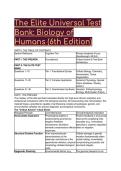
The Elite Universal Test
Bank: Biology of
Humans (6th Edition)
PART 0: THE TABLE OF CONTENTS
Section Reference Cognitive Tier Primary Academic Focus
(Goodenough, 6th Ed.)
PART I: THE PREVIEW Foundational Critical Axioms & Test Bank
Architecture
PART II: THE ELITE TEST
BANK
Questions 1–10 Tier 1: Foundational Syntax Cellular Biology, Chemistry,
Homeostasis, Tissue
Organization
Questions 11–20 Tier 2: Complex Application Systemic Physiology, Special
Topics (Diabetes, Obesity,
Autism)
Questions 21–30 Tier 3: Grandmaster Synthesis Genetics, Pathophysiology,
Ecology, Multi-System Failure
PART I: THE PREVIEW
The mastery of this elite test bank translates directly into high-level clinical, analytical, and
professional competence within the biological sciences. By transcending rote memorization, this
material forges a practitioner capable of synthesizing complex physiological, genetic, and
environmental variables into precise diagnostic and analytical conclusions.
The "Critical Axioms" Cheat Sheet:
Biological Principle Core Mechanism Clinical/Analytical Implication
Homeostatic Imperative Physiological stability is Positive feedback is exclusively
predominantly governed by reserved for amplifying finite
negative feedback cascades (e.g., hemostasis,
mechanisms; deviations parturition); systemic regulation
mandate compensatory effector relies on negation.
responses.
Structure Dictates Function From macromolecular Cellular damage or genetic
stereochemistry to the mutation fundamentally alters
trabecular architecture of the protein folding, immediately
appendicular skeleton, physical compromising enzymatic and
morphology dictates biological structural integrity.
limits.
Epigenetic Plasticity Environmental factors (e.g., The genomic blueprint is not
,Biological Principle Core Mechanism Clinical/Analytical Implication
maternal nutrition) dynamically rigid; lifestyle and environment
modify gene expression via program the functional software
methylation without altering the of metabolism and disease
DNA sequence. predisposition.
Metabolic Continuity ATP generation via cellular Hypoxia triggers a rapid
respiration dictates survival; transition to anaerobic
oxygen serves as the terminal fermentation, severely limiting
electron acceptor in oxidative energy yield and causing
phosphorylation. localized lactic acidosis.
PART II: THE ELITE TEST BANK
Q1: An interdisciplinary medical team is evaluating a patient's capacity to digest specific
macromolecules following a localized ischemic event in the gastrointestinal tract. The patient
exhibits profound inability to enzymatically hydrolyze dietary lipids, despite possessing a fully
functional hepatic and biliary system. Based on the principles of the digestive system and
accessory organ function, which action/conclusion is the MOST ACCURATE? A) The patient's
liver has ceased the production of proteases, preventing the mechanical breakdown of fat
globules. B) The patient has suffered severe damage to the exocrine pancreas, completely
halting the synthesis and secretion of pancreatic lipases. C) The gallbladder has ruptured,
causing bile salts to chemically digest the intestinal lining rather than the dietary lipids. D) The
patient's stomach has ceased the production of intrinsic factor, which is the primary enzyme
responsible for lipid hydrolysis.
● Answer/Respuesta/Réponse: B (The patient has suffered severe damage to the
exocrine pancreas, completely halting the synthesis and secretion of pancreatic lipases.)
● Distractor Analysis:
○ A is incorrect: The liver produces bile, which is an emulsifier, not an enzyme
(protease digests protein, not fat). Emulsification is mechanical, not enzymatic
hydrolysis.
○ C is incorrect: Bile salts do not chemically digest anything; they physically disperse
large lipid droplets into smaller micelles to increase the surface area for enzymes to
act upon.
○ D is incorrect: Intrinsic factor is synthesized in the stomach, but its sole
physiological purpose is the binding and absorption of Vitamin B12, having zero role
in lipid digestion.
The Mentor's Analysis: Understanding the division of labor in the digestive tract is essential for
isolating gastrointestinal pathologies. When facing a failure in chemical lipid digestion despite
functional emulsification, the immediate priority is evaluating the primary source of digestive
enzymes. By utilizing pancreatic exocrine profiling, you bypass the common trap of assuming
the liver or gallbladder chemically digests fat. Professional/Academic Intuition: Bile
mechanically emulsifies; pancreatic lipase chemically digests. One prepares the surface
area; the other breaks the molecular bonds.
Q2: A pharmaceutical corporation initiates human testing for a novel neuro-modulatory
compound. The investigative team administers the drug to a small, carefully monitored cohort of
healthy volunteers to determine the effective dosage range, establish pharmacokinetic profiles,
and identify acute toxicities. Based on the protocols outlined in Special Topic: Becoming a
Patient, which action/conclusion is the MOST ACCURATE? A) The drug has bypassed
preliminary safety checks and is currently undergoing Phase III efficacy trials against a placebo.
, B) The investigative team is currently conducting a Phase I clinical trial, which inherently
prioritizes physiological safety over therapeutic efficacy. C) The researchers are conducting an
epidemiological cohort study to determine the long-term environmental impacts of the drug. D)
The compound is exempt from traditional trial phases because it acts directly on the central
nervous system, requiring immediate Phase II implementation.
● Answer/Respuesta/Réponse: B (The investigative team is currently conducting a Phase
I clinical trial, which inherently prioritizes physiological safety over therapeutic efficacy.)
● Distractor Analysis:
○ A is incorrect: Phase III trials involve thousands of patients who actually suffer from
the condition being treated, strictly to compare efficacy against standard treatments.
○ C is incorrect: Epidemiological cohort studies are observational and analyze
population-level patterns over time; they do not involve the active administration of
unapproved, novel pharmaceuticals to healthy volunteers.
○ D is incorrect: No pharmacological intervention is exempt from Phase I safety
testing. Drugs targeting the central nervous system require even more rigorous
initial safety profiling due to the blood-brain barrier.
The Mentor's Analysis: The pathway of pharmaceutical validation is rigid and sequential.
When facing initial human exposure to a novel compound, the immediate priority is establishing
a baseline of physiological tolerance. By utilizing Phase I safety protocols, you bypass the
common trap of exposing vulnerable patient populations to uncharacterized and potentially
lethal toxicities. Professional/Academic Intuition: Safety precedes efficacy; Phase I trials
establish physiological tolerance in healthy individuals prior to targeted therapeutic
application.
Q3: An individual transitions from a freezing external environment into a heavily heated room.
The core body temperature briefly spikes above the homeostatic set point. The hypothalamus
detects this shift and immediately initiates cutaneous vasodilation and eccrine gland secretion.
Once the core temperature normalizes, these responses cease. Based on the principles of body
organization and homeostasis, which action/conclusion is the MOST ACCURATE? A) The
cessation of sweating represents a positive feedback loop that amplifies the initial temperature
spike to achieve cellular equilibrium. B) The body's response relies on feed-forward
mechanisms that anticipate future heat exposure and permanently alter the hypothalamic set
point. C) The regulation is governed by a negative feedback mechanism, where the effector
action negates the original stimulus to restore baseline stability. D) The hypothalamus
undergoes rapid apoptosis once the core temperature drops below the physiological set point,
allowing peripheral nerves to take over.
● Answer/Respuesta/Réponse: C (The regulation is governed by a negative feedback
mechanism, where the effector action negates the original stimulus to restore baseline
stability.)
● Distractor Analysis:
○ A is incorrect: Positive feedback amplifies a stimulus (e.g., oxytocin during
parturition). Thermoregulation fundamentally operates by negating or reversing the
stimulus to maintain a narrow physiological window.
○ B is incorrect: Feed-forward mechanisms anticipate physiological changes (e.g.,
salivation before a meal). This scenario describes a direct, reactionary cascade to
an already established deviation in core temperature.
○ D is incorrect: The hypothalamus is the central integrating center for autonomic
function; it does not undergo apoptosis (programmed cell death) during normal
homeostatic regulation.
Bank: Biology of
Humans (6th Edition)
PART 0: THE TABLE OF CONTENTS
Section Reference Cognitive Tier Primary Academic Focus
(Goodenough, 6th Ed.)
PART I: THE PREVIEW Foundational Critical Axioms & Test Bank
Architecture
PART II: THE ELITE TEST
BANK
Questions 1–10 Tier 1: Foundational Syntax Cellular Biology, Chemistry,
Homeostasis, Tissue
Organization
Questions 11–20 Tier 2: Complex Application Systemic Physiology, Special
Topics (Diabetes, Obesity,
Autism)
Questions 21–30 Tier 3: Grandmaster Synthesis Genetics, Pathophysiology,
Ecology, Multi-System Failure
PART I: THE PREVIEW
The mastery of this elite test bank translates directly into high-level clinical, analytical, and
professional competence within the biological sciences. By transcending rote memorization, this
material forges a practitioner capable of synthesizing complex physiological, genetic, and
environmental variables into precise diagnostic and analytical conclusions.
The "Critical Axioms" Cheat Sheet:
Biological Principle Core Mechanism Clinical/Analytical Implication
Homeostatic Imperative Physiological stability is Positive feedback is exclusively
predominantly governed by reserved for amplifying finite
negative feedback cascades (e.g., hemostasis,
mechanisms; deviations parturition); systemic regulation
mandate compensatory effector relies on negation.
responses.
Structure Dictates Function From macromolecular Cellular damage or genetic
stereochemistry to the mutation fundamentally alters
trabecular architecture of the protein folding, immediately
appendicular skeleton, physical compromising enzymatic and
morphology dictates biological structural integrity.
limits.
Epigenetic Plasticity Environmental factors (e.g., The genomic blueprint is not
,Biological Principle Core Mechanism Clinical/Analytical Implication
maternal nutrition) dynamically rigid; lifestyle and environment
modify gene expression via program the functional software
methylation without altering the of metabolism and disease
DNA sequence. predisposition.
Metabolic Continuity ATP generation via cellular Hypoxia triggers a rapid
respiration dictates survival; transition to anaerobic
oxygen serves as the terminal fermentation, severely limiting
electron acceptor in oxidative energy yield and causing
phosphorylation. localized lactic acidosis.
PART II: THE ELITE TEST BANK
Q1: An interdisciplinary medical team is evaluating a patient's capacity to digest specific
macromolecules following a localized ischemic event in the gastrointestinal tract. The patient
exhibits profound inability to enzymatically hydrolyze dietary lipids, despite possessing a fully
functional hepatic and biliary system. Based on the principles of the digestive system and
accessory organ function, which action/conclusion is the MOST ACCURATE? A) The patient's
liver has ceased the production of proteases, preventing the mechanical breakdown of fat
globules. B) The patient has suffered severe damage to the exocrine pancreas, completely
halting the synthesis and secretion of pancreatic lipases. C) The gallbladder has ruptured,
causing bile salts to chemically digest the intestinal lining rather than the dietary lipids. D) The
patient's stomach has ceased the production of intrinsic factor, which is the primary enzyme
responsible for lipid hydrolysis.
● Answer/Respuesta/Réponse: B (The patient has suffered severe damage to the
exocrine pancreas, completely halting the synthesis and secretion of pancreatic lipases.)
● Distractor Analysis:
○ A is incorrect: The liver produces bile, which is an emulsifier, not an enzyme
(protease digests protein, not fat). Emulsification is mechanical, not enzymatic
hydrolysis.
○ C is incorrect: Bile salts do not chemically digest anything; they physically disperse
large lipid droplets into smaller micelles to increase the surface area for enzymes to
act upon.
○ D is incorrect: Intrinsic factor is synthesized in the stomach, but its sole
physiological purpose is the binding and absorption of Vitamin B12, having zero role
in lipid digestion.
The Mentor's Analysis: Understanding the division of labor in the digestive tract is essential for
isolating gastrointestinal pathologies. When facing a failure in chemical lipid digestion despite
functional emulsification, the immediate priority is evaluating the primary source of digestive
enzymes. By utilizing pancreatic exocrine profiling, you bypass the common trap of assuming
the liver or gallbladder chemically digests fat. Professional/Academic Intuition: Bile
mechanically emulsifies; pancreatic lipase chemically digests. One prepares the surface
area; the other breaks the molecular bonds.
Q2: A pharmaceutical corporation initiates human testing for a novel neuro-modulatory
compound. The investigative team administers the drug to a small, carefully monitored cohort of
healthy volunteers to determine the effective dosage range, establish pharmacokinetic profiles,
and identify acute toxicities. Based on the protocols outlined in Special Topic: Becoming a
Patient, which action/conclusion is the MOST ACCURATE? A) The drug has bypassed
preliminary safety checks and is currently undergoing Phase III efficacy trials against a placebo.
, B) The investigative team is currently conducting a Phase I clinical trial, which inherently
prioritizes physiological safety over therapeutic efficacy. C) The researchers are conducting an
epidemiological cohort study to determine the long-term environmental impacts of the drug. D)
The compound is exempt from traditional trial phases because it acts directly on the central
nervous system, requiring immediate Phase II implementation.
● Answer/Respuesta/Réponse: B (The investigative team is currently conducting a Phase
I clinical trial, which inherently prioritizes physiological safety over therapeutic efficacy.)
● Distractor Analysis:
○ A is incorrect: Phase III trials involve thousands of patients who actually suffer from
the condition being treated, strictly to compare efficacy against standard treatments.
○ C is incorrect: Epidemiological cohort studies are observational and analyze
population-level patterns over time; they do not involve the active administration of
unapproved, novel pharmaceuticals to healthy volunteers.
○ D is incorrect: No pharmacological intervention is exempt from Phase I safety
testing. Drugs targeting the central nervous system require even more rigorous
initial safety profiling due to the blood-brain barrier.
The Mentor's Analysis: The pathway of pharmaceutical validation is rigid and sequential.
When facing initial human exposure to a novel compound, the immediate priority is establishing
a baseline of physiological tolerance. By utilizing Phase I safety protocols, you bypass the
common trap of exposing vulnerable patient populations to uncharacterized and potentially
lethal toxicities. Professional/Academic Intuition: Safety precedes efficacy; Phase I trials
establish physiological tolerance in healthy individuals prior to targeted therapeutic
application.
Q3: An individual transitions from a freezing external environment into a heavily heated room.
The core body temperature briefly spikes above the homeostatic set point. The hypothalamus
detects this shift and immediately initiates cutaneous vasodilation and eccrine gland secretion.
Once the core temperature normalizes, these responses cease. Based on the principles of body
organization and homeostasis, which action/conclusion is the MOST ACCURATE? A) The
cessation of sweating represents a positive feedback loop that amplifies the initial temperature
spike to achieve cellular equilibrium. B) The body's response relies on feed-forward
mechanisms that anticipate future heat exposure and permanently alter the hypothalamic set
point. C) The regulation is governed by a negative feedback mechanism, where the effector
action negates the original stimulus to restore baseline stability. D) The hypothalamus
undergoes rapid apoptosis once the core temperature drops below the physiological set point,
allowing peripheral nerves to take over.
● Answer/Respuesta/Réponse: C (The regulation is governed by a negative feedback
mechanism, where the effector action negates the original stimulus to restore baseline
stability.)
● Distractor Analysis:
○ A is incorrect: Positive feedback amplifies a stimulus (e.g., oxytocin during
parturition). Thermoregulation fundamentally operates by negating or reversing the
stimulus to maintain a narrow physiological window.
○ B is incorrect: Feed-forward mechanisms anticipate physiological changes (e.g.,
salivation before a meal). This scenario describes a direct, reactionary cascade to
an already established deviation in core temperature.
○ D is incorrect: The hypothalamus is the central integrating center for autonomic
function; it does not undergo apoptosis (programmed cell death) during normal
homeostatic regulation.


