

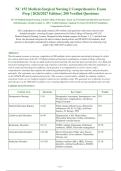
NU 155 Medical-Surgical Nursing I Comprehensive Exam
Prep | 2026/2027 Edition | 200 Verified Questions
NU 155 Medical-Surgical Nursing I (Galen College of Nursing) - Exam 1,2,3 & Final Exam Questions and Answers
with Rationales. Already Graded A+. 100% Verified Solutions | Updated Per Latest NCLEX/ATI Guidelines |
Comprehensive Review
This comprehensive study guide contains 200 verified exam questions with correct answers and
detailed rationales, covering all major content areas for Galen College of Nursing's NU 155
Medical-Surgical Nursing I course. Designed to help students prepare for Exams 1, 2, 3, and the Final
Exam, this document integrates the latest evidence-based practice and NCLEX/ATI standards. Each
question is thoroughly rationalized to enhance understanding and retention. Perfect for achieving a top
grade in the 2026-2027 academic year.
Abstract:
This document presents a rigorous compilation of 200 multiple-choice questions meticulously designed to reflect
the content and format of the NU 155 Medical-Surgical Nursing I examinations at Galen College of Nursing.
Covering fundamental concepts in adult medical-surgical nursing, the material spans perioperative care, fluid and
electrolyte management, cardiovascular and respiratory disorders, gastrointestinal and endocrine pathologies, as
well as renal and neurological conditions. Each question is accompanied by a correct answer and a
comprehensive rationale that explains the underlying pathophysiology, nursing interventions, and prioritization
principles. The rationales are crafted to reinforce critical thinking and clinical judgment skills essential for success
on the NCLEX-RN and in professional practice. This resource is particularly valuable for students seeking a
structured review of core medical-surgical content across multiple exams. The questions are verified for accuracy
and relevance to the 2026-2027 academic year, ensuring alignment with current nursing standards and curricula.
Content Area Overview:
Content Area Questions Key Topics Weight
Perioperative Nursing 1-30 Preoperative assessment, Intraoperative care, 15%
Postoperative complications, Anesthesia,
Surgical asepsis
Fluid & Electrolyte Balance 31-60 Fluid volume deficits/excess, Electrolyte 15%
imbalances (Na, K, Ca, Mg), Acid-base
balance, IV therapy, TPN
Cardiovascular Disorders 61-90 Hypertension, CAD, Heart failure, 15%
Myocardial infarction, Cardiac arrhythmias,
Peripheral vascular disease
Respiratory Disorders 91-115 COPD, Asthma, Pneumonia, Pulmonary 12.5%
embolism, ARDS, Chest tube management
Gastrointestinal Disorders 116-140 Bowel obstruction, Peptic ulcer disease, 12.5%
Diverticulitis, Liver cirrhosis, Pancreatitis,
Ostomy care
Endocrine Disorders 141-165 Diabetes mellitus (DKA, HHS), Thyroid 12.5%
disorders, Adrenal insufficiency, SIADH,
Diabetes insipidus
Page 1
,Renal Disorders 166-185 Acute kidney injury, Chronic kidney 10%
disease, Dialysis, Urinary tract infections,
Fluid monitoring
Neurological Disorders 186-200 Stroke, Traumatic brain injury, Increased 7.5%
intracranial pressure, Seizures, Meningitis
Page 2
,Q1. A patient with severe hyponatremia (serum sodium 115 mEq/L) is receiving 3% hypertonic
saline infusion. Which assessment finding requires immediate discontinuation of the infusion?
A. Increase in urine output to 200 mL/hr
B. New onset crackles in the lung bases
C. Decrease in serum sodium by 4 mEq/L in 2 hours
D. Complaint of dry mouth and thirst
Correct Answer: B. New onset crackles in the lung bases
Rationale: Hypertonic saline can cause rapid fluid shifts leading to pulmonary edema. New crackles
indicate fluid overload; infusion must be stopped. Urine output increase is expected as sodium rises; a 4
mEq/L rise in 2 hours is within safe limits (10 mEq/L in 24h). Dry mouth is a side effect of hypertonicity,
not an indication to stop.
Why Wrong:
A - Increased urine output reflects renal compensation and is an expected response to sodium
correction.
C - A rise of 4 mEq/L in 2 hours is within safe correction limits (max 8-10 mEq/L in 24h).
D - Dry mouth and thirst are expected due to concentrated saline and do not signal an adverse event.
Reference: Lewis, S. et al. (2023). Medical-Surgical Nursing, 11th ed., Ch. 16.
Q2. During a surgical procedure under general anesthesia, the patient develops sudden masseter
muscle spasm, tachycardia, and a rapid rise in end-tidal CO2. Which medication should the nurse
anticipate administering immediately?
A. Dantrolene sodium
B. Atropine sulfate
C. Sodium bicarbonate
D. Epinephrine
Correct Answer: A. Dantrolene sodium
Rationale: The presentation is classic malignant hyperthermia (MH), a hypermetabolic crisis triggered
by volatile anesthetics and succinylcholine. Dantrolene is the definitive treatment, inhibiting calcium
release from sarcoplasmic reticulum. Atropine increases heart rate erroneously; sodium bicarbonate may
be used for acidosis but is not the priority; epinephrine would worsen the hypermetabolic state.
Why Wrong:
B - Atropine increases heart rate, which is already elevated, and does not address the underlying
pathophysiology.
C - Sodium bicarbonate treats metabolic acidosis but does not stop the progression of MH.
D - Epinephrine stimulates beta-adrenergic receptors, exacerbating hypermetabolism and heat
production.
Reference: Lehne, R. (2026). Pharmacology for Nursing Care, 12th ed., Ch. 25.
Page 3
, Q3. A patient with acute respiratory distress syndrome (ARDS) is on mechanical ventilation. Which
intervention below is most likely to improve oxygenation while minimizing ventilator-induced lung
injury?
A. Tidal volume of 12 mL/kg ideal body weight
B. Positive end-expiratory pressure (PEEP) of 5 cm H2O
C. Prone positioning for 16 hours per day
D. Permissive hypercapnia with pH maintained above 7.35
Correct Answer: C. Prone positioning for 16 hours per day
Rationale: Prone positioning improves ventilation-perfusion matching and reduces lung injury,
recommended for severe ARDS. Low tidal volumes (6 mL/kg) are lung-protective, not 12 mL/kg. Higher
PEEP (10) is typical, not 5. Permissive hypercapnia (pH 7.25-7.30) is tolerated to avoid high pressures,
but maintaining pH >7.35 is not standard as it can require excessive ventilation.
Why Wrong:
A - High tidal volumes (12 mL/kg) cause volutrauma and worsen lung injury.
B - PEEP of 5 cm H2O is low; moderate to high PEEP is needed to recruit alveoli.
D - Permissive hypercapnia typically tolerates pH 7.25-7.30, not above 7.35, to reduce ventilator
settings.
Reference: Ely, E. & Fessler, H. (2023). Intensive Care Med, 49:1. ARDS Network Guidelines.
Q4. A patient presents with ST-segment elevation in leads II, III, and aVF and is hemodynamically
stable. Which reperfusion strategy is contraindicated if the patient has a history of a recent major
surgery?
A. Percutaneous coronary intervention (PCI)
B. Fibrinolytic therapy with alteplase
C. Emergent coronary artery bypass grafting
D. Conservative medical management
Correct Answer: B. Fibrinolytic therapy with alteplase
Rationale: Recent major surgery is an absolute contraindication to fibrinolytic therapy due to high risk of
hemorrhage. PCI is the preferred strategy for STEMI, not contraindicated by recent surgery. CABG may
be considered later but not for immediate reperfusion. Conservative management is not appropriate when
PCI is available.
Why Wrong:
A - PCI is not contraindicated by recent surgery and is actually preferred.
C - CABG is used for left main or complex disease, not as first-line for simple inferior STEMI.
D - Conservative management would delay reperfusion and worsen outcomes.
Reference: O'Gara, P. et al. (2013). ACCF/AHA STEMI Guidelines. Circulation, 127:4.
Page 4
Prep | 2026/2027 Edition | 200 Verified Questions
NU 155 Medical-Surgical Nursing I (Galen College of Nursing) - Exam 1,2,3 & Final Exam Questions and Answers
with Rationales. Already Graded A+. 100% Verified Solutions | Updated Per Latest NCLEX/ATI Guidelines |
Comprehensive Review
This comprehensive study guide contains 200 verified exam questions with correct answers and
detailed rationales, covering all major content areas for Galen College of Nursing's NU 155
Medical-Surgical Nursing I course. Designed to help students prepare for Exams 1, 2, 3, and the Final
Exam, this document integrates the latest evidence-based practice and NCLEX/ATI standards. Each
question is thoroughly rationalized to enhance understanding and retention. Perfect for achieving a top
grade in the 2026-2027 academic year.
Abstract:
This document presents a rigorous compilation of 200 multiple-choice questions meticulously designed to reflect
the content and format of the NU 155 Medical-Surgical Nursing I examinations at Galen College of Nursing.
Covering fundamental concepts in adult medical-surgical nursing, the material spans perioperative care, fluid and
electrolyte management, cardiovascular and respiratory disorders, gastrointestinal and endocrine pathologies, as
well as renal and neurological conditions. Each question is accompanied by a correct answer and a
comprehensive rationale that explains the underlying pathophysiology, nursing interventions, and prioritization
principles. The rationales are crafted to reinforce critical thinking and clinical judgment skills essential for success
on the NCLEX-RN and in professional practice. This resource is particularly valuable for students seeking a
structured review of core medical-surgical content across multiple exams. The questions are verified for accuracy
and relevance to the 2026-2027 academic year, ensuring alignment with current nursing standards and curricula.
Content Area Overview:
Content Area Questions Key Topics Weight
Perioperative Nursing 1-30 Preoperative assessment, Intraoperative care, 15%
Postoperative complications, Anesthesia,
Surgical asepsis
Fluid & Electrolyte Balance 31-60 Fluid volume deficits/excess, Electrolyte 15%
imbalances (Na, K, Ca, Mg), Acid-base
balance, IV therapy, TPN
Cardiovascular Disorders 61-90 Hypertension, CAD, Heart failure, 15%
Myocardial infarction, Cardiac arrhythmias,
Peripheral vascular disease
Respiratory Disorders 91-115 COPD, Asthma, Pneumonia, Pulmonary 12.5%
embolism, ARDS, Chest tube management
Gastrointestinal Disorders 116-140 Bowel obstruction, Peptic ulcer disease, 12.5%
Diverticulitis, Liver cirrhosis, Pancreatitis,
Ostomy care
Endocrine Disorders 141-165 Diabetes mellitus (DKA, HHS), Thyroid 12.5%
disorders, Adrenal insufficiency, SIADH,
Diabetes insipidus
Page 1
,Renal Disorders 166-185 Acute kidney injury, Chronic kidney 10%
disease, Dialysis, Urinary tract infections,
Fluid monitoring
Neurological Disorders 186-200 Stroke, Traumatic brain injury, Increased 7.5%
intracranial pressure, Seizures, Meningitis
Page 2
,Q1. A patient with severe hyponatremia (serum sodium 115 mEq/L) is receiving 3% hypertonic
saline infusion. Which assessment finding requires immediate discontinuation of the infusion?
A. Increase in urine output to 200 mL/hr
B. New onset crackles in the lung bases
C. Decrease in serum sodium by 4 mEq/L in 2 hours
D. Complaint of dry mouth and thirst
Correct Answer: B. New onset crackles in the lung bases
Rationale: Hypertonic saline can cause rapid fluid shifts leading to pulmonary edema. New crackles
indicate fluid overload; infusion must be stopped. Urine output increase is expected as sodium rises; a 4
mEq/L rise in 2 hours is within safe limits (10 mEq/L in 24h). Dry mouth is a side effect of hypertonicity,
not an indication to stop.
Why Wrong:
A - Increased urine output reflects renal compensation and is an expected response to sodium
correction.
C - A rise of 4 mEq/L in 2 hours is within safe correction limits (max 8-10 mEq/L in 24h).
D - Dry mouth and thirst are expected due to concentrated saline and do not signal an adverse event.
Reference: Lewis, S. et al. (2023). Medical-Surgical Nursing, 11th ed., Ch. 16.
Q2. During a surgical procedure under general anesthesia, the patient develops sudden masseter
muscle spasm, tachycardia, and a rapid rise in end-tidal CO2. Which medication should the nurse
anticipate administering immediately?
A. Dantrolene sodium
B. Atropine sulfate
C. Sodium bicarbonate
D. Epinephrine
Correct Answer: A. Dantrolene sodium
Rationale: The presentation is classic malignant hyperthermia (MH), a hypermetabolic crisis triggered
by volatile anesthetics and succinylcholine. Dantrolene is the definitive treatment, inhibiting calcium
release from sarcoplasmic reticulum. Atropine increases heart rate erroneously; sodium bicarbonate may
be used for acidosis but is not the priority; epinephrine would worsen the hypermetabolic state.
Why Wrong:
B - Atropine increases heart rate, which is already elevated, and does not address the underlying
pathophysiology.
C - Sodium bicarbonate treats metabolic acidosis but does not stop the progression of MH.
D - Epinephrine stimulates beta-adrenergic receptors, exacerbating hypermetabolism and heat
production.
Reference: Lehne, R. (2026). Pharmacology for Nursing Care, 12th ed., Ch. 25.
Page 3
, Q3. A patient with acute respiratory distress syndrome (ARDS) is on mechanical ventilation. Which
intervention below is most likely to improve oxygenation while minimizing ventilator-induced lung
injury?
A. Tidal volume of 12 mL/kg ideal body weight
B. Positive end-expiratory pressure (PEEP) of 5 cm H2O
C. Prone positioning for 16 hours per day
D. Permissive hypercapnia with pH maintained above 7.35
Correct Answer: C. Prone positioning for 16 hours per day
Rationale: Prone positioning improves ventilation-perfusion matching and reduces lung injury,
recommended for severe ARDS. Low tidal volumes (6 mL/kg) are lung-protective, not 12 mL/kg. Higher
PEEP (10) is typical, not 5. Permissive hypercapnia (pH 7.25-7.30) is tolerated to avoid high pressures,
but maintaining pH >7.35 is not standard as it can require excessive ventilation.
Why Wrong:
A - High tidal volumes (12 mL/kg) cause volutrauma and worsen lung injury.
B - PEEP of 5 cm H2O is low; moderate to high PEEP is needed to recruit alveoli.
D - Permissive hypercapnia typically tolerates pH 7.25-7.30, not above 7.35, to reduce ventilator
settings.
Reference: Ely, E. & Fessler, H. (2023). Intensive Care Med, 49:1. ARDS Network Guidelines.
Q4. A patient presents with ST-segment elevation in leads II, III, and aVF and is hemodynamically
stable. Which reperfusion strategy is contraindicated if the patient has a history of a recent major
surgery?
A. Percutaneous coronary intervention (PCI)
B. Fibrinolytic therapy with alteplase
C. Emergent coronary artery bypass grafting
D. Conservative medical management
Correct Answer: B. Fibrinolytic therapy with alteplase
Rationale: Recent major surgery is an absolute contraindication to fibrinolytic therapy due to high risk of
hemorrhage. PCI is the preferred strategy for STEMI, not contraindicated by recent surgery. CABG may
be considered later but not for immediate reperfusion. Conservative management is not appropriate when
PCI is available.
Why Wrong:
A - PCI is not contraindicated by recent surgery and is actually preferred.
C - CABG is used for left main or complex disease, not as first-line for simple inferior STEMI.
D - Conservative management would delay reperfusion and worsen outcomes.
Reference: O'Gara, P. et al. (2013). ACCF/AHA STEMI Guidelines. Circulation, 127:4.
Page 4


