

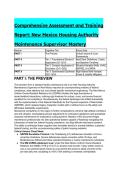
Comprehensive Assessment and Training
Report: New Mexico Housing Authority
Maintenance Supervisor Mastery
Section Cognitive Tier Focus Area
PART I The Preview Critical Axioms & Core
Frameworks
PART II Tier 1: Foundational Syntax & Hard Deck Definitions, Codes,
Application (Q1–Q10) and Baseline Timelines
PART II Tier 2: Complex Application & Situation/Variable Shifts, HVAC,
Simulation (Q11–Q20) NSPIRE, & UORRA
PART II Tier 3: Grandmaster Synthesis High-Stakes Multi-Variable
(Q21–Q30) Crises & Liability Mitigation
PART I: THE PREVIEW
The transition from a standard facility maintenance role to an elite Housing Authority
Maintenance Supervisor in New Mexico requires an uncompromising mastery of federal
compliance, state statutory law, and climate-specific mechanical engineering. The New Mexico
Uniform Owner-Resident Relations Act (UORRA) dictates the legal boundaries of
tenant-landlord interactions, outlining rigid timelines for notices, cures, and severe financial
penalties for non-compliance. Simultaneously, the federal landscape has shifted dramatically
with the implementation of the National Standards for the Physical Inspection of Real Estate
(NSPIRE), which replaced legacy inspection models with a ruthless focus on life-safety and
affirmative habitability requirements.
Mechanical competency in this region is further complicated by extreme high-altitude conditions
and arid climates, necessitating precise adjustments to combustion appliances and specialized
seasonal maintenance for evaporative cooling systems. Mastery of this document forges
maintenance professionals into elite operational leaders capable of flawlessly navigating this
intersection of state law, federal housing compliance, and high-altitude mechanical systems.
The ability to synthesize these cognitive tiers translates directly to averted liabilities, sustained
federal funding, and the uncompromising safety of public housing residents.
Critical Axioms Cheat Sheet:
● NSPIRE Escalation Protocol: Life-Threatening (LT) deficiencies mandate a 24-hour
correction timeframe, Severe deficiencies require correction within 30 days, and
Moderate/Low deficiencies follow extended timelines or routine maintenance schedules.
● The NM UORRA Abatement Law: Under the New Mexico Uniform Owner-Resident
Relations Act (NMSA 1978 § 47-8-27.2), tenants must provide 7 days' written notice to
cure a non-amenity failure; failure to cure permits the tenant to abate one-third of the
pro-rata daily rent, escalating to 100% if the dwelling is rendered uninhabitable.
, ● Procurement Thresholds (NMSA 13-1-125): Small purchase procurement for tangible
goods and services is capped at $60,000, requiring at least three quotes, while direct
purchase orders (micro-purchases) based on the best obtainable price max out at
$20,000.
● Mechanical & High-Altitude Operations: High-pressure steam boilers demand annual
internal and external inspections, while low-pressure hot water heating boilers require
inspection every 24 months. All gas-fired appliances installed at high altitudes (>5,000 ft)
must be BTU-derated per manufacturer specifications due to lower oxygen density.
● Lead-Based Paint (LBP) De Minimis & EBLs: Safe work practices in pre-1978 housing
are triggered when paint disturbance exceeds 20 square feet on exteriors, 2 square feet
in any interior room, or 10% of a small surface area. An Elevated Blood Lead (EBL) level
report for a child under 6 mandates an environmental investigation within 15 calendar
days.
The following tables synthesize the critical data matrices required for operational excellence.
Defect Severity Correction Timeframe Common NSPIRE Examples
Life-Threatening (LT) 24 Hours Missing smoke/CO alarms,
blocked egress, missing GFCI
within 6ft of water, gas leaks.
Severe 30 Days Fire doors failing to close,
major structural instability,
severe water intrusion.
Moderate 30 Days Cracked outlet covers, missing
stair railings, broken locks.
Low 60 Days Minor cosmetic issues, small
leaks, surface damage.
Purchase Category Statutory Threshold Required Solicitation Action
Micro-Purchase (Direct ≤ $20,000 Best obtainable price; no formal
Order) quotes required.
Small Purchase $20,001 – $60,000 Minimum of three written or
(Goods/Services) verbal quotes attached to
requisition.
Professional Services ≤ $60,000 Best available source at best
attainable price; bypasses
formal RFP.
Formal Sealed Bidding > $60,000 Advertised, written, sealed
(ITB/RFP) competitive proposals.
PART II: THE ELITE TEST BANK
Tier 1: Foundational Syntax & Application
Q1: A New Mexico public housing maintenance supervisor is tasked with replacing a failed
commercial HVAC rooftop unit. The estimated cost of the unit and installation is $45,000. Based
on the New Mexico Procurement Code, which procurement action is the MOST ACCURATE?
A) Issue a direct purchase order to a pre-approved vendor based on the best obtainable price.
B) Publish an Invitation to Bid (ITB) for formal competitive sealed bidding. C) Obtain a minimum
, of three written or verbal quotes and attach them to the purchase requisition. D) Submit the
purchase to the Board of Regents or central governing authority for a sole-source exemption.
● The Answer: C (Obtain a minimum of three written or verbal quotes and attach them to
the purchase requisition.)
● Distractor Analysis:
○ A is incorrect: The assertion that a direct purchase order can be issued without
quotes fails because micro-purchases are strictly capped at a maximum of $20,000
under NMSA 1.4.1.50.
○ B is incorrect: Formal competitive sealed bidding is an unnecessary administrative
burden here, as it is only statutorily required for amounts exceeding the $60,000
small purchase threshold.
○ D is incorrect: Board approval and sole-source justifications at this level are
reserved for professional service contracts over $500,000, not routine mechanical
replacements under the small purchase threshold.
The Mentor's Analysis: Procurement compliance prevents systemic audit failures and ensures
federal funds are utilized transparently. When purchasing goods or services between $20,001
and $60,000, the Small Purchase regulations dictate that the agency must solicit at least three
quotes to guarantee fair market value without the administrative burden of formal sealed
bidding. Professional/Academic Intuition: Always segment purchasing tiers logically based on
state thresholds: <$20k = direct/best price; $20k–$60k = 3 quotes; >$60k = formal sealed bid.
Q2: During a routine facility audit in Santa Fe, an inspector evaluates a low-pressure hot-water
heating boiler serving a 20-unit building. According to the New Mexico Administrative Code
(NMAC 14.9.4.25), what is the statutorily required frequency for internal and external
inspections for this specific equipment? A) An external inspection every 6 months and an
internal inspection annually. B) An external and internal inspection every 24 months. C) An
internal inspection annually with no external requirement. D) An external and internal inspection
every 5 years alongside the Capital Needs Assessment.
● The Answer: B (An external and internal inspection every 24 months.)
● Distractor Analysis:
○ A is incorrect: This timeline mirrors requirements for specific high-pressure
industrial applications in out-of-state jurisdictions, but does not apply to New Mexico
low-pressure systems.
○ C is incorrect: Annual internal inspections are exclusively reserved for
high-pressure boilers and high-pressure steam generators under the NMAC.
○ D is incorrect: Capital Needs Assessments (CNAs) track the remaining useful life of
major systems, but they do not override or dictate the rigorous 24-month
mechanical inspection mandates of the State Boiler Inspection Program.
The Mentor's Analysis: Mechanical catastrophic failures in public housing carry massive
liability, making regulatory compliance non-negotiable. The New Mexico mechanical code draws
a strict line between high-pressure systems (requiring annual checks) and low-pressure
hot-water heating boilers, which are safely monitored on a 24-month (biennial) cycle.
Professional/Academic Intuition: Equipment pressure directly correlates to statutory
inspection frequency; high-pressure is annual, low-pressure is biennial.
Q3: A tenant in a subsidized apartment complex submits a written complaint that the communal
hot tub heater has failed. After 10 days, the supervisor has not completed the repair due to
backordered parts. Under NMSA 1978 § 47-8-27.2, which legal right does the resident
IMMEDIATELY possess? A) The right to abate one-third of their pro-rata daily rent for each day
the repair is delayed. B) The right to withhold 100% of their rent, as the facility is in breach of the
Report: New Mexico Housing Authority
Maintenance Supervisor Mastery
Section Cognitive Tier Focus Area
PART I The Preview Critical Axioms & Core
Frameworks
PART II Tier 1: Foundational Syntax & Hard Deck Definitions, Codes,
Application (Q1–Q10) and Baseline Timelines
PART II Tier 2: Complex Application & Situation/Variable Shifts, HVAC,
Simulation (Q11–Q20) NSPIRE, & UORRA
PART II Tier 3: Grandmaster Synthesis High-Stakes Multi-Variable
(Q21–Q30) Crises & Liability Mitigation
PART I: THE PREVIEW
The transition from a standard facility maintenance role to an elite Housing Authority
Maintenance Supervisor in New Mexico requires an uncompromising mastery of federal
compliance, state statutory law, and climate-specific mechanical engineering. The New Mexico
Uniform Owner-Resident Relations Act (UORRA) dictates the legal boundaries of
tenant-landlord interactions, outlining rigid timelines for notices, cures, and severe financial
penalties for non-compliance. Simultaneously, the federal landscape has shifted dramatically
with the implementation of the National Standards for the Physical Inspection of Real Estate
(NSPIRE), which replaced legacy inspection models with a ruthless focus on life-safety and
affirmative habitability requirements.
Mechanical competency in this region is further complicated by extreme high-altitude conditions
and arid climates, necessitating precise adjustments to combustion appliances and specialized
seasonal maintenance for evaporative cooling systems. Mastery of this document forges
maintenance professionals into elite operational leaders capable of flawlessly navigating this
intersection of state law, federal housing compliance, and high-altitude mechanical systems.
The ability to synthesize these cognitive tiers translates directly to averted liabilities, sustained
federal funding, and the uncompromising safety of public housing residents.
Critical Axioms Cheat Sheet:
● NSPIRE Escalation Protocol: Life-Threatening (LT) deficiencies mandate a 24-hour
correction timeframe, Severe deficiencies require correction within 30 days, and
Moderate/Low deficiencies follow extended timelines or routine maintenance schedules.
● The NM UORRA Abatement Law: Under the New Mexico Uniform Owner-Resident
Relations Act (NMSA 1978 § 47-8-27.2), tenants must provide 7 days' written notice to
cure a non-amenity failure; failure to cure permits the tenant to abate one-third of the
pro-rata daily rent, escalating to 100% if the dwelling is rendered uninhabitable.
, ● Procurement Thresholds (NMSA 13-1-125): Small purchase procurement for tangible
goods and services is capped at $60,000, requiring at least three quotes, while direct
purchase orders (micro-purchases) based on the best obtainable price max out at
$20,000.
● Mechanical & High-Altitude Operations: High-pressure steam boilers demand annual
internal and external inspections, while low-pressure hot water heating boilers require
inspection every 24 months. All gas-fired appliances installed at high altitudes (>5,000 ft)
must be BTU-derated per manufacturer specifications due to lower oxygen density.
● Lead-Based Paint (LBP) De Minimis & EBLs: Safe work practices in pre-1978 housing
are triggered when paint disturbance exceeds 20 square feet on exteriors, 2 square feet
in any interior room, or 10% of a small surface area. An Elevated Blood Lead (EBL) level
report for a child under 6 mandates an environmental investigation within 15 calendar
days.
The following tables synthesize the critical data matrices required for operational excellence.
Defect Severity Correction Timeframe Common NSPIRE Examples
Life-Threatening (LT) 24 Hours Missing smoke/CO alarms,
blocked egress, missing GFCI
within 6ft of water, gas leaks.
Severe 30 Days Fire doors failing to close,
major structural instability,
severe water intrusion.
Moderate 30 Days Cracked outlet covers, missing
stair railings, broken locks.
Low 60 Days Minor cosmetic issues, small
leaks, surface damage.
Purchase Category Statutory Threshold Required Solicitation Action
Micro-Purchase (Direct ≤ $20,000 Best obtainable price; no formal
Order) quotes required.
Small Purchase $20,001 – $60,000 Minimum of three written or
(Goods/Services) verbal quotes attached to
requisition.
Professional Services ≤ $60,000 Best available source at best
attainable price; bypasses
formal RFP.
Formal Sealed Bidding > $60,000 Advertised, written, sealed
(ITB/RFP) competitive proposals.
PART II: THE ELITE TEST BANK
Tier 1: Foundational Syntax & Application
Q1: A New Mexico public housing maintenance supervisor is tasked with replacing a failed
commercial HVAC rooftop unit. The estimated cost of the unit and installation is $45,000. Based
on the New Mexico Procurement Code, which procurement action is the MOST ACCURATE?
A) Issue a direct purchase order to a pre-approved vendor based on the best obtainable price.
B) Publish an Invitation to Bid (ITB) for formal competitive sealed bidding. C) Obtain a minimum
, of three written or verbal quotes and attach them to the purchase requisition. D) Submit the
purchase to the Board of Regents or central governing authority for a sole-source exemption.
● The Answer: C (Obtain a minimum of three written or verbal quotes and attach them to
the purchase requisition.)
● Distractor Analysis:
○ A is incorrect: The assertion that a direct purchase order can be issued without
quotes fails because micro-purchases are strictly capped at a maximum of $20,000
under NMSA 1.4.1.50.
○ B is incorrect: Formal competitive sealed bidding is an unnecessary administrative
burden here, as it is only statutorily required for amounts exceeding the $60,000
small purchase threshold.
○ D is incorrect: Board approval and sole-source justifications at this level are
reserved for professional service contracts over $500,000, not routine mechanical
replacements under the small purchase threshold.
The Mentor's Analysis: Procurement compliance prevents systemic audit failures and ensures
federal funds are utilized transparently. When purchasing goods or services between $20,001
and $60,000, the Small Purchase regulations dictate that the agency must solicit at least three
quotes to guarantee fair market value without the administrative burden of formal sealed
bidding. Professional/Academic Intuition: Always segment purchasing tiers logically based on
state thresholds: <$20k = direct/best price; $20k–$60k = 3 quotes; >$60k = formal sealed bid.
Q2: During a routine facility audit in Santa Fe, an inspector evaluates a low-pressure hot-water
heating boiler serving a 20-unit building. According to the New Mexico Administrative Code
(NMAC 14.9.4.25), what is the statutorily required frequency for internal and external
inspections for this specific equipment? A) An external inspection every 6 months and an
internal inspection annually. B) An external and internal inspection every 24 months. C) An
internal inspection annually with no external requirement. D) An external and internal inspection
every 5 years alongside the Capital Needs Assessment.
● The Answer: B (An external and internal inspection every 24 months.)
● Distractor Analysis:
○ A is incorrect: This timeline mirrors requirements for specific high-pressure
industrial applications in out-of-state jurisdictions, but does not apply to New Mexico
low-pressure systems.
○ C is incorrect: Annual internal inspections are exclusively reserved for
high-pressure boilers and high-pressure steam generators under the NMAC.
○ D is incorrect: Capital Needs Assessments (CNAs) track the remaining useful life of
major systems, but they do not override or dictate the rigorous 24-month
mechanical inspection mandates of the State Boiler Inspection Program.
The Mentor's Analysis: Mechanical catastrophic failures in public housing carry massive
liability, making regulatory compliance non-negotiable. The New Mexico mechanical code draws
a strict line between high-pressure systems (requiring annual checks) and low-pressure
hot-water heating boilers, which are safely monitored on a 24-month (biennial) cycle.
Professional/Academic Intuition: Equipment pressure directly correlates to statutory
inspection frequency; high-pressure is annual, low-pressure is biennial.
Q3: A tenant in a subsidized apartment complex submits a written complaint that the communal
hot tub heater has failed. After 10 days, the supervisor has not completed the repair due to
backordered parts. Under NMSA 1978 § 47-8-27.2, which legal right does the resident
IMMEDIATELY possess? A) The right to abate one-third of their pro-rata daily rent for each day
the repair is delayed. B) The right to withhold 100% of their rent, as the facility is in breach of the


