

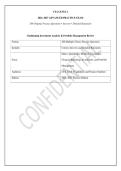
CFA LEVEL I
2026–2027 ADVANCED PRACTICE EXAM
200 Original Practice Questions • Answers • Detailed Rationales
Challenging Investment Analysis & Portfolio Management Review
Format 200 Multiple-Choice Practice Questions
Includes Correct Answers and Detailed Rationales
Ethics, Quantitative Methods, Economics,
Focus Financial Reporting, Investments, and Portfolio
Management
Audience CFA Level I Candidates and Finance Students
Edition 2026–2027 Practice Edition
,Contents
• Section 1: Ethical and Professional Standards (Questions 1–25)
• Section 2: Quantitative Methods (Questions 26–50)
• Section 3: Economics (Questions 51–75)
• Section 4: Financial Statement Analysis (Questions 76–100)
• Section 5: Corporate Issuers and Equity Investments (Questions 101–125)
• Section 6: Fixed Income and Derivatives (Questions 126–150)
• Section 7: Alternative Investments and Portfolio Management (Questions 151–175)
• Section 8: Integrated CFA Level I Scenario Review (Questions 176–200)
,Section 1: Ethical and Professional Standards
25 original practice questions designed to test conceptual understanding, calculations, ethical judgment,
and application.
1. An analyst receives material nonpublic information from a company executive. What is the
most appropriate action?
• Trade immediately before the information becomes public
• Share it selectively with favored clients
• Refrain from trading and avoid causing others to trade
• Post it anonymously online
Answer: Refrain from trading and avoid causing others to trade
Rationale: Trading or causing others to trade on material nonpublic information violates the principle
against misuse of material nonpublic information.
2. A CFA charterholder discovers a conflict of interest that could affect an investment
recommendation. The best practice is to:
• Ignore it if the recommendation is reasonable
• Disclose the conflict clearly and prominently
• Hide it from clients
• Only disclose it after the investment loses money
Answer: Disclose the conflict clearly and prominently
Rationale: Conflicts should be disclosed in a manner that allows clients to understand their potential
impact on objectivity.
3. Which action most clearly represents misrepresentation?
• Presenting a model with disclosed assumptions
• Claiming a credential that has not been earned
• Explaining investment risks
, • Disclosing a limitation in an analysis
Answer: Claiming a credential that has not been earned
Rationale: Professionals must not misrepresent qualifications, experience, services, or performance.
4. An analyst is pressured by a supervisor to alter a valuation to support a desired investment-
banking outcome. The analyst should:
• Alter the model quietly
• Refuse to compromise professional independence
• Delete the original analysis
• Publish confidential information
Answer: Refuse to compromise professional independence
Rationale: Professional judgment should remain independent and free from inappropriate pressure.
5. A portfolio manager receives a valuable gift from a broker immediately after directing
significant trading volume to that broker. The primary ethical concern is:
• Potential conflict affecting objectivity
• Improved diversification
• Lower accounting risk
• Better liquidity
Answer: Potential conflict affecting objectivity
Rationale: Gifts and benefits can create conflicts and should be handled according to applicable policies
and disclosure requirements.
6. Fair dealing requires that investment recommendations be:
• Provided fairly to clients without unfair selective treatment
• Given only to the largest client
• Shared only with friends
• Released after the market closes to selected investors
2026–2027 ADVANCED PRACTICE EXAM
200 Original Practice Questions • Answers • Detailed Rationales
Challenging Investment Analysis & Portfolio Management Review
Format 200 Multiple-Choice Practice Questions
Includes Correct Answers and Detailed Rationales
Ethics, Quantitative Methods, Economics,
Focus Financial Reporting, Investments, and Portfolio
Management
Audience CFA Level I Candidates and Finance Students
Edition 2026–2027 Practice Edition
,Contents
• Section 1: Ethical and Professional Standards (Questions 1–25)
• Section 2: Quantitative Methods (Questions 26–50)
• Section 3: Economics (Questions 51–75)
• Section 4: Financial Statement Analysis (Questions 76–100)
• Section 5: Corporate Issuers and Equity Investments (Questions 101–125)
• Section 6: Fixed Income and Derivatives (Questions 126–150)
• Section 7: Alternative Investments and Portfolio Management (Questions 151–175)
• Section 8: Integrated CFA Level I Scenario Review (Questions 176–200)
,Section 1: Ethical and Professional Standards
25 original practice questions designed to test conceptual understanding, calculations, ethical judgment,
and application.
1. An analyst receives material nonpublic information from a company executive. What is the
most appropriate action?
• Trade immediately before the information becomes public
• Share it selectively with favored clients
• Refrain from trading and avoid causing others to trade
• Post it anonymously online
Answer: Refrain from trading and avoid causing others to trade
Rationale: Trading or causing others to trade on material nonpublic information violates the principle
against misuse of material nonpublic information.
2. A CFA charterholder discovers a conflict of interest that could affect an investment
recommendation. The best practice is to:
• Ignore it if the recommendation is reasonable
• Disclose the conflict clearly and prominently
• Hide it from clients
• Only disclose it after the investment loses money
Answer: Disclose the conflict clearly and prominently
Rationale: Conflicts should be disclosed in a manner that allows clients to understand their potential
impact on objectivity.
3. Which action most clearly represents misrepresentation?
• Presenting a model with disclosed assumptions
• Claiming a credential that has not been earned
• Explaining investment risks
, • Disclosing a limitation in an analysis
Answer: Claiming a credential that has not been earned
Rationale: Professionals must not misrepresent qualifications, experience, services, or performance.
4. An analyst is pressured by a supervisor to alter a valuation to support a desired investment-
banking outcome. The analyst should:
• Alter the model quietly
• Refuse to compromise professional independence
• Delete the original analysis
• Publish confidential information
Answer: Refuse to compromise professional independence
Rationale: Professional judgment should remain independent and free from inappropriate pressure.
5. A portfolio manager receives a valuable gift from a broker immediately after directing
significant trading volume to that broker. The primary ethical concern is:
• Potential conflict affecting objectivity
• Improved diversification
• Lower accounting risk
• Better liquidity
Answer: Potential conflict affecting objectivity
Rationale: Gifts and benefits can create conflicts and should be handled according to applicable policies
and disclosure requirements.
6. Fair dealing requires that investment recommendations be:
• Provided fairly to clients without unfair selective treatment
• Given only to the largest client
• Shared only with friends
• Released after the market closes to selected investors


