

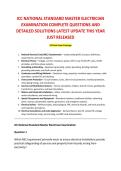
ICC NATIONAL STANDARD MASTER ELECTRICIAN
EXAMINATION COMPLETE QUESTIONS AND
DETAILED SOLUTIONS LATEST UPDATE THIS YEAR
JUST RELEASED
10-Point Exam Coverage
1. National Electrical Code (NEC) Fundamentals – Understanding NEC structure, definitions,
requirements, and code navigation.
2. Electrical Theory – Voltage, current, resistance, power, Ohm's Law, Kirchhoff's Laws, AC/DC
principles, and three-phase systems.
3. Grounding and Bonding – Equipment grounding, system grounding, bonding methods,
grounding electrodes, and fault-current paths.
4. Conductors and Wiring Methods – Conductor sizing, ampacity, insulation types, raceways, cable
assemblies, conduit fill, and derating.
5. Overcurrent Protection – Circuit breakers, fuses, short-circuit protection, overload protection,
interrupting ratings, and coordination.
6. Services and Distribution Systems – Service calculations, feeders, branch circuits, panelboards,
transformers, generators, and load calculations.
7. Motors and Industrial Installations – Motor controllers, disconnects, overload protection,
motor calculations, and industrial wiring.
8. Special Occupancies and Equipment – Hazardous locations, healthcare facilities, swimming
pools, marinas, photovoltaic systems, generators, and emergency systems.
9. Electrical Safety – OSHA principles, lockout/tagout, PPE, electrical hazards, safe work practices,
and inspection procedures.
10. Electrical Calculations and Code Application – Demand factors, box fill, conduit fill, voltage
drop, transformer sizing, service sizing, and NEC code interpretation.
ICC National Standard Master Electrician Examination
Question 1
Which NEC requirement primarily exists to ensure electrical installations provide
practical safeguarding of persons and property from hazards arising from
electricity?
,A. Minimise installation costs while maintaining functionality
B. Ensure all equipment uses identical manufacturers
C. Provide practical safeguarding against electrical hazards
D. Eliminate the need for inspections
Answer: C
Rationale: NEC Article 90 states the Code's primary purpose is practical
safeguarding of persons and property from electrical hazards.
Question 2
A 20-ampere branch circuit supplies continuous lighting loads operating for more
than three hours. According to the NEC, what minimum circuit rating should be
considered?
A. 20 A
B. 22 A
C. 25 A
D. 30 A
Answer: C
Rationale: Continuous loads are calculated at 125%; 20 A × 125% equals 25
amperes.
Question 3
Which electrical quantity represents the opposition that limits current flow
through a conductor under direct current conditions?
A. Voltage
B. Resistance
,C. Power
D. Frequency
Answer: B
Rationale: Resistance opposes current flow and is measured in ohms.
Question 4
According to Ohm's Law, what current flows through a resistor of 24 ohms
connected across a 120-volt source?
A. 2 amperes
B. 4 amperes
C. 5 amperes
D. 24 amperes
Answer: C
Rationale: I = V ÷ R = 120 ÷ 24 = 5 amperes.
Question 5
What is the principal purpose of equipment grounding conductors within an
electrical installation operating under the National Electrical Code?
A. Increase conductor ampacity
B. Reduce utility demand charges
C. Provide an effective ground-fault current path
D. Improve power factor
Answer: C
, Rationale: Equipment grounding conductors facilitate rapid operation of
overcurrent protective devices during faults.
Question 6
Which NEC article primarily contains requirements governing grounding and
bonding of electrical systems and equipment?
A. Article 110
B. Article 250
C. Article 300
D. Article 430
Answer: B
Rationale: NEC Article 250 covers grounding and bonding requirements.
Question 7
Why is conductor ampacity adjustment necessary when multiple current-carrying
conductors occupy the same raceway?
A. Conductors become mechanically weaker
B. Heat dissipation decreases, increasing operating temperatures
C. Voltage automatically increases
D. Circuit resistance becomes zero
Answer: B
Rationale: Closely grouped conductors retain heat, requiring ampacity
adjustment.
EXAMINATION COMPLETE QUESTIONS AND
DETAILED SOLUTIONS LATEST UPDATE THIS YEAR
JUST RELEASED
10-Point Exam Coverage
1. National Electrical Code (NEC) Fundamentals – Understanding NEC structure, definitions,
requirements, and code navigation.
2. Electrical Theory – Voltage, current, resistance, power, Ohm's Law, Kirchhoff's Laws, AC/DC
principles, and three-phase systems.
3. Grounding and Bonding – Equipment grounding, system grounding, bonding methods,
grounding electrodes, and fault-current paths.
4. Conductors and Wiring Methods – Conductor sizing, ampacity, insulation types, raceways, cable
assemblies, conduit fill, and derating.
5. Overcurrent Protection – Circuit breakers, fuses, short-circuit protection, overload protection,
interrupting ratings, and coordination.
6. Services and Distribution Systems – Service calculations, feeders, branch circuits, panelboards,
transformers, generators, and load calculations.
7. Motors and Industrial Installations – Motor controllers, disconnects, overload protection,
motor calculations, and industrial wiring.
8. Special Occupancies and Equipment – Hazardous locations, healthcare facilities, swimming
pools, marinas, photovoltaic systems, generators, and emergency systems.
9. Electrical Safety – OSHA principles, lockout/tagout, PPE, electrical hazards, safe work practices,
and inspection procedures.
10. Electrical Calculations and Code Application – Demand factors, box fill, conduit fill, voltage
drop, transformer sizing, service sizing, and NEC code interpretation.
ICC National Standard Master Electrician Examination
Question 1
Which NEC requirement primarily exists to ensure electrical installations provide
practical safeguarding of persons and property from hazards arising from
electricity?
,A. Minimise installation costs while maintaining functionality
B. Ensure all equipment uses identical manufacturers
C. Provide practical safeguarding against electrical hazards
D. Eliminate the need for inspections
Answer: C
Rationale: NEC Article 90 states the Code's primary purpose is practical
safeguarding of persons and property from electrical hazards.
Question 2
A 20-ampere branch circuit supplies continuous lighting loads operating for more
than three hours. According to the NEC, what minimum circuit rating should be
considered?
A. 20 A
B. 22 A
C. 25 A
D. 30 A
Answer: C
Rationale: Continuous loads are calculated at 125%; 20 A × 125% equals 25
amperes.
Question 3
Which electrical quantity represents the opposition that limits current flow
through a conductor under direct current conditions?
A. Voltage
B. Resistance
,C. Power
D. Frequency
Answer: B
Rationale: Resistance opposes current flow and is measured in ohms.
Question 4
According to Ohm's Law, what current flows through a resistor of 24 ohms
connected across a 120-volt source?
A. 2 amperes
B. 4 amperes
C. 5 amperes
D. 24 amperes
Answer: C
Rationale: I = V ÷ R = 120 ÷ 24 = 5 amperes.
Question 5
What is the principal purpose of equipment grounding conductors within an
electrical installation operating under the National Electrical Code?
A. Increase conductor ampacity
B. Reduce utility demand charges
C. Provide an effective ground-fault current path
D. Improve power factor
Answer: C
, Rationale: Equipment grounding conductors facilitate rapid operation of
overcurrent protective devices during faults.
Question 6
Which NEC article primarily contains requirements governing grounding and
bonding of electrical systems and equipment?
A. Article 110
B. Article 250
C. Article 300
D. Article 430
Answer: B
Rationale: NEC Article 250 covers grounding and bonding requirements.
Question 7
Why is conductor ampacity adjustment necessary when multiple current-carrying
conductors occupy the same raceway?
A. Conductors become mechanically weaker
B. Heat dissipation decreases, increasing operating temperatures
C. Voltage automatically increases
D. Circuit resistance becomes zero
Answer: B
Rationale: Closely grouped conductors retain heat, requiring ampacity
adjustment.


