

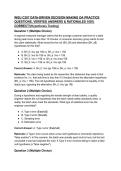
WGU C207 DATA-DRIVEN DECISION MAKING OA PRACTICE
QUESTIONS, VERIFIED ANSWERS & RATIONALES 100%
CORRECT!(Hypothesis Testing)
Question 1 (Multiple Choice)
A regional restaurant manager claims that the average customer wait time for a table
during peak hours is less than 15 minutes. A consumer advocacy group wants to test
this claim statistically. What should be the null ($H_0$) and alternative ($H_a$)
hypotheses for this test?
● A. $H_0: \mu \ge 15$ vs. $H_a: \mu < 15$
● B. $H_0: \mu \le 15$ vs. $H_a: \mu > 15$
● C. $H_0: \mu = 15$ vs. $H_a: \mu \neq 15$
● D. $H_0: \mu < 15$ vs. $H_a: \mu \ge 15$
Correct Answer: A. $H_0: \mu \ge 15$ vs. $H_a: \mu < 15$
Rationale: The claim being tested by the researcher (the statement they want to find
evidence for, i.e., that wait time is less than 15 minutes) forms the alternative hypothesis
($H_a: \mu < 15$). The null hypothesis always contains a statement of equality or the
status quo, opposing the alternative: $H_0: \mu \ge 15$.
Question 2 (Multiple Choice)
During a hypothesis test regarding the tensile strength of steel cables, a quality
engineer rejects the null hypothesis that the batch meets safety standards when, in
reality, the batch does meet the standards. What type of statistical error has the
engineer committed?
● A. Type I error ($\alpha$)
● B. Type II error ($\beta$)
● C. Sampling error
● D. Estimation error
Correct Answer: A. Type I error ($\alpha$)
Rationale: A Type I error occurs when a true null hypothesis is incorrectly rejected (a
"false positive"). In this scenario, the batch was actually good (null is true), but the test
concluded it was bad (rejected the null). A Type II error involves failing to reject a false
null hypothesis (a "false negative").
Question 3 (Multiple Choice)
, An agricultural researcher tests whether a new fertilizer increases crop yields. The
researcher fails to reject a false null hypothesis, concluding there is no difference in
yield when the fertilizer actually works. What type of error has occurred?
● A. Type I error
● B. Type II error
● C. Measurement error
● D. Selection bias
Correct Answer: B. Type II error
Rationale: A Type II error ($\beta$) occurs when the null hypothesis is false (meaning
the fertilizer does work), but the statistical test fails to reject it. This represents a false
negative outcome.
Question 4 (Multiple Choice)
If an analyst conducts a two-tailed hypothesis test at a significance level ($\alpha$) of
$0.05$ and calculates a $p$-value of $0.032$, what is the correct statistical decision?
● A. Fail to reject the null hypothesis because $0.032 > 0.01$.
● B. Reject the null hypothesis because the $p$-value is less than the significance
level ($\alpha$).
● C. Accept the null hypothesis as absolute truth.
● D. Redo the test because the $p$-value is too close to $0.05$.
Correct Answer: B. Reject the null hypothesis because the $p$-value is less than the
significance level ($\alpha$).
Rationale: The fundamental decision rule in hypothesis testing states that if the
$p$-value is less than or equal to the chosen significance level ($\alpha$), the sample
evidence against the null hypothesis is strong enough to reject $H_0$. Since $0.032 \le
0.05$, we reject $H_0$.
Question 5 (Multiple Choice)
An HR director wants to test whether employee productivity scores differ significantly
across four different shift schedules (Morning, Afternoon, Night, Weekend). Which
statistical test should the director use to compare the means of these four groups
simultaneously?
● A. Multiple linear regression
● B. One-Way Analysis of Variance (ANOVA)
● C. Chi-Square test of goodness-of-fit
QUESTIONS, VERIFIED ANSWERS & RATIONALES 100%
CORRECT!(Hypothesis Testing)
Question 1 (Multiple Choice)
A regional restaurant manager claims that the average customer wait time for a table
during peak hours is less than 15 minutes. A consumer advocacy group wants to test
this claim statistically. What should be the null ($H_0$) and alternative ($H_a$)
hypotheses for this test?
● A. $H_0: \mu \ge 15$ vs. $H_a: \mu < 15$
● B. $H_0: \mu \le 15$ vs. $H_a: \mu > 15$
● C. $H_0: \mu = 15$ vs. $H_a: \mu \neq 15$
● D. $H_0: \mu < 15$ vs. $H_a: \mu \ge 15$
Correct Answer: A. $H_0: \mu \ge 15$ vs. $H_a: \mu < 15$
Rationale: The claim being tested by the researcher (the statement they want to find
evidence for, i.e., that wait time is less than 15 minutes) forms the alternative hypothesis
($H_a: \mu < 15$). The null hypothesis always contains a statement of equality or the
status quo, opposing the alternative: $H_0: \mu \ge 15$.
Question 2 (Multiple Choice)
During a hypothesis test regarding the tensile strength of steel cables, a quality
engineer rejects the null hypothesis that the batch meets safety standards when, in
reality, the batch does meet the standards. What type of statistical error has the
engineer committed?
● A. Type I error ($\alpha$)
● B. Type II error ($\beta$)
● C. Sampling error
● D. Estimation error
Correct Answer: A. Type I error ($\alpha$)
Rationale: A Type I error occurs when a true null hypothesis is incorrectly rejected (a
"false positive"). In this scenario, the batch was actually good (null is true), but the test
concluded it was bad (rejected the null). A Type II error involves failing to reject a false
null hypothesis (a "false negative").
Question 3 (Multiple Choice)
, An agricultural researcher tests whether a new fertilizer increases crop yields. The
researcher fails to reject a false null hypothesis, concluding there is no difference in
yield when the fertilizer actually works. What type of error has occurred?
● A. Type I error
● B. Type II error
● C. Measurement error
● D. Selection bias
Correct Answer: B. Type II error
Rationale: A Type II error ($\beta$) occurs when the null hypothesis is false (meaning
the fertilizer does work), but the statistical test fails to reject it. This represents a false
negative outcome.
Question 4 (Multiple Choice)
If an analyst conducts a two-tailed hypothesis test at a significance level ($\alpha$) of
$0.05$ and calculates a $p$-value of $0.032$, what is the correct statistical decision?
● A. Fail to reject the null hypothesis because $0.032 > 0.01$.
● B. Reject the null hypothesis because the $p$-value is less than the significance
level ($\alpha$).
● C. Accept the null hypothesis as absolute truth.
● D. Redo the test because the $p$-value is too close to $0.05$.
Correct Answer: B. Reject the null hypothesis because the $p$-value is less than the
significance level ($\alpha$).
Rationale: The fundamental decision rule in hypothesis testing states that if the
$p$-value is less than or equal to the chosen significance level ($\alpha$), the sample
evidence against the null hypothesis is strong enough to reject $H_0$. Since $0.032 \le
0.05$, we reject $H_0$.
Question 5 (Multiple Choice)
An HR director wants to test whether employee productivity scores differ significantly
across four different shift schedules (Morning, Afternoon, Night, Weekend). Which
statistical test should the director use to compare the means of these four groups
simultaneously?
● A. Multiple linear regression
● B. One-Way Analysis of Variance (ANOVA)
● C. Chi-Square test of goodness-of-fit


