

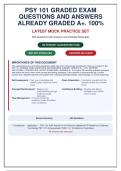
PSY 101 GRADED EXAM
QUESTIONS AND ANSWERS
ALREADY GRADED A+. 100%
LATEST MOCK PRACTICE SET
250 Questions with Answers and Detailed Rationales
100 PERCENT GUARANTEED PASS
INSTANT DOWNLOAD ANSWERS INCLUDED
IMPORTANCE OF THIS DOCUMENT
This comprehensive examination preparation guide has been meticulously developed to help you succeed in the
PSY 101 GRADED EXAM QUESTIONS AND ANSWERS ALREADY GRADED A+. 100% VERIFIED
SOLUTIONS | UPDATED PER LATEST GUIDELINES | GRADED A+. It contains 250 carefully selected questions
that reflect the most current exam content and testing strategies. Each question is accompanied by a correct
answer and a detailed rationale that explains the underlying pathophysiology, pharmacology, or clinical reasoning.
Self-Assessment – Test your knowledge and Exam Preparation – Familiarize yourself with the
identify areas requiring further question format and content
study areas
Concept Reinforcement – Deepen your Confidence Building – Develop test-taking
understanding through strategies and reduce
evidence-based exam anxiety
rationales
Time Management – Practice answering
questions under simulated
exam conditions
Review Summary 250 Questions
Foundations - Application - PSY 101 AND Already A 100 Solutions Updated PER Guidelines A General
Psychology PSY 101 Undergraduate YEAR 1-2 / Introductory Psychology
All answers with rationales
,Table of Contents
Section A - History AND Approaches Section B - Research Methods AND
TO Psychology Statistics
Questions 1 to 63 Questions 64 to 126
Section C - Biological Bases OF Section D - Sensation AND Perception
Behavior Questions 190 to 250
Questions 127 to 189
,Section A - History AND Approaches TO Psychology
Q1.
A researcher conducts a study on memory and finds a correlation of r = -0.85 between the
number of hours spent on social media per day and scores on a delayed recall test. Which
of the following is the most appropriate interpretation?
A. Spending more time on social media B. The relationship is strong and negative,
causes poorer memory performance. but causation cannot be inferred.
C. The correlation is not significant because D. Approximately 72% of the variance in
it is negative. memory scores can be explained by social
media use.
Correct: B - The relationship is strong and negative, but causation cannot be inferred.
Rationale:A correlation of -0.85 indicates a strong negative relationship, but correlation does
not imply causation. Option D is incorrect because r² = 0.7225, so about 72% of variance is
shared, but the statement about explanation is ambiguous without causal inference. Option A
is a causal claim not supported. Option C is false; negative correlations can be significant.
Q2.
In a classic experiment, a rat learns to press a lever to receive a food pellet, but then the
pellet dispenser jams and no longer delivers food. The rat initially presses the lever many
times but eventually stops. This extinction of the lever-pressing behavior is best explained
by which principle?
A. The rat has forgotten the association B. The rat's behavior is no longer reinforced,
between lever and food due to disuse. leading to a gradual decrease in response.
C. The rat experiences learned D. The rat's behavior is inhibited by the
helplessness and gives up. frustration of non-reward.
Correct: B - The rat's behavior is no longer reinforced, leading to a gradual decrease in
response.
Rationale:Extinction in operant conditioning occurs when a previously reinforced behavior is
no longer reinforced, leading to a decline in that behavior. Option A describes forgetting
theory, but extinction is not simply forgetting. Option C refers to a different phenomenon
(learned helplessness) where the organism stops trying due to uncontrollable aversive
events. Option D is not the primary explanatory principle; frustration may occur but is not the
mechanism of extinction.
Page 3
, Section A - History AND Approaches TO Psychology
Q3.
A patient with damage to the left hemisphere is unable to produce fluent speech but can
understand language relatively well. Which of the following is the most likely diagnosis?
A. Wernicke's aphasia B. Conduction aphasia
C. Global aphasia D. Broca's aphasia
Correct: D - Broca's aphasia
Rationale:Broca's aphasia is characterized by non-fluent, effortful speech with relatively
preserved comprehension, typically resulting from damage to the left frontal lobe (Broca's
area). Wernicke's aphasia involves fluent but meaningless speech and poor comprehension.
Conduction aphasia features good comprehension but impaired repetition. Global aphasia
involves severe deficits in both production and comprehension.
Q4.
A psychologist administers a test that asks participants to report the first word that comes
to mind after seeing a stimulus word. This technique is most closely associated with
which of the following concepts?
A. Free association in psychoanalysis B. Semantic priming in cognitive psychology
C. Implicit association test (IAT) in social D. Projective testing in personality
psychology assessment
Correct: B - Semantic priming in cognitive psychology
Rationale:The word association task is a classic measure of semantic priming, where a prime
word activates related concepts in memory, influencing the response to a subsequent word.
Free association (A) is a psychoanalytic technique but typically involves reporting all thoughts
without censorship. The IAT (C) measures implicit attitudes through reaction times. Projective
tests (D) like the Rorschach use ambiguous stimuli, not word associations.
Q5.
According to Piaget's theory, a child who is able to understand that the quantity of liquid
remains the same even when poured into a differently shaped container has achieved
which cognitive milestone?
A. Object permanence B. Conservation
C. Egocentrism D. Formal operational thought
Correct: B - Conservation
Page 4
QUESTIONS AND ANSWERS
ALREADY GRADED A+. 100%
LATEST MOCK PRACTICE SET
250 Questions with Answers and Detailed Rationales
100 PERCENT GUARANTEED PASS
INSTANT DOWNLOAD ANSWERS INCLUDED
IMPORTANCE OF THIS DOCUMENT
This comprehensive examination preparation guide has been meticulously developed to help you succeed in the
PSY 101 GRADED EXAM QUESTIONS AND ANSWERS ALREADY GRADED A+. 100% VERIFIED
SOLUTIONS | UPDATED PER LATEST GUIDELINES | GRADED A+. It contains 250 carefully selected questions
that reflect the most current exam content and testing strategies. Each question is accompanied by a correct
answer and a detailed rationale that explains the underlying pathophysiology, pharmacology, or clinical reasoning.
Self-Assessment – Test your knowledge and Exam Preparation – Familiarize yourself with the
identify areas requiring further question format and content
study areas
Concept Reinforcement – Deepen your Confidence Building – Develop test-taking
understanding through strategies and reduce
evidence-based exam anxiety
rationales
Time Management – Practice answering
questions under simulated
exam conditions
Review Summary 250 Questions
Foundations - Application - PSY 101 AND Already A 100 Solutions Updated PER Guidelines A General
Psychology PSY 101 Undergraduate YEAR 1-2 / Introductory Psychology
All answers with rationales
,Table of Contents
Section A - History AND Approaches Section B - Research Methods AND
TO Psychology Statistics
Questions 1 to 63 Questions 64 to 126
Section C - Biological Bases OF Section D - Sensation AND Perception
Behavior Questions 190 to 250
Questions 127 to 189
,Section A - History AND Approaches TO Psychology
Q1.
A researcher conducts a study on memory and finds a correlation of r = -0.85 between the
number of hours spent on social media per day and scores on a delayed recall test. Which
of the following is the most appropriate interpretation?
A. Spending more time on social media B. The relationship is strong and negative,
causes poorer memory performance. but causation cannot be inferred.
C. The correlation is not significant because D. Approximately 72% of the variance in
it is negative. memory scores can be explained by social
media use.
Correct: B - The relationship is strong and negative, but causation cannot be inferred.
Rationale:A correlation of -0.85 indicates a strong negative relationship, but correlation does
not imply causation. Option D is incorrect because r² = 0.7225, so about 72% of variance is
shared, but the statement about explanation is ambiguous without causal inference. Option A
is a causal claim not supported. Option C is false; negative correlations can be significant.
Q2.
In a classic experiment, a rat learns to press a lever to receive a food pellet, but then the
pellet dispenser jams and no longer delivers food. The rat initially presses the lever many
times but eventually stops. This extinction of the lever-pressing behavior is best explained
by which principle?
A. The rat has forgotten the association B. The rat's behavior is no longer reinforced,
between lever and food due to disuse. leading to a gradual decrease in response.
C. The rat experiences learned D. The rat's behavior is inhibited by the
helplessness and gives up. frustration of non-reward.
Correct: B - The rat's behavior is no longer reinforced, leading to a gradual decrease in
response.
Rationale:Extinction in operant conditioning occurs when a previously reinforced behavior is
no longer reinforced, leading to a decline in that behavior. Option A describes forgetting
theory, but extinction is not simply forgetting. Option C refers to a different phenomenon
(learned helplessness) where the organism stops trying due to uncontrollable aversive
events. Option D is not the primary explanatory principle; frustration may occur but is not the
mechanism of extinction.
Page 3
, Section A - History AND Approaches TO Psychology
Q3.
A patient with damage to the left hemisphere is unable to produce fluent speech but can
understand language relatively well. Which of the following is the most likely diagnosis?
A. Wernicke's aphasia B. Conduction aphasia
C. Global aphasia D. Broca's aphasia
Correct: D - Broca's aphasia
Rationale:Broca's aphasia is characterized by non-fluent, effortful speech with relatively
preserved comprehension, typically resulting from damage to the left frontal lobe (Broca's
area). Wernicke's aphasia involves fluent but meaningless speech and poor comprehension.
Conduction aphasia features good comprehension but impaired repetition. Global aphasia
involves severe deficits in both production and comprehension.
Q4.
A psychologist administers a test that asks participants to report the first word that comes
to mind after seeing a stimulus word. This technique is most closely associated with
which of the following concepts?
A. Free association in psychoanalysis B. Semantic priming in cognitive psychology
C. Implicit association test (IAT) in social D. Projective testing in personality
psychology assessment
Correct: B - Semantic priming in cognitive psychology
Rationale:The word association task is a classic measure of semantic priming, where a prime
word activates related concepts in memory, influencing the response to a subsequent word.
Free association (A) is a psychoanalytic technique but typically involves reporting all thoughts
without censorship. The IAT (C) measures implicit attitudes through reaction times. Projective
tests (D) like the Rorschach use ambiguous stimuli, not word associations.
Q5.
According to Piaget's theory, a child who is able to understand that the quantity of liquid
remains the same even when poured into a differently shaped container has achieved
which cognitive milestone?
A. Object permanence B. Conservation
C. Egocentrism D. Formal operational thought
Correct: B - Conservation
Page 4


