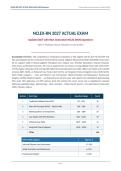
NCLEX-RN 2027 ACTUAL EXAM with NGN Questions Clinical Judgment Measurement Model (NCJMM)
NCLEX-RN 2027 ACTUAL EXAM
Updated 2027 with Next Generation NCLEX (NGN) Questions
SATA • Multiple Choice • Bowtie • Case Studies
Examination Overview: This comprehensive 150-question examination is fully aligned with the 2027 NCLEX-RN Test
Plan and integrates the Next Generation NCLEX (NGN) Clinical Judgment Measurement Model (NCJMM). Items assess
the six cognitive skills of clinical judgment: Recognize Cues, Analyze Cues, Prioritize Hypotheses, Generate Solutions,
Take Action, and Evaluate Outcomes. The exam is organized into six sections covering Multiple Choice (Q1–Q35), Select
All That Apply with partial credit scoring (Q36–Q60), Bowtie prioritization items (Q61–Q80), Case Studies with extended
scenarios (Q81–Q120), an Enhanced Case Study (Q121–Q135), and Integrated Clinical Judgment items (Q136–Q150).
Client Needs categories — Safe and Effective Care Environment, Health Promotion and Maintenance, Psychosocial
Integrity, and Physiological Integrity — are balanced across all item types, with cognitive-level distribution approximating
20% recall, 50% application, and 30% analysis. Each item includes the correct answer and a comprehensive rationale
addressing pathophysiology, pharmacology, safety principles, evidence-based practice, and prioritization frameworks
(ABCs, Maslow, Safety).
Section Item Type Question Range Count
1 Traditional Multiple Choice (MC) Q1 – Q35 35
2 Select All That Apply (SATA) – Partial Credit Q36 – Q60 25
3 Bowtie Questions (3-Component) Q61 – Q80 20
4 Case Studies with NGN Questions Q81 – Q120 40
5 Enhanced Case Study Q121 – Q135 15
6 Integrated Clinical Judgment Q136 – Q150 15
TOTAL 150
Client Needs Category Approx. %
Safe and Effective Care Environment 17–23%
Health Promotion and Maintenance 6–12%
Psychosocial Integrity 6–12%
Page 1
,NCLEX-RN 2027 ACTUAL EXAM with NGN Questions Clinical Judgment Measurement Model (NCJMM)
Physiological Integrity 61–87%
Page 2
,NCLEX-RN 2027 ACTUAL EXAM with NGN Questions Clinical Judgment Measurement Model (NCJMM)
Section 1: Traditional Multiple Choice (MC)
Clinical Judgment and Foundational Knowledge — Questions 1–35. Each item has four options (A–D) with one correct
answer. Items are distributed across all Client Needs categories and integrate the six NCJMM cognitive skills: Recognize
Cues, Analyze Cues, Prioritize Hypotheses, Generate Solutions, Take Action, and Evaluate Outcomes. Prioritization
frameworks (ABCs, Maslow's hierarchy, Safety) and evidence-based practice inform correct responses.
1. A charge nurse is assigning clients to a newly licensed practical nurse (LPN) and an experienced registered
nurse (RN) on a medical-surgical unit. Which client should the charge nurse assign to the LPN? (NCJMM: Prioritize
Hypotheses — Delegation)
A. A client 4 hours post-coronary artery stent placement requiring continuous cardiac monitoring
B. A client with a tracheostomy admitted 2 hours ago for respiratory distress requiring frequent suctioning
C. A client with a closed femur fracture in balanced suspension traction with stable vital signs **[CORRECT]**
D. A client who received IV morphine 30 minutes ago and is reporting uncontrolled pain rated 9/10
Correct Answer: C
Rationale:
The LPN's scope of practice includes caring for stable clients with predictable outcomes. A client with a closed femur
fracture in balanced suspension traction and stable vital signs represents a stable, non-complex scenario appropriate for
LPN care (C). The post-stent client (A) requires continuous cardiac monitoring and assessment of complications beyond
LPN scope. The fresh tracheostomy with respiratory distress (B) requires frequent complex airway assessment by an RN.
The client with uncontrolled pain after morphine (D) requires reassessment and possibly opioid reversal — an RN
responsibility. The Five Rights of Delegation include Right Task, Right Circumstance, Right Person, Right
Direction/Communication, and Right Supervision/Evaluation.
2. A nurse is caring for a client who refuses a prescribed blood transfusion based on religious beliefs (Jehovah's
Witness). Which action should the nurse take first? (NCJMM: Take Action — Ethical/Legal)
A. Notify the provider and document the refusal in the medical record **[CORRECT]**
B. Explain the risks of refusing the transfusion in detail to the client
C. Contact the ethics committee for an emergency consultation
D. Administer the transfusion as ordered since it is life-saving
Correct Answer: A
Rationale:
A competent adult has the legal and ethical right to refuse any medical treatment, including life-saving interventions. The
nurse's first action is to notify the provider and document the refusal (A), ensuring the provider can discuss risks and offer
alternatives. While the nurse should ensure the client understands risks (B), detailed risk explanation is primarily the
provider's responsibility during informed consent. The ethics committee (C) may be consulted if conflicts persist, but this
is not the first action. Forcing a transfusion (D) constitutes battery and violates the client's autonomy and the principle of
informed consent, even if the transfusion is life-saving.
3. A nurse is implementing fall precautions for a confused older adult client. Which intervention is most
appropriate to implement first? (NCJMM: Generate Solutions — Safety)
A. Apply bilateral soft wrist restraints and secure ties to the bed frame
B. Place the client in a room close to the nurses' station and ensure the bed alarm is activated **[CORRECT]**
C. Request a prescription for a sedative medication to reduce agitation
D. Instruct the family that they must remain at the bedside around the clock
Page 3
, NCLEX-RN 2027 ACTUAL EXAM with NGN Questions Clinical Judgment Measurement Model (NCJMM)
Correct Answer: B
Rationale:
The least restrictive intervention should always be tried first per restraint standards. Placing the client near the nurses'
station with a bed alarm (B) allows close observation and early intervention without restricting freedom. Restraints (A)
are a last resort requiring a provider prescription, time-limited orders, and ongoing reassessment — they should not be the
first intervention. Sedatives (C) increase fall risk and confusion in older adults (Beers Criteria). While family presence (D)
may help, it cannot be mandated, and the nurse cannot delegate safety responsibilities solely to family. The Joint
Commission and CMS require documentation of least-restrictive alternatives attempted before restraints.
4. A nurse is caring for a client on airborne precautions for pulmonary tuberculosis. Which personal protective
equipment (PPE) should the nurse don before entering the client's room? (NCJMM: Take Action — Infection
Control)
A. Surgical mask, gown, gloves, and eye protection
B. N95 respirator, gown, and gloves **[CORRECT]**
C. N95 respirator, gown, gloves, and eye protection
D. Surgical mask, gown, gloves, and shoe covers
Correct Answer: B
Rationale:
Pulmonary tuberculosis requires airborne precautions, which mandates an N95 respirator (or PAPR) for entry, plus a
gown and gloves if direct client contact is anticipated (B). A surgical mask (A, D) does not filter the small airborne
droplet nuclei of Mycobacterium tuberculosis. Eye protection (C) is required only if splashes of body fluids are
anticipated; it is not a standard requirement for airborne precautions alone. The N95 must be fit-tested annually, and the
client should be in a negative-pressure AIIR (airborne infection isolation room) with at least 6–12 air exchanges per hour.
Door must remain closed.
5. A nurse manager is reviewing HIPAA compliance on a medical unit. Which staff action represents a HIPAA
violation? (NCJMM: Recognize Cues — Legal)
A. Discussing a client's lab results with the oncoming nurse during handoff report in a private conference room
B. Accessing the electronic health record of a neighbor who was admitted to another unit out of personal
concern **[CORRECT]**
C. Faxing a client's discharge summary to the receiving skilled nursing facility with a verified cover sheet
D. Reporting suspected child abuse to the state child protective services hotline
Correct Answer: B
Rationale:
HIPAA's Privacy Rule prohibits accessing protected health information (PHI) without a legitimate treatment, payment, or
operations (TPO) reason. Accessing a neighbor's record out of personal concern (B) is a clear HIPAA violation, even if no
information is shared. Handoff reports in private (A) are permitted under TPO. Faxing to a SNF (C) is permitted under
TPO with proper safeguards. Reporting suspected child abuse (D) is mandated by law and is explicitly permitted —
mandatory reporting laws supersede HIPAA. Violations can result in civil penalties ($100–$50,000 per violation),
criminal charges, and termination.
6. A client is scheduled for an elective cholecystectomy and has signed the consent form. The client tells the
nurse, “I'm not really sure what they're going to do in surgery.” What is the nurse's best response? (NCJMM:
Take Action — Informed Consent)
A. Explain the surgical procedure in detail to the client using simple language
Page 4
NCLEX-RN 2027 ACTUAL EXAM
Updated 2027 with Next Generation NCLEX (NGN) Questions
SATA • Multiple Choice • Bowtie • Case Studies
Examination Overview: This comprehensive 150-question examination is fully aligned with the 2027 NCLEX-RN Test
Plan and integrates the Next Generation NCLEX (NGN) Clinical Judgment Measurement Model (NCJMM). Items assess
the six cognitive skills of clinical judgment: Recognize Cues, Analyze Cues, Prioritize Hypotheses, Generate Solutions,
Take Action, and Evaluate Outcomes. The exam is organized into six sections covering Multiple Choice (Q1–Q35), Select
All That Apply with partial credit scoring (Q36–Q60), Bowtie prioritization items (Q61–Q80), Case Studies with extended
scenarios (Q81–Q120), an Enhanced Case Study (Q121–Q135), and Integrated Clinical Judgment items (Q136–Q150).
Client Needs categories — Safe and Effective Care Environment, Health Promotion and Maintenance, Psychosocial
Integrity, and Physiological Integrity — are balanced across all item types, with cognitive-level distribution approximating
20% recall, 50% application, and 30% analysis. Each item includes the correct answer and a comprehensive rationale
addressing pathophysiology, pharmacology, safety principles, evidence-based practice, and prioritization frameworks
(ABCs, Maslow, Safety).
Section Item Type Question Range Count
1 Traditional Multiple Choice (MC) Q1 – Q35 35
2 Select All That Apply (SATA) – Partial Credit Q36 – Q60 25
3 Bowtie Questions (3-Component) Q61 – Q80 20
4 Case Studies with NGN Questions Q81 – Q120 40
5 Enhanced Case Study Q121 – Q135 15
6 Integrated Clinical Judgment Q136 – Q150 15
TOTAL 150
Client Needs Category Approx. %
Safe and Effective Care Environment 17–23%
Health Promotion and Maintenance 6–12%
Psychosocial Integrity 6–12%
Page 1
,NCLEX-RN 2027 ACTUAL EXAM with NGN Questions Clinical Judgment Measurement Model (NCJMM)
Physiological Integrity 61–87%
Page 2
,NCLEX-RN 2027 ACTUAL EXAM with NGN Questions Clinical Judgment Measurement Model (NCJMM)
Section 1: Traditional Multiple Choice (MC)
Clinical Judgment and Foundational Knowledge — Questions 1–35. Each item has four options (A–D) with one correct
answer. Items are distributed across all Client Needs categories and integrate the six NCJMM cognitive skills: Recognize
Cues, Analyze Cues, Prioritize Hypotheses, Generate Solutions, Take Action, and Evaluate Outcomes. Prioritization
frameworks (ABCs, Maslow's hierarchy, Safety) and evidence-based practice inform correct responses.
1. A charge nurse is assigning clients to a newly licensed practical nurse (LPN) and an experienced registered
nurse (RN) on a medical-surgical unit. Which client should the charge nurse assign to the LPN? (NCJMM: Prioritize
Hypotheses — Delegation)
A. A client 4 hours post-coronary artery stent placement requiring continuous cardiac monitoring
B. A client with a tracheostomy admitted 2 hours ago for respiratory distress requiring frequent suctioning
C. A client with a closed femur fracture in balanced suspension traction with stable vital signs **[CORRECT]**
D. A client who received IV morphine 30 minutes ago and is reporting uncontrolled pain rated 9/10
Correct Answer: C
Rationale:
The LPN's scope of practice includes caring for stable clients with predictable outcomes. A client with a closed femur
fracture in balanced suspension traction and stable vital signs represents a stable, non-complex scenario appropriate for
LPN care (C). The post-stent client (A) requires continuous cardiac monitoring and assessment of complications beyond
LPN scope. The fresh tracheostomy with respiratory distress (B) requires frequent complex airway assessment by an RN.
The client with uncontrolled pain after morphine (D) requires reassessment and possibly opioid reversal — an RN
responsibility. The Five Rights of Delegation include Right Task, Right Circumstance, Right Person, Right
Direction/Communication, and Right Supervision/Evaluation.
2. A nurse is caring for a client who refuses a prescribed blood transfusion based on religious beliefs (Jehovah's
Witness). Which action should the nurse take first? (NCJMM: Take Action — Ethical/Legal)
A. Notify the provider and document the refusal in the medical record **[CORRECT]**
B. Explain the risks of refusing the transfusion in detail to the client
C. Contact the ethics committee for an emergency consultation
D. Administer the transfusion as ordered since it is life-saving
Correct Answer: A
Rationale:
A competent adult has the legal and ethical right to refuse any medical treatment, including life-saving interventions. The
nurse's first action is to notify the provider and document the refusal (A), ensuring the provider can discuss risks and offer
alternatives. While the nurse should ensure the client understands risks (B), detailed risk explanation is primarily the
provider's responsibility during informed consent. The ethics committee (C) may be consulted if conflicts persist, but this
is not the first action. Forcing a transfusion (D) constitutes battery and violates the client's autonomy and the principle of
informed consent, even if the transfusion is life-saving.
3. A nurse is implementing fall precautions for a confused older adult client. Which intervention is most
appropriate to implement first? (NCJMM: Generate Solutions — Safety)
A. Apply bilateral soft wrist restraints and secure ties to the bed frame
B. Place the client in a room close to the nurses' station and ensure the bed alarm is activated **[CORRECT]**
C. Request a prescription for a sedative medication to reduce agitation
D. Instruct the family that they must remain at the bedside around the clock
Page 3
, NCLEX-RN 2027 ACTUAL EXAM with NGN Questions Clinical Judgment Measurement Model (NCJMM)
Correct Answer: B
Rationale:
The least restrictive intervention should always be tried first per restraint standards. Placing the client near the nurses'
station with a bed alarm (B) allows close observation and early intervention without restricting freedom. Restraints (A)
are a last resort requiring a provider prescription, time-limited orders, and ongoing reassessment — they should not be the
first intervention. Sedatives (C) increase fall risk and confusion in older adults (Beers Criteria). While family presence (D)
may help, it cannot be mandated, and the nurse cannot delegate safety responsibilities solely to family. The Joint
Commission and CMS require documentation of least-restrictive alternatives attempted before restraints.
4. A nurse is caring for a client on airborne precautions for pulmonary tuberculosis. Which personal protective
equipment (PPE) should the nurse don before entering the client's room? (NCJMM: Take Action — Infection
Control)
A. Surgical mask, gown, gloves, and eye protection
B. N95 respirator, gown, and gloves **[CORRECT]**
C. N95 respirator, gown, gloves, and eye protection
D. Surgical mask, gown, gloves, and shoe covers
Correct Answer: B
Rationale:
Pulmonary tuberculosis requires airborne precautions, which mandates an N95 respirator (or PAPR) for entry, plus a
gown and gloves if direct client contact is anticipated (B). A surgical mask (A, D) does not filter the small airborne
droplet nuclei of Mycobacterium tuberculosis. Eye protection (C) is required only if splashes of body fluids are
anticipated; it is not a standard requirement for airborne precautions alone. The N95 must be fit-tested annually, and the
client should be in a negative-pressure AIIR (airborne infection isolation room) with at least 6–12 air exchanges per hour.
Door must remain closed.
5. A nurse manager is reviewing HIPAA compliance on a medical unit. Which staff action represents a HIPAA
violation? (NCJMM: Recognize Cues — Legal)
A. Discussing a client's lab results with the oncoming nurse during handoff report in a private conference room
B. Accessing the electronic health record of a neighbor who was admitted to another unit out of personal
concern **[CORRECT]**
C. Faxing a client's discharge summary to the receiving skilled nursing facility with a verified cover sheet
D. Reporting suspected child abuse to the state child protective services hotline
Correct Answer: B
Rationale:
HIPAA's Privacy Rule prohibits accessing protected health information (PHI) without a legitimate treatment, payment, or
operations (TPO) reason. Accessing a neighbor's record out of personal concern (B) is a clear HIPAA violation, even if no
information is shared. Handoff reports in private (A) are permitted under TPO. Faxing to a SNF (C) is permitted under
TPO with proper safeguards. Reporting suspected child abuse (D) is mandated by law and is explicitly permitted —
mandatory reporting laws supersede HIPAA. Violations can result in civil penalties ($100–$50,000 per violation),
criminal charges, and termination.
6. A client is scheduled for an elective cholecystectomy and has signed the consent form. The client tells the
nurse, “I'm not really sure what they're going to do in surgery.” What is the nurse's best response? (NCJMM:
Take Action — Informed Consent)
A. Explain the surgical procedure in detail to the client using simple language
Page 4