

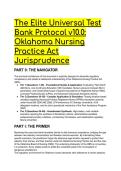
The Elite Universal Test
Bank Protocol v10.0:
Oklahoma Nursing
Practice Act
Jurisprudence
PART 0: THE NAVIGATOR
The structural architecture of this document is explicitly designed to dismantle regulatory
complacency and rebuild a bulletproof understanding of the Oklahoma Nursing Practice Act
(NPA).
● Tier 1 (Questions 1–29) - Foundational Syntax & Application: Evaluating "Hard Deck"
definitions, core Continuing Education (CE) mandates, Nurse Licensure Compact (NLC)
parameters, and fundamental scope of practice boundaries for Registered Nurses (RNs),
Licensed Practical Nurses (LPNs), and Advanced Unlicensed Assistants (AUAs).
● Tier 2 (Questions 30–58) - Complex Application & Simulation: Testing situation-based
variables regarding Advanced Practice Registered Nurse (APRN) prescriptive authority
under House Bill 2298 (HB 2298), LPN intravenous (IV) therapy constraints, AUA
delegation matrices, and the strict operational mechanics of the Peer Assistance Program
(PAP).
● Tier 3 (Questions 59–88) - Grandmaster Synthesis: High-stakes, multi-variable
scenarios requiring the synthesis of disciplinary actions, administrative penalties,
professional boundary violations, exclusionary formularies, and catastrophic regulatory
failure prevention.
PART I: THE PRIMER
Mastering this exact test bank translates directly to elite licensure competence, bridging the gap
between raw statutory memorization and flawless clinical execution. By internalizing these
specific scenarios, the practitioner forges the defensive legal intuition required to protect their
patients, their license, and their practice under the Oklahoma Nursing Practice Act and the rules
of the Oklahoma Board of Nursing (OBN). The underlying philosophy of the OBN is not punitive;
it is protective. Every statute exists to shield the vulnerable public from incompetent or
dangerous practitioners.
The regulatory environment for Oklahoma nurses demands strict adherence to recent statutory
,updates. The passage of HB 2298 fundamentally altered the prescriptive authority of APRNs.
This legislation grants eligible Certified Nurse Practitioners (CNPs), Clinical Nurse Specialists
(CNSs), and Certified Nurse-Midwives (CNMs) a pathway to independent prescribing, removing
the legacy requirement for lifelong physician supervision. However, the state maintains strict,
non-negotiable boundaries; regardless of independent status, APRNs are categorically
prohibited from independently prescribing Schedule II controlled substances under the
Exclusionary Formulary.
Concurrently, Oklahoma has aggressively codified delegation limits to prevent scope creep. The
state established distinct boundaries between RN autonomous assessment, LPN directed
practice, and the specific acute-care technical skill sets of AUAs. Furthermore, Oklahoma's
integration of the Nurse Licensure Compact (NLC) requires exact compliance regarding primary
state of residence (PSOR) transitions, eliminating grace periods for border-crossing
practitioners.
Critical Axioms and Operational Matrices
Axiom Category Statutory Rule Clinical/Operational Implication
APRN Authority (HB 2298) 6,240 supervised hours + 45
Unlocks independent
Cat B CE hours. prescribing. Schedule II drugs
remain strictly prohibited.
Workforce Delegation (AUA) Acute care only. 200-hour AUAs can perform EKGs and
training. No assessment. phlebotomy but cannot be
delegated tasks requiring
nursing judgment.
LPN IV Therapy Limits No cardiac push/bolus. No IV LPNs may monitor blood and
blood push. administer fluids via
central/PICC lines but cannot
initiate high-risk pushes unless
ACLS certified for emergencies.
NLC Mobility 60-day PSOR change deadline. A nurse moving to OK from
another compact state has
exactly 60 days to apply for a
new multistate license.
License Renewal & CE 24 contact hours OR 520 work Licenses must be renewed with
hours every 2 years. verifiable proof of continued
competence; options cannot be
combined.
Disciplinary Fines Maximum $500 administrative Violating the NPA is a
penalty per count. misdemeanor. The Board can
also recover all investigation
and prosecution costs.
PART II: THE ELITE TEST BANK
TIER 1: Foundational Syntax & Application
Q1: A Registered Nurse relocates their primary state of residence from Texas to Oklahoma.
, Under the NLC, how many days does the RN have to apply for an Oklahoma multistate license?
A) 30 days B) 60 days C) 90 days D) Prior to the expiration of the Texas license The Answer:
B. Distractor Analysis: A is the timeframe for in-state address changes. B is the correct NLC
rule implemented in 2024. C and D represent incorrect grace periods. Mentor's Analysis:
Jurisdictional mobility requires absolute administrative compliance. The 60-day clock is
non-negotiable and triggers the moment residency is established.
Q2: To meet the continuing qualifications for practice for license renewal, an Oklahoma RN or
LPN must complete which of the following within the past two years? A) 12 contact hours and
260 work hours B) 520 verifiable work hours in a position requiring a nursing license C) 1,000
verifiable work hours D) 40 hours of Category I CME The Answer: B. Distractor Analysis: A is
incorrect because CE options cannot be combined. C is excessive. D applies to APRN
independent prescriptive authority renewal. Mentor's Analysis: The 520-hour rule translates to
roughly 10 hours a week over two years, ensuring active clinical competence without
demanding full-time employment.
Q3: An Oklahoma nurse legally changes their name following a marriage. Within what
timeframe must the licensee notify the Board of Nursing and provide certified evidence? A) 14
days B) 30 days C) 60 days D) At the next license renewal The Answer: B. Distractor
Analysis: B is the strict statutory deadline for both name and address changes. Delaying until
renewal (D) constitutes a direct violation of Board rules. Mentor's Analysis: Administrative
delays reflect poorly on professional accountability. Transparency regarding your identity is
mandatory.
Q4: Which of the following defines the operational setting limits for a Board-Certified Advanced
Unlicensed Assistant (AUA)? A) Home health care environments B) Long-term care and skilled
nursing facilities C) Acute care settings, including hospitals D) Independent outpatient clinics
The Answer: C. Distractor Analysis: AUAs are explicitly prohibited from functioning in the
AUA role in long-term care or home care settings. Mentor's Analysis: The AUA was
legislatively created to assist in high-acuity hospital environments, bridging the gap between
CNAs and licensed nurses, not to replace aides in long-term care.
Q5: An LPN is assigned to care for a patient. According to the Oklahoma NPA, the scope of
licensed practical nursing includes which of the following? A) Formulating the initial plan of
nursing care B) Contributing to the assessment of the health status of individuals C) Performing
independent, comprehensive psychological assessments D) Analyzing assessment data to
determine nursing care needs The Answer: B. Distractor Analysis: A, C, and D are explicit,
exclusive functions of the Registered Nurse. The LPN practices under supervision and
contributes to the assessment. Mentor's Analysis: The RN builds the blueprint; the LPN helps
gather the materials and executes the directed build.
Q6: How many hours of approved training must a candidate successfully complete to be eligible
for AUA certification in Oklahoma? A) 75 hours B) 120 hours C) 200 hours D) 400 hours The
Answer: C. Distractor Analysis: C is the exact statutory requirement for AUA training
programs. Mentor's Analysis: The 200-hour threshold ensures the AUA has sufficient technical
proficiency before managing high-acuity tasks.
Q7: An applicant for RN licensure by examination fails the NCLEX-RN. What is the minimum
waiting period required before they can retake the exam? A) 14 days B) 30 days C) 45 days D)
60 days The Answer: C. Distractor Analysis: The NCSBN and state boards enforce a strict
45-day waiting period between NCLEX testing dates. Mentor's Analysis: This enforced pause
forces candidates to remediate and address knowledge gaps rather than panic-test.
Q8: Which of the following criminal convictions categorically disqualifies an individual from
obtaining a nursing license in Oklahoma? A) Misdemeanor possession of marijuana B)
Bank Protocol v10.0:
Oklahoma Nursing
Practice Act
Jurisprudence
PART 0: THE NAVIGATOR
The structural architecture of this document is explicitly designed to dismantle regulatory
complacency and rebuild a bulletproof understanding of the Oklahoma Nursing Practice Act
(NPA).
● Tier 1 (Questions 1–29) - Foundational Syntax & Application: Evaluating "Hard Deck"
definitions, core Continuing Education (CE) mandates, Nurse Licensure Compact (NLC)
parameters, and fundamental scope of practice boundaries for Registered Nurses (RNs),
Licensed Practical Nurses (LPNs), and Advanced Unlicensed Assistants (AUAs).
● Tier 2 (Questions 30–58) - Complex Application & Simulation: Testing situation-based
variables regarding Advanced Practice Registered Nurse (APRN) prescriptive authority
under House Bill 2298 (HB 2298), LPN intravenous (IV) therapy constraints, AUA
delegation matrices, and the strict operational mechanics of the Peer Assistance Program
(PAP).
● Tier 3 (Questions 59–88) - Grandmaster Synthesis: High-stakes, multi-variable
scenarios requiring the synthesis of disciplinary actions, administrative penalties,
professional boundary violations, exclusionary formularies, and catastrophic regulatory
failure prevention.
PART I: THE PRIMER
Mastering this exact test bank translates directly to elite licensure competence, bridging the gap
between raw statutory memorization and flawless clinical execution. By internalizing these
specific scenarios, the practitioner forges the defensive legal intuition required to protect their
patients, their license, and their practice under the Oklahoma Nursing Practice Act and the rules
of the Oklahoma Board of Nursing (OBN). The underlying philosophy of the OBN is not punitive;
it is protective. Every statute exists to shield the vulnerable public from incompetent or
dangerous practitioners.
The regulatory environment for Oklahoma nurses demands strict adherence to recent statutory
,updates. The passage of HB 2298 fundamentally altered the prescriptive authority of APRNs.
This legislation grants eligible Certified Nurse Practitioners (CNPs), Clinical Nurse Specialists
(CNSs), and Certified Nurse-Midwives (CNMs) a pathway to independent prescribing, removing
the legacy requirement for lifelong physician supervision. However, the state maintains strict,
non-negotiable boundaries; regardless of independent status, APRNs are categorically
prohibited from independently prescribing Schedule II controlled substances under the
Exclusionary Formulary.
Concurrently, Oklahoma has aggressively codified delegation limits to prevent scope creep. The
state established distinct boundaries between RN autonomous assessment, LPN directed
practice, and the specific acute-care technical skill sets of AUAs. Furthermore, Oklahoma's
integration of the Nurse Licensure Compact (NLC) requires exact compliance regarding primary
state of residence (PSOR) transitions, eliminating grace periods for border-crossing
practitioners.
Critical Axioms and Operational Matrices
Axiom Category Statutory Rule Clinical/Operational Implication
APRN Authority (HB 2298) 6,240 supervised hours + 45
Unlocks independent
Cat B CE hours. prescribing. Schedule II drugs
remain strictly prohibited.
Workforce Delegation (AUA) Acute care only. 200-hour AUAs can perform EKGs and
training. No assessment. phlebotomy but cannot be
delegated tasks requiring
nursing judgment.
LPN IV Therapy Limits No cardiac push/bolus. No IV LPNs may monitor blood and
blood push. administer fluids via
central/PICC lines but cannot
initiate high-risk pushes unless
ACLS certified for emergencies.
NLC Mobility 60-day PSOR change deadline. A nurse moving to OK from
another compact state has
exactly 60 days to apply for a
new multistate license.
License Renewal & CE 24 contact hours OR 520 work Licenses must be renewed with
hours every 2 years. verifiable proof of continued
competence; options cannot be
combined.
Disciplinary Fines Maximum $500 administrative Violating the NPA is a
penalty per count. misdemeanor. The Board can
also recover all investigation
and prosecution costs.
PART II: THE ELITE TEST BANK
TIER 1: Foundational Syntax & Application
Q1: A Registered Nurse relocates their primary state of residence from Texas to Oklahoma.
, Under the NLC, how many days does the RN have to apply for an Oklahoma multistate license?
A) 30 days B) 60 days C) 90 days D) Prior to the expiration of the Texas license The Answer:
B. Distractor Analysis: A is the timeframe for in-state address changes. B is the correct NLC
rule implemented in 2024. C and D represent incorrect grace periods. Mentor's Analysis:
Jurisdictional mobility requires absolute administrative compliance. The 60-day clock is
non-negotiable and triggers the moment residency is established.
Q2: To meet the continuing qualifications for practice for license renewal, an Oklahoma RN or
LPN must complete which of the following within the past two years? A) 12 contact hours and
260 work hours B) 520 verifiable work hours in a position requiring a nursing license C) 1,000
verifiable work hours D) 40 hours of Category I CME The Answer: B. Distractor Analysis: A is
incorrect because CE options cannot be combined. C is excessive. D applies to APRN
independent prescriptive authority renewal. Mentor's Analysis: The 520-hour rule translates to
roughly 10 hours a week over two years, ensuring active clinical competence without
demanding full-time employment.
Q3: An Oklahoma nurse legally changes their name following a marriage. Within what
timeframe must the licensee notify the Board of Nursing and provide certified evidence? A) 14
days B) 30 days C) 60 days D) At the next license renewal The Answer: B. Distractor
Analysis: B is the strict statutory deadline for both name and address changes. Delaying until
renewal (D) constitutes a direct violation of Board rules. Mentor's Analysis: Administrative
delays reflect poorly on professional accountability. Transparency regarding your identity is
mandatory.
Q4: Which of the following defines the operational setting limits for a Board-Certified Advanced
Unlicensed Assistant (AUA)? A) Home health care environments B) Long-term care and skilled
nursing facilities C) Acute care settings, including hospitals D) Independent outpatient clinics
The Answer: C. Distractor Analysis: AUAs are explicitly prohibited from functioning in the
AUA role in long-term care or home care settings. Mentor's Analysis: The AUA was
legislatively created to assist in high-acuity hospital environments, bridging the gap between
CNAs and licensed nurses, not to replace aides in long-term care.
Q5: An LPN is assigned to care for a patient. According to the Oklahoma NPA, the scope of
licensed practical nursing includes which of the following? A) Formulating the initial plan of
nursing care B) Contributing to the assessment of the health status of individuals C) Performing
independent, comprehensive psychological assessments D) Analyzing assessment data to
determine nursing care needs The Answer: B. Distractor Analysis: A, C, and D are explicit,
exclusive functions of the Registered Nurse. The LPN practices under supervision and
contributes to the assessment. Mentor's Analysis: The RN builds the blueprint; the LPN helps
gather the materials and executes the directed build.
Q6: How many hours of approved training must a candidate successfully complete to be eligible
for AUA certification in Oklahoma? A) 75 hours B) 120 hours C) 200 hours D) 400 hours The
Answer: C. Distractor Analysis: C is the exact statutory requirement for AUA training
programs. Mentor's Analysis: The 200-hour threshold ensures the AUA has sufficient technical
proficiency before managing high-acuity tasks.
Q7: An applicant for RN licensure by examination fails the NCLEX-RN. What is the minimum
waiting period required before they can retake the exam? A) 14 days B) 30 days C) 45 days D)
60 days The Answer: C. Distractor Analysis: The NCSBN and state boards enforce a strict
45-day waiting period between NCLEX testing dates. Mentor's Analysis: This enforced pause
forces candidates to remediate and address knowledge gaps rather than panic-test.
Q8: Which of the following criminal convictions categorically disqualifies an individual from
obtaining a nursing license in Oklahoma? A) Misdemeanor possession of marijuana B)


