

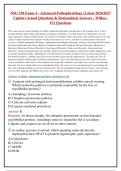
NSG 530 Exam 4 - Advanced Pathophysiology (Latest 2026/2027
Update) Actual Questions & Rationalized Answers - Wilkes -
151 Questions
This exam assesses understanding of cellular adaptation and injury mechanisms at the graduate level. Topics
include atrophy, hypertrophy, hyperplasia, metaplasia, dysplasia, reversible and irreversible injury, necrosis
types, apoptosis, and free radical injury. It contains 151 multiple-choice questions, each with four distractors and
a fully worked rationale that explains why the keyed answer is correct. Content is organized into 10 focused
sections: Cellular Adaptation and Injury, Inflammation and Immune Response, Genetic and Congenital Disorders,
Neoplastic Disorders and Cancer Biology, Cardiovascular and Peripheral Vascular Disorders, Respiratory
Disorders, Renal and Urinary Disorders, Neurological Disorders, Endocrine Disorders, Gastrointestinal
Disorders. Targeted learning outcomes include: Analyze molecular pathways underlying cellular adaptations such
as atrophy and hypertrophy.; Distinguish reversible from irreversible cell injury based on ultrastructural and
biochemical markers.; Identify types of necrosis and their tissue-specific appearances.; Evaluate the roles of
apoptosis and free radical injury in disease pathogenesis.. Every item has been reviewed for clinical accuracy,
current guidelines, and clarity so that students can study with confidence and self-correct as they work through
the bank. Use it as a high-yield review immediately before the exam, or as a structured practice tool during the
unit - the rationales double as concise teaching notes. The recommended writing time is 2 hours, with a passing
score of 70%. Aligned with Wilkes University, PA - Graduate Nursing Program standards and reflects the
Section 1: Cellular Adaptation and Injury (Questions 1-10)
1 A patient with prolonged limb immobilization exhibits muscle wasting.
Which molecular pathway is primarily responsible for the loss of
myofibrillar proteins?
A) Autophagy-lysosome pathway
B) Ubiquitin-proteasome pathway
C) Calcium-activated calpains
D) Caspase-mediated proteolysis
Answer: B
Rationale: In disuse atrophy, the ubiquitin-proteasome system degrades
myofibrillar proteins. Autophagy removes organelles but is secondary.
Calpains and caspases are involved in other contexts.
2 In cardiac pressure overload, which signaling molecule directly
dephosphorylates NFAT to promote hypertrophic gene expression?
A) Calcineurin
B) GATA4
C) MAPK
D) PI3K
,Answer: A
Rationale: Calcineurin, a calcium-regulated phosphatase, dephosphorylates
NFAT, allowing its nuclear translocation and activation of hypertrophic genes.
GATA4 is a downstream transcription factor. MAPK and PI3K are involved in
other hypertrophic signaling.
3 After partial hepatectomy, remaining hepatocytes proliferate. Which growth
factor is most critical for this compensatory hyperplasia?
A) Hepatocyte growth factor (HGF)
B) Epidermal growth factor (EGF)
C) Transforming growth factor-alpha (TGF-)
D) Insulin-like growth factor (IGF)
Answer: A
Rationale: HGF is the primary mitogen driving hepatocyte proliferation after
partial hepatectomy. While EGF, TGF-, and IGF contribute, HGF is most
critical.
4 In Barrett esophagus, normal squamous epithelium is replaced by columnar
cells. Which transcription factor is essential for this metaplastic change?
A) Sox2
B) Cdx2
C) P63
D) TTF-1
Answer: B
Rationale: Cdx2 is a homeobox transcription factor that induces columnar
differentiation in esophageal epithelium. Sox2 maintains squamous identity,
P63 marks basal cells, and TTF-1 is lung-specific.
5 A cervical biopsy shows full-thickness loss of polarity, nuclear atypia, and
numerous mitoses without basement membrane invasion. This lesion is best
classified as:
A) Mild dysplasia
B) Moderate dysplasia
C) Severe dysplasia/carcinoma in situ
D) Invasive carcinoma
Answer: C
,Rationale: Full-thickness atypia without invasion defines severe
dysplasia/carcinoma in situ. Mild and moderate dysplasia involve only lower
layers. Invasion through basement membrane defines invasive carcinoma.
6 In hepatic ischemia, which of the following is the earliest microscopic sign
of reversible cell injury?
A) Loss of ribosomes from rough endoplasmic reticulum
B) Cellular swelling with blebbing
C) Myelin figures
D) Increased eosinophilia
Answer: B
Rationale: Cellular swelling results from failure of the Na+/K+ pump due to
ATP depletion and is the earliest reversible change. Loss of ribosomes and
myelin figures occur later. Increased eosinophilia indicates irreversible injury.
7 The point of no return in cell injury is closely associated with which event?
A) DNA fragmentation
B) Massive calcium influx into mitochondria
C) Activation of caspases
D) Loss of plasma membrane integrity
Answer: B
Rationale: Massive calcium influx into mitochondria triggers opening of the
mitochondrial permeability transition pore, releasing cytochrome c and
committing the cell to death. DNA fragmentation and caspase activation occur
downstream.
8 A myocardial infarction shows preserved tissue architecture with loss of
nuclei and eosinophilic cytoplasm. This appearance is characteristic of which
type of necrosis?
A) Coagulative necrosis
B) Liquefactive necrosis
C) Caseous necrosis
D) Gangrenous necrosis
Answer: A
Rationale: Coagulative necrosis preserves tissue architecture due to
denaturation of structural proteins. Liquefactive necrosis leads to cystic
, cavities, caseous necrosis is soft and cheesy, and gangrenous involves
superimposed liquefaction.
9 In the intrinsic apoptotic pathway, which mitochondrial protein, when
released, directly forms the apoptosome with Apaf-1?
A) Cytochrome c
B) SMAC/DIABLO
C) Endonuclease G
D) AIF
Answer: A
Rationale: Cytochrome c binds Apaf-1 to form the apoptosome, activating
procaspase-9. SMAC/DIABLO inhibits IAPs, while Endonuclease G and AIF
cause DNA fragmentation independently of caspases.
10 Which antioxidant enzyme directly converts hydrogen peroxide to water
and molecular oxygen?
A) Superoxide dismutase
B) Catalase
C) Glutathione peroxidase
D) Heme oxygenase
Answer: B
Rationale: Catalase, located in peroxisomes, catalyzes the conversion of H2O2
to H2O and O2. Superoxide dismutase converts superoxide to H2O2.
Glutathione peroxidase removes H2O2 using reduced glutathione.
Section 2: Inflammation and Immune Response (Questions 11-30)
11 In a patient with persistent bacterial infection, macrophages release IL-23
which stimulates Th17 cells. Which of the following best describes the
downstream effect of this interaction on the inflammatory response?
A) Enhances eosinophil recruitment via IL-5 secretion
B) Promotes neutrophil accumulation through IL-17 secretion
C) Induces mast cell degranulation via IgE cross-linking
D) Activates natural killer cells through IL-12 secretion
Answer: B
Rationale: IL-23 activates Th17 cells to produce IL-17, which recruits
Update) Actual Questions & Rationalized Answers - Wilkes -
151 Questions
This exam assesses understanding of cellular adaptation and injury mechanisms at the graduate level. Topics
include atrophy, hypertrophy, hyperplasia, metaplasia, dysplasia, reversible and irreversible injury, necrosis
types, apoptosis, and free radical injury. It contains 151 multiple-choice questions, each with four distractors and
a fully worked rationale that explains why the keyed answer is correct. Content is organized into 10 focused
sections: Cellular Adaptation and Injury, Inflammation and Immune Response, Genetic and Congenital Disorders,
Neoplastic Disorders and Cancer Biology, Cardiovascular and Peripheral Vascular Disorders, Respiratory
Disorders, Renal and Urinary Disorders, Neurological Disorders, Endocrine Disorders, Gastrointestinal
Disorders. Targeted learning outcomes include: Analyze molecular pathways underlying cellular adaptations such
as atrophy and hypertrophy.; Distinguish reversible from irreversible cell injury based on ultrastructural and
biochemical markers.; Identify types of necrosis and their tissue-specific appearances.; Evaluate the roles of
apoptosis and free radical injury in disease pathogenesis.. Every item has been reviewed for clinical accuracy,
current guidelines, and clarity so that students can study with confidence and self-correct as they work through
the bank. Use it as a high-yield review immediately before the exam, or as a structured practice tool during the
unit - the rationales double as concise teaching notes. The recommended writing time is 2 hours, with a passing
score of 70%. Aligned with Wilkes University, PA - Graduate Nursing Program standards and reflects the
Section 1: Cellular Adaptation and Injury (Questions 1-10)
1 A patient with prolonged limb immobilization exhibits muscle wasting.
Which molecular pathway is primarily responsible for the loss of
myofibrillar proteins?
A) Autophagy-lysosome pathway
B) Ubiquitin-proteasome pathway
C) Calcium-activated calpains
D) Caspase-mediated proteolysis
Answer: B
Rationale: In disuse atrophy, the ubiquitin-proteasome system degrades
myofibrillar proteins. Autophagy removes organelles but is secondary.
Calpains and caspases are involved in other contexts.
2 In cardiac pressure overload, which signaling molecule directly
dephosphorylates NFAT to promote hypertrophic gene expression?
A) Calcineurin
B) GATA4
C) MAPK
D) PI3K
,Answer: A
Rationale: Calcineurin, a calcium-regulated phosphatase, dephosphorylates
NFAT, allowing its nuclear translocation and activation of hypertrophic genes.
GATA4 is a downstream transcription factor. MAPK and PI3K are involved in
other hypertrophic signaling.
3 After partial hepatectomy, remaining hepatocytes proliferate. Which growth
factor is most critical for this compensatory hyperplasia?
A) Hepatocyte growth factor (HGF)
B) Epidermal growth factor (EGF)
C) Transforming growth factor-alpha (TGF-)
D) Insulin-like growth factor (IGF)
Answer: A
Rationale: HGF is the primary mitogen driving hepatocyte proliferation after
partial hepatectomy. While EGF, TGF-, and IGF contribute, HGF is most
critical.
4 In Barrett esophagus, normal squamous epithelium is replaced by columnar
cells. Which transcription factor is essential for this metaplastic change?
A) Sox2
B) Cdx2
C) P63
D) TTF-1
Answer: B
Rationale: Cdx2 is a homeobox transcription factor that induces columnar
differentiation in esophageal epithelium. Sox2 maintains squamous identity,
P63 marks basal cells, and TTF-1 is lung-specific.
5 A cervical biopsy shows full-thickness loss of polarity, nuclear atypia, and
numerous mitoses without basement membrane invasion. This lesion is best
classified as:
A) Mild dysplasia
B) Moderate dysplasia
C) Severe dysplasia/carcinoma in situ
D) Invasive carcinoma
Answer: C
,Rationale: Full-thickness atypia without invasion defines severe
dysplasia/carcinoma in situ. Mild and moderate dysplasia involve only lower
layers. Invasion through basement membrane defines invasive carcinoma.
6 In hepatic ischemia, which of the following is the earliest microscopic sign
of reversible cell injury?
A) Loss of ribosomes from rough endoplasmic reticulum
B) Cellular swelling with blebbing
C) Myelin figures
D) Increased eosinophilia
Answer: B
Rationale: Cellular swelling results from failure of the Na+/K+ pump due to
ATP depletion and is the earliest reversible change. Loss of ribosomes and
myelin figures occur later. Increased eosinophilia indicates irreversible injury.
7 The point of no return in cell injury is closely associated with which event?
A) DNA fragmentation
B) Massive calcium influx into mitochondria
C) Activation of caspases
D) Loss of plasma membrane integrity
Answer: B
Rationale: Massive calcium influx into mitochondria triggers opening of the
mitochondrial permeability transition pore, releasing cytochrome c and
committing the cell to death. DNA fragmentation and caspase activation occur
downstream.
8 A myocardial infarction shows preserved tissue architecture with loss of
nuclei and eosinophilic cytoplasm. This appearance is characteristic of which
type of necrosis?
A) Coagulative necrosis
B) Liquefactive necrosis
C) Caseous necrosis
D) Gangrenous necrosis
Answer: A
Rationale: Coagulative necrosis preserves tissue architecture due to
denaturation of structural proteins. Liquefactive necrosis leads to cystic
, cavities, caseous necrosis is soft and cheesy, and gangrenous involves
superimposed liquefaction.
9 In the intrinsic apoptotic pathway, which mitochondrial protein, when
released, directly forms the apoptosome with Apaf-1?
A) Cytochrome c
B) SMAC/DIABLO
C) Endonuclease G
D) AIF
Answer: A
Rationale: Cytochrome c binds Apaf-1 to form the apoptosome, activating
procaspase-9. SMAC/DIABLO inhibits IAPs, while Endonuclease G and AIF
cause DNA fragmentation independently of caspases.
10 Which antioxidant enzyme directly converts hydrogen peroxide to water
and molecular oxygen?
A) Superoxide dismutase
B) Catalase
C) Glutathione peroxidase
D) Heme oxygenase
Answer: B
Rationale: Catalase, located in peroxisomes, catalyzes the conversion of H2O2
to H2O and O2. Superoxide dismutase converts superoxide to H2O2.
Glutathione peroxidase removes H2O2 using reduced glutathione.
Section 2: Inflammation and Immune Response (Questions 11-30)
11 In a patient with persistent bacterial infection, macrophages release IL-23
which stimulates Th17 cells. Which of the following best describes the
downstream effect of this interaction on the inflammatory response?
A) Enhances eosinophil recruitment via IL-5 secretion
B) Promotes neutrophil accumulation through IL-17 secretion
C) Induces mast cell degranulation via IgE cross-linking
D) Activates natural killer cells through IL-12 secretion
Answer: B
Rationale: IL-23 activates Th17 cells to produce IL-17, which recruits


