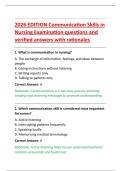
2026 EDITION Communication Skills in
Nursing Examination questions and
verified answers with rationales
1. What is communication in nursing?
A. The exchange of information, feelings, and ideas between
people
B. Giving instructions without listening
C. Writing reports only
D. Talking to patients only
Correct Answer: A
Rationale: Communication is a two-way process involving
sending and receiving messages to promote understanding.
2. Which communication skill is considered most important
for nurses?
A. Active listening
B. Interrupting patients frequently
C. Speaking loudly
D. Memorising medical terminology
Correct Answer: A
Rationale: Active listening helps nurses understand patients'
concerns accurately and build trust.
,3. Which form of communication uses facial expressions and
body language?
A. Verbal communication
B. Non-verbal communication
C. Written communication
D. Electronic communication
Correct Answer: B
Rationale: Non-verbal communication includes gestures,
posture, eye contact, facial expressions, and body
movements.
4. Which statement demonstrates therapeutic
communication?
A. "Tell me more about how you are feeling."
B. "You should not feel that way."
C. "Stop worrying about it."
D. "Everything will be fine."
Correct Answer: A
Rationale: Open-ended questions encourage patients to
express their thoughts and feelings.
5. Which factor is most likely to interfere with effective
communication?
,A. Noise
B. Eye contact
C. Respect
D. Empathy
Correct Answer: A
Rationale: Environmental noise can prevent clear
transmission and understanding of messages.
6. What is the primary purpose of communication in
nursing?
A. To promote safe and effective patient care
B. To entertain patients
C. To increase paperwork
D. To avoid patient interaction
Correct Answer: A
Rationale: Effective communication supports accurate
assessment, patient safety, and quality care.
7. Which communication technique helps clarify a patient's
message?
A. Paraphrasing
B. Ignoring
C. Changing the topic
D. Giving advice immediately
Correct Answer: A
, Rationale: Paraphrasing confirms understanding and
encourages further discussion.
8. Which is an example of verbal communication?
A. Speaking to a patient
B. Smiling at a patient
C. Nodding during a conversation
D. Maintaining eye contact
Correct Answer: A
Rationale: Verbal communication involves spoken words.
9. Which quality is essential for therapeutic
communication?
A. Empathy
B. Judgement
C. Criticism
D. Impatience
Correct Answer: A
Rationale: Empathy allows nurses to understand and respond
appropriately to patients' emotions.
10. Which communication style encourages patient
participation?
A. Open-ended questions
B. Closed commands only
Nursing Examination questions and
verified answers with rationales
1. What is communication in nursing?
A. The exchange of information, feelings, and ideas between
people
B. Giving instructions without listening
C. Writing reports only
D. Talking to patients only
Correct Answer: A
Rationale: Communication is a two-way process involving
sending and receiving messages to promote understanding.
2. Which communication skill is considered most important
for nurses?
A. Active listening
B. Interrupting patients frequently
C. Speaking loudly
D. Memorising medical terminology
Correct Answer: A
Rationale: Active listening helps nurses understand patients'
concerns accurately and build trust.
,3. Which form of communication uses facial expressions and
body language?
A. Verbal communication
B. Non-verbal communication
C. Written communication
D. Electronic communication
Correct Answer: B
Rationale: Non-verbal communication includes gestures,
posture, eye contact, facial expressions, and body
movements.
4. Which statement demonstrates therapeutic
communication?
A. "Tell me more about how you are feeling."
B. "You should not feel that way."
C. "Stop worrying about it."
D. "Everything will be fine."
Correct Answer: A
Rationale: Open-ended questions encourage patients to
express their thoughts and feelings.
5. Which factor is most likely to interfere with effective
communication?
,A. Noise
B. Eye contact
C. Respect
D. Empathy
Correct Answer: A
Rationale: Environmental noise can prevent clear
transmission and understanding of messages.
6. What is the primary purpose of communication in
nursing?
A. To promote safe and effective patient care
B. To entertain patients
C. To increase paperwork
D. To avoid patient interaction
Correct Answer: A
Rationale: Effective communication supports accurate
assessment, patient safety, and quality care.
7. Which communication technique helps clarify a patient's
message?
A. Paraphrasing
B. Ignoring
C. Changing the topic
D. Giving advice immediately
Correct Answer: A
, Rationale: Paraphrasing confirms understanding and
encourages further discussion.
8. Which is an example of verbal communication?
A. Speaking to a patient
B. Smiling at a patient
C. Nodding during a conversation
D. Maintaining eye contact
Correct Answer: A
Rationale: Verbal communication involves spoken words.
9. Which quality is essential for therapeutic
communication?
A. Empathy
B. Judgement
C. Criticism
D. Impatience
Correct Answer: A
Rationale: Empathy allows nurses to understand and respond
appropriately to patients' emotions.
10. Which communication style encourages patient
participation?
A. Open-ended questions
B. Closed commands only