

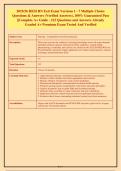
2025/26 HESI RN Exit Exam Versions 1 - 7 Multiple Choice
Questions & Answers (Verified Answers), 100% Guaranteed Pass
||Complete A+ Guide - 212 Questions and Answers Already
Graded A+ Premium Exam Tested And Verified
Subject Area Nursing - Comprehensive Exit Examination
Description This exam assesses the synthesis of nursing knowledge across all major domains
including medical-surgical, maternal-newborn, pediatrics, mental health,
pharmacology, leadership, and critical care. Based on the 2025/26 HESI RN Exit
Exam blueprint, questions require application of evidence-based practice, clinical
reasoning, and prioritization skills.
Expected Grade A+
Total Questions 212
Duration 3 hours 30 minutes
Learning Outcomes 1. Apply pharmacokinetics and pharmacodynamics to client care scenarios.
2. Interpret cardiac rhythms and select appropriate interventions.
3. Manage obstetric emergencies using current guidelines.
4. Demonstrate therapeutic communication in mental health nursing.
5. Prioritize nursing actions using Maslow's hierarchy and safety principles.
6. Analyze diagnostic data to guide fluid and electrolyte therapy.
7. Delegate tasks according to scope of practice and state regulations.
8. Implement infection control measures based on pathogen transmission.
9. Evaluate ethical issues surrounding informed consent and client autonomy.
Accreditation Aligns with AACN Essentials and NCLEX-RN test plan; typical of Ivy League
and top-tier US nursing schools.
Page 1
,1. A client receiving intravenous vancomycin for a methicillin-resistant
Staphylococcus aureus infection develops sudden onset of flushing, pruritus,
and hypotension. Which nursing action is most appropriate?
A. Administer diphenhydramine and continue the infusion at a slower rate.
B. Stop the infusion immediately and apply a cold compress to the client's face.
C. Discontinue the IV line and notify the healthcare provider stat.
D. Slow the infusion rate to 50% and document the reaction as an expected side effect.
Answer: C. Discontinue the IV line and notify the healthcare provider stat.
These symptoms suggest vancomycin-related anaphylaxis. The immediate
priority is to stop the infusion and discontinue the IV line to prevent further drug
administration, then notify the provider. Option A is incorrect because
diphenhydramine is for mild histamine release, not anaphylaxis; slowing the
infusion would still be dangerous. Option B is insufficient because the IV line still
contains the drug. Option D mistakenly treats a severe reaction as a minor red
man syndrome.
2. A client with acute coronary syndrome develops ventricular tachycardia and
becomes pulseless. After defibrillation, the rhythm shows asystole. What is the
next immediate action per advanced cardiac life support?
A. Administer epinephrine 1 mg IV push every 3-5 minutes.
B. Perform synchronized cardioversion at 100 joules.
C. Start a dopamine infusion at 5 mcg/kg/min.
D. Give amiodarone 300 mg IV push.
Answer: A. Administer epinephrine 1 mg IV push every 3-5 minutes.
After defibrillation for pulseless VT, asystole is a non-shockable rhythm. The
ACLS algorithm for asystole prioritizes high-quality CPR and epinephrine 1 mg
IV every 3-5 minutes. Synchronized cardioversion (B) is not used for pulseless
rhythms. Dopamine (C) is not indicated in asystole. Amiodarone (D) is for
shockable rhythms (VF/pVT).
Page 2
,3. A client in active labor receives oxytocin augmentation. The fetal heart rate
(FHR) shows variable decelerations with late return to baseline. Contractions
occur every 2 minutes and last 90 seconds. What is the immediate priority?
A. Decrease the oxytocin infusion rate by half.
B. Reposition the client to the left lateral side.
C. Administer oxygen via nonrebreather mask at 15 L/min.
D. Prepare for immediate cesarean delivery.
Answer: B. Reposition the client to the left lateral side.
Variable decelerations suggest cord compression, and late return may indicate
developing hypoxia. First-line interventions include maternal position change to
relieve cord compression. Decreasing oxytocin (A) is done for tachysystole but
does not address the decelerations directly. Oxygen (C) is appropriate but not the
first action. Cesarean (D) is reserved for nonreassuring status unresponsive to
conservative measures.
4. A child with croup is placed in a mist tent. The nurse notes increasing
stridor at rest and intercostal retractions. The pulse oximetry is 90% on room
air. What is the nurse's best action?
A. Administer nebulized racemic epinephrine and prepare for intubation.
B. Increase the oxygen concentration in the mist tent to 50%.
C. Suction the child's airway vigorously.
D. Administer a dose of dexamethasone IV push.
Answer: A. Administer nebulized racemic epinephrine and prepare for
intubation.
Increasing stridor at rest, retractions, and hypoxemia indicate severe croup.
Racemic epinephrine provides rapid mucosal vasoconstriction. The need for
intubation is imminent if not improving. Option B may help but does not treat
the airway edema directly. Suctioning (C) can cause further irritation.
Dexamethasone (D) is a mainstay but has slow onset (hours).
Page 3
, 5. A client with obsessive-compulsive disorder is admitted after spending hours
each day washing hands to the point of skin breakdown. The client states, 'I
know it's irrational, but I can't stop.' Which is the most appropriate nursing
response?
A. Tell the client to interrupt the behavior by setting a timer for decreasing durations.
B. Reassure the client that the urge will subside if they resist.
C. Allow the client to continue the behavior to reduce anxiety initially.
D. Challenge the client's belief by asking, 'What is the worst that could happen if you
don't wash?'
Answer: A. Tell the client to interrupt the behavior by setting a timer for
decreasing durations.
Response prevention with gradual reduction is a behavioral technique for OCD.
Setting a timer helps the client gain control without overwhelming anxiety.
Option B may increase anxiety if the client cannot resist. Option C reinforces the
compulsion. Option D is a cognitive intervention but premature; the client
already recognizes irrationality.
6. The charge nurse on a medical-surgical unit must assign the following tasks
to a licensed practical nurse (LPN) and a certified nursing assistant (CNA).
Which assignment is most appropriate for the LPN?
A. Administer oral metoprolol to a client with a heart rate of 66/min.
B. Perform a sterile dressing change on a client with a stage 3 pressure injury.
C. Assess a client reporting chest pain and shortness of breath.
D. Teach a client with new type 2 diabetes how to self-administer insulin.
Answer: B. Perform a sterile dressing change on a client with a stage 3
pressure injury.
LPN scope includes performing sterile wound care and monitoring stable clients.
Administering oral medications (A) is within LPN scope but requires verifying
heart rate; however, the client is stable. The LPN can perform the dressing
change, but assessment (C) and teaching (D) are RN responsibilities. Option B is
an LPN task, but the critical point is that the wound is stable; complex wounds
may require RN.
Page 4
Questions & Answers (Verified Answers), 100% Guaranteed Pass
||Complete A+ Guide - 212 Questions and Answers Already
Graded A+ Premium Exam Tested And Verified
Subject Area Nursing - Comprehensive Exit Examination
Description This exam assesses the synthesis of nursing knowledge across all major domains
including medical-surgical, maternal-newborn, pediatrics, mental health,
pharmacology, leadership, and critical care. Based on the 2025/26 HESI RN Exit
Exam blueprint, questions require application of evidence-based practice, clinical
reasoning, and prioritization skills.
Expected Grade A+
Total Questions 212
Duration 3 hours 30 minutes
Learning Outcomes 1. Apply pharmacokinetics and pharmacodynamics to client care scenarios.
2. Interpret cardiac rhythms and select appropriate interventions.
3. Manage obstetric emergencies using current guidelines.
4. Demonstrate therapeutic communication in mental health nursing.
5. Prioritize nursing actions using Maslow's hierarchy and safety principles.
6. Analyze diagnostic data to guide fluid and electrolyte therapy.
7. Delegate tasks according to scope of practice and state regulations.
8. Implement infection control measures based on pathogen transmission.
9. Evaluate ethical issues surrounding informed consent and client autonomy.
Accreditation Aligns with AACN Essentials and NCLEX-RN test plan; typical of Ivy League
and top-tier US nursing schools.
Page 1
,1. A client receiving intravenous vancomycin for a methicillin-resistant
Staphylococcus aureus infection develops sudden onset of flushing, pruritus,
and hypotension. Which nursing action is most appropriate?
A. Administer diphenhydramine and continue the infusion at a slower rate.
B. Stop the infusion immediately and apply a cold compress to the client's face.
C. Discontinue the IV line and notify the healthcare provider stat.
D. Slow the infusion rate to 50% and document the reaction as an expected side effect.
Answer: C. Discontinue the IV line and notify the healthcare provider stat.
These symptoms suggest vancomycin-related anaphylaxis. The immediate
priority is to stop the infusion and discontinue the IV line to prevent further drug
administration, then notify the provider. Option A is incorrect because
diphenhydramine is for mild histamine release, not anaphylaxis; slowing the
infusion would still be dangerous. Option B is insufficient because the IV line still
contains the drug. Option D mistakenly treats a severe reaction as a minor red
man syndrome.
2. A client with acute coronary syndrome develops ventricular tachycardia and
becomes pulseless. After defibrillation, the rhythm shows asystole. What is the
next immediate action per advanced cardiac life support?
A. Administer epinephrine 1 mg IV push every 3-5 minutes.
B. Perform synchronized cardioversion at 100 joules.
C. Start a dopamine infusion at 5 mcg/kg/min.
D. Give amiodarone 300 mg IV push.
Answer: A. Administer epinephrine 1 mg IV push every 3-5 minutes.
After defibrillation for pulseless VT, asystole is a non-shockable rhythm. The
ACLS algorithm for asystole prioritizes high-quality CPR and epinephrine 1 mg
IV every 3-5 minutes. Synchronized cardioversion (B) is not used for pulseless
rhythms. Dopamine (C) is not indicated in asystole. Amiodarone (D) is for
shockable rhythms (VF/pVT).
Page 2
,3. A client in active labor receives oxytocin augmentation. The fetal heart rate
(FHR) shows variable decelerations with late return to baseline. Contractions
occur every 2 minutes and last 90 seconds. What is the immediate priority?
A. Decrease the oxytocin infusion rate by half.
B. Reposition the client to the left lateral side.
C. Administer oxygen via nonrebreather mask at 15 L/min.
D. Prepare for immediate cesarean delivery.
Answer: B. Reposition the client to the left lateral side.
Variable decelerations suggest cord compression, and late return may indicate
developing hypoxia. First-line interventions include maternal position change to
relieve cord compression. Decreasing oxytocin (A) is done for tachysystole but
does not address the decelerations directly. Oxygen (C) is appropriate but not the
first action. Cesarean (D) is reserved for nonreassuring status unresponsive to
conservative measures.
4. A child with croup is placed in a mist tent. The nurse notes increasing
stridor at rest and intercostal retractions. The pulse oximetry is 90% on room
air. What is the nurse's best action?
A. Administer nebulized racemic epinephrine and prepare for intubation.
B. Increase the oxygen concentration in the mist tent to 50%.
C. Suction the child's airway vigorously.
D. Administer a dose of dexamethasone IV push.
Answer: A. Administer nebulized racemic epinephrine and prepare for
intubation.
Increasing stridor at rest, retractions, and hypoxemia indicate severe croup.
Racemic epinephrine provides rapid mucosal vasoconstriction. The need for
intubation is imminent if not improving. Option B may help but does not treat
the airway edema directly. Suctioning (C) can cause further irritation.
Dexamethasone (D) is a mainstay but has slow onset (hours).
Page 3
, 5. A client with obsessive-compulsive disorder is admitted after spending hours
each day washing hands to the point of skin breakdown. The client states, 'I
know it's irrational, but I can't stop.' Which is the most appropriate nursing
response?
A. Tell the client to interrupt the behavior by setting a timer for decreasing durations.
B. Reassure the client that the urge will subside if they resist.
C. Allow the client to continue the behavior to reduce anxiety initially.
D. Challenge the client's belief by asking, 'What is the worst that could happen if you
don't wash?'
Answer: A. Tell the client to interrupt the behavior by setting a timer for
decreasing durations.
Response prevention with gradual reduction is a behavioral technique for OCD.
Setting a timer helps the client gain control without overwhelming anxiety.
Option B may increase anxiety if the client cannot resist. Option C reinforces the
compulsion. Option D is a cognitive intervention but premature; the client
already recognizes irrationality.
6. The charge nurse on a medical-surgical unit must assign the following tasks
to a licensed practical nurse (LPN) and a certified nursing assistant (CNA).
Which assignment is most appropriate for the LPN?
A. Administer oral metoprolol to a client with a heart rate of 66/min.
B. Perform a sterile dressing change on a client with a stage 3 pressure injury.
C. Assess a client reporting chest pain and shortness of breath.
D. Teach a client with new type 2 diabetes how to self-administer insulin.
Answer: B. Perform a sterile dressing change on a client with a stage 3
pressure injury.
LPN scope includes performing sterile wound care and monitoring stable clients.
Administering oral medications (A) is within LPN scope but requires verifying
heart rate; however, the client is stable. The LPN can perform the dressing
change, but assessment (C) and teaching (D) are RN responsibilities. Option B is
an LPN task, but the critical point is that the wound is stable; complex wounds
may require RN.
Page 4


