

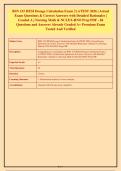
BSN 215 HESI Dosage Calculation Exam | LATEST 2026 | Actual
Exam Questions & Correct Answers with Detailed Rationales |
Graded A | Nursing Math & NCLEX-RN® Prep PDF - 84
Questions and Answers Already Graded A+ Premium Exam
Tested And Verified
Subject Area BSN 215 HESI Dosage Calculation Exam | LATEST 2026 | Actual Exam
Questions & Correct Answers with Detailed Rationales | Graded A | Nursing
Math & NCLEX-RN® Prep PDF
Description Comprehensive examination on BSN 215 HESI Dosage Calculation Exam |
LATEST 2026 | Actual Exam Questions & Correct Answers with Detailed
Rationales | Graded A | Nursing Math & NCLEX-RN® Prep PDF.
Expected Grade A+
Total Questions 84
Duration 3 hours
Learning Outcomes 1. Demonstrate mastery of core concepts
Accreditation Aligned with US university standards.
Page 1
,1. A patient weighing 82 kg is prescribed dopamine 5 mcg/kg/min. The
pharmacy supplies dopamine 400 mg in 250 mL D5W. Calculate the infusion
rate in mL/hr.
Answer: 15.4 mL/hr
First, calculate the dose per minute: 5 mcg/kg/min * 82 kg = 410 mcg/min.
Convert to mcg/hr: 410 * 60 = 24,600 mcg/hr = 24.6 mg/hr. Concentration = 400
mg/250 mL = 1.6 mg/mL. Then mL/hr = 24..6 = 15.375 15.4 mL/hr. Common
errors: forgetting to convert minutes to hours (option B) or inverting the
concentration (option C).
2. A patient weighing 70 kg is on norepinephrine at 0.1 mcg/kg/min via infusion
of 4 mg in 250 mL D5W, running at 26.25 mL/hr. The order reads: 'Titrate by
0.05 mcg/kg/min every 5 min until MAP > 65, then decrease by 0.02 if
overshoot.' After 5 min, MAP is 60. What is the new infusion rate in mL/hr?
Answer: 39.4 mL/hr
Current rate = 0.1 mcg/kg/min. Increase by 0.05 gives 0.15 mcg/kg/min. Dose per
min = 0.15*70 = 10.5 mcg/min = 630 mcg/hr = 0.63 mg/hr. Concentration = 4
mg/250 mL = 0.016 mg/mL. mL/hr = 0.63/0.016 = 39.375 39.4 mL/hr. Option B
uses 0.12 mcg/kg/min (incorrect titration), C uses 0.175 (double increase), D
leaves unchanged.
3. A patient weighs 56 kg. Prescription: gentamicin 120 mg IV every 8 hours.
Recommended dose range: 6-7.5 mg/kg/day. Which action is most
appropriate?
Answer: Administer as prescribed; the dose is within the safe range.
Total daily dose = 120 mg * 3 = 360 mg. Dose per kg = 360/56 6.43 mg/kg/day,
which falls within the 6-7.5 mg/kg/day range. Options B, C, D are unnecessary.
The ordered dose is safe.
Page 2
, 4. Prepare 500 mL of 0.45% sodium chloride solution using 0.9% NaCl and
sterile water. How many mL of 0.9% NaCl are needed?
Answer: 250 mL
Using alligation: desired 0.45%, higher 0.9%, lower 0%. Ratio parts:
(0.45-0)/(0.9-0.45)=0.45/0.45=1, so 1 part higher to 1 part lower. Total 2 parts =
500 mL, so each part = 250 mL. Thus, 250 mL of 0.9% NaCl and 250 mL water.
Option B is 1/3 higher, C is 2/3 higher, D is all 0.9%.
5. A patient requires digoxin 0.1875 mg PO daily. Available are 0.125 mg and
0.25 mg scored tablets. Which administration is correct?
Answer: 1.5 tablets of 0.125 mg
0.1875 mg equals 1.5 tablets of 0.125 mg (since 0.125*1.5=0.1875). Option B gives
0.25 mg (0.125+0.125? Actually 0.25/2=0.125 plus 0.125=0.25). Option C:
0.75*0.25=0.1875 mg also correct if the 0.25 mg tablet is scored into quarters?
But typically scored tablets are scored in halves, not quarters. Option D gives
0.375 mg. The most practical using half-scored 0.125 mg tablet is A. However, if
0.25 mg tablets are scored, 0.75 may be unreliable.
6. A primary IV of 1000 mL D5W is running at 100 mL/hr. A secondary
antibiotic in 50 mL NS is to infuse over 30 min. The tubing has a priming
volume of 20 mL. What is the total volume of secondary solution that will be
infused?
Answer: 50 mL
The secondary solution (50 mL) is the medication, but the tubing is already
primed with the primary fluid. When the secondary is started, the primary flow
is temporarily interrupted. The 20 mL priming volume does not affect the volume
of secondary infused; it merely displaces primary fluid. Thus, all 50 mL of
secondary will be infused. Options B, C, D incorrectly account for priming
volume.
Page 3
Exam Questions & Correct Answers with Detailed Rationales |
Graded A | Nursing Math & NCLEX-RN® Prep PDF - 84
Questions and Answers Already Graded A+ Premium Exam
Tested And Verified
Subject Area BSN 215 HESI Dosage Calculation Exam | LATEST 2026 | Actual Exam
Questions & Correct Answers with Detailed Rationales | Graded A | Nursing
Math & NCLEX-RN® Prep PDF
Description Comprehensive examination on BSN 215 HESI Dosage Calculation Exam |
LATEST 2026 | Actual Exam Questions & Correct Answers with Detailed
Rationales | Graded A | Nursing Math & NCLEX-RN® Prep PDF.
Expected Grade A+
Total Questions 84
Duration 3 hours
Learning Outcomes 1. Demonstrate mastery of core concepts
Accreditation Aligned with US university standards.
Page 1
,1. A patient weighing 82 kg is prescribed dopamine 5 mcg/kg/min. The
pharmacy supplies dopamine 400 mg in 250 mL D5W. Calculate the infusion
rate in mL/hr.
Answer: 15.4 mL/hr
First, calculate the dose per minute: 5 mcg/kg/min * 82 kg = 410 mcg/min.
Convert to mcg/hr: 410 * 60 = 24,600 mcg/hr = 24.6 mg/hr. Concentration = 400
mg/250 mL = 1.6 mg/mL. Then mL/hr = 24..6 = 15.375 15.4 mL/hr. Common
errors: forgetting to convert minutes to hours (option B) or inverting the
concentration (option C).
2. A patient weighing 70 kg is on norepinephrine at 0.1 mcg/kg/min via infusion
of 4 mg in 250 mL D5W, running at 26.25 mL/hr. The order reads: 'Titrate by
0.05 mcg/kg/min every 5 min until MAP > 65, then decrease by 0.02 if
overshoot.' After 5 min, MAP is 60. What is the new infusion rate in mL/hr?
Answer: 39.4 mL/hr
Current rate = 0.1 mcg/kg/min. Increase by 0.05 gives 0.15 mcg/kg/min. Dose per
min = 0.15*70 = 10.5 mcg/min = 630 mcg/hr = 0.63 mg/hr. Concentration = 4
mg/250 mL = 0.016 mg/mL. mL/hr = 0.63/0.016 = 39.375 39.4 mL/hr. Option B
uses 0.12 mcg/kg/min (incorrect titration), C uses 0.175 (double increase), D
leaves unchanged.
3. A patient weighs 56 kg. Prescription: gentamicin 120 mg IV every 8 hours.
Recommended dose range: 6-7.5 mg/kg/day. Which action is most
appropriate?
Answer: Administer as prescribed; the dose is within the safe range.
Total daily dose = 120 mg * 3 = 360 mg. Dose per kg = 360/56 6.43 mg/kg/day,
which falls within the 6-7.5 mg/kg/day range. Options B, C, D are unnecessary.
The ordered dose is safe.
Page 2
, 4. Prepare 500 mL of 0.45% sodium chloride solution using 0.9% NaCl and
sterile water. How many mL of 0.9% NaCl are needed?
Answer: 250 mL
Using alligation: desired 0.45%, higher 0.9%, lower 0%. Ratio parts:
(0.45-0)/(0.9-0.45)=0.45/0.45=1, so 1 part higher to 1 part lower. Total 2 parts =
500 mL, so each part = 250 mL. Thus, 250 mL of 0.9% NaCl and 250 mL water.
Option B is 1/3 higher, C is 2/3 higher, D is all 0.9%.
5. A patient requires digoxin 0.1875 mg PO daily. Available are 0.125 mg and
0.25 mg scored tablets. Which administration is correct?
Answer: 1.5 tablets of 0.125 mg
0.1875 mg equals 1.5 tablets of 0.125 mg (since 0.125*1.5=0.1875). Option B gives
0.25 mg (0.125+0.125? Actually 0.25/2=0.125 plus 0.125=0.25). Option C:
0.75*0.25=0.1875 mg also correct if the 0.25 mg tablet is scored into quarters?
But typically scored tablets are scored in halves, not quarters. Option D gives
0.375 mg. The most practical using half-scored 0.125 mg tablet is A. However, if
0.25 mg tablets are scored, 0.75 may be unreliable.
6. A primary IV of 1000 mL D5W is running at 100 mL/hr. A secondary
antibiotic in 50 mL NS is to infuse over 30 min. The tubing has a priming
volume of 20 mL. What is the total volume of secondary solution that will be
infused?
Answer: 50 mL
The secondary solution (50 mL) is the medication, but the tubing is already
primed with the primary fluid. When the secondary is started, the primary flow
is temporarily interrupted. The 20 mL priming volume does not affect the volume
of secondary infused; it merely displaces primary fluid. Thus, all 50 mL of
secondary will be infused. Options B, C, D incorrectly account for priming
volume.
Page 3


