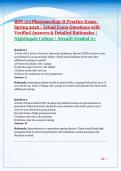
BSN 315 Pharmacology II Practice Exam -
Spring 2026 | Actual Exam Questions with
Verified Answers & Detailed Rationales |
Nightingale College | Already Graded A+
Question 1
A client with a history of chronic obstructive pulmonary disease (COPD) receives a new
prescription for an ipratropium inhaler. Which action indicates to the nurse that
additional teaching is needed?
A) Primes the inhaler with 7 pumps
B) Attaches spacer device to the inhaler
C) Rinses mouth after each use
D) Stores the medication at room temperature
Answer: A
Rationale: Ipratropium inhaler should be primed with 2-3 pumps before first use or if
not used for 24+ hours. Priming with 7 pumps is excessive and indicates the client needs
additional teaching.
Question 2
A client with heart failure (HF) develops hyperaldosteronism and spironolactone is
prescribed. Which instruction should the nurse include in this client's plan of care?
A) Cover your skin before going outside
B) Limit intake of high-potassium foods
C) Replace salt with a salt substitute
D) Monitor skin for excessive bruising
Answer: B
Rationale: Spironolactone is a potassium-sparing diuretic. Clients should limit high-
potassium foods to prevent hyperkalemia. Salt substitutes contain potassium and
should be avoided.
pg. 1
,Question 3
A client with peptic ulcer disease receives a new prescription for cimetidine. Which
statement provided by the client requires additional instruction by the nurse?
A) Notify the healthcare provider of lethargy
B) Monitor for any signs of sexual dysfunction
C) Decrease cigarette use to a pack per day
D) Take the medication an hour after antacids
Answer: C
Rationale: Smoking should be completely avoided, not just decreased. Smoking
increases gastric acid secretion and delays ulcer healing. The client should be instructed
to quit smoking entirely.
Question 4
A client with chemotherapy-induced nausea receives a prescription for metoclopramide.
Which adverse effect is most important for the nurse to report?
A) Drowsiness
B) Involuntary movements
C) Dry mouth
D) Constipation
Answer: B
Rationale: Involuntary movements (extrapyramidal symptoms) are a serious adverse
effect of metoclopramide and require immediate reporting. EPS can be irreversible if
not treated promptly.
Question 5
The nurse admits a client with a diagnosis of stage 4 cancer. The client has a
prescription to wear a subcutaneous morphine sulfate patch for pain. The client is short
of breath and difficult to arouse. While performing a head to toe assessment, the nurse
discovers four patches on the client's body. Which action should the nurse take first?
A) Monitor blood pressure
B) Administer a narcotic reversal drug
C) Remove the morphine patches
D) Apply oxygen face mask
Answer: C
Rationale: The priority is to remove the excess morphine patches to stop further drug
absorption. This is a life-threatening situation due to opioid overdose. Oxygen and
naloxone may be needed after removal.
pg. 2
,Question 6
The nurse is providing instructions about a client's new medications. How should the
nurse explain the purpose of probenecid, a uricosuric drug?
A) Decreases pain and burning during urination
B) Prevents the formation of kidney stones
C) Increases the strength of the urine stream
D) Promotes excretion of uric acid in the urine
Answer: D
Rationale: Probenecid promotes the excretion of uric acid in the urine by inhibiting
renal reabsorption of uric acid. It is used to prevent gout attacks.
Question 7
A client taking atorvastatin develops an increased serum creatine phosphokinase (CK)
level. The nurse should assess the client for the onset of which problem?
A) Excessive bruising
B) Muscle tenderness
C) Memory loss
D) Kidney stones
Answer: B
Rationale: Elevated CK indicates muscle damage (myopathy), a serious adverse effect
of statins. The nurse should assess for muscle tenderness, pain, or weakness. Bruising is
not related to statins.
Question 8
A client receives a new prescription for levothyroxine. Which statement made by client
indicates to the nurse the education was effective?
A) Take medication on an empty stomach
B) Avoid the use of iron supplements
C) Administer levothyroxine at bedtime
D) Consume foods that are high in iodine
Answer: A
Rationale: Levothyroxine should be taken on an empty stomach 30-60 minutes before
breakfast for optimal absorption. Iron supplements should be taken 4 hours apart from
levothyroxine.
pg. 3
, Question 9
A client with Parkinson's disease who is taking carbidopa/levodopa reports the urine
appears to be darker in color. Which action should the nurse take?
A) Explain the color change is normal
B) Measure the client's urinary output
C) Obtain a specimen for a urine culture
D) Encourage an increase in oral intake
Answer: A
Rationale: Dark urine is a harmless side effect of carbidopa/levodopa caused by
metabolites of the medication. The nurse should reassure the client that this is normal
and not harmful.
Question 10
A client receives a prescription for ciprofloxacin 400 mg intravenously (IV) every 12
hours to be infused over an hour. The IV bag contains ciprofloxacin 400 mg in dextrose
5% in water (D5W) 200 mL. The nurse should program the infusion pump to deliver
how many mL/hr? (Enter numerical value only.)
Answer: 200
Rationale: The medication is in 200 mL and is to be infused over 1 hour. The pump
should be set to 200 mL/hr.
Question 11
A female client who is a vegetarian has a new prescription for warfarin. The client states
she eats leafy green vegetables every day. How should the nurse respond?
A) Suggest that the client replace the leafy vegetables with a protein source such as nuts
or beans
B) Confirm that her diet choices will help the medication be more effective in preventing
blood clots
C) Instruct the client to notify the healthcare provider of her dietary intake
D) Advise the client to stop eating leafy green vegetables
Answer: C
Rationale: The healthcare provider should be made aware of the client's consistent
intake of vitamin K-rich foods (leafy greens). The dose of warfarin may need to be
adjusted to maintain therapeutic INR.
pg. 4
Spring 2026 | Actual Exam Questions with
Verified Answers & Detailed Rationales |
Nightingale College | Already Graded A+
Question 1
A client with a history of chronic obstructive pulmonary disease (COPD) receives a new
prescription for an ipratropium inhaler. Which action indicates to the nurse that
additional teaching is needed?
A) Primes the inhaler with 7 pumps
B) Attaches spacer device to the inhaler
C) Rinses mouth after each use
D) Stores the medication at room temperature
Answer: A
Rationale: Ipratropium inhaler should be primed with 2-3 pumps before first use or if
not used for 24+ hours. Priming with 7 pumps is excessive and indicates the client needs
additional teaching.
Question 2
A client with heart failure (HF) develops hyperaldosteronism and spironolactone is
prescribed. Which instruction should the nurse include in this client's plan of care?
A) Cover your skin before going outside
B) Limit intake of high-potassium foods
C) Replace salt with a salt substitute
D) Monitor skin for excessive bruising
Answer: B
Rationale: Spironolactone is a potassium-sparing diuretic. Clients should limit high-
potassium foods to prevent hyperkalemia. Salt substitutes contain potassium and
should be avoided.
pg. 1
,Question 3
A client with peptic ulcer disease receives a new prescription for cimetidine. Which
statement provided by the client requires additional instruction by the nurse?
A) Notify the healthcare provider of lethargy
B) Monitor for any signs of sexual dysfunction
C) Decrease cigarette use to a pack per day
D) Take the medication an hour after antacids
Answer: C
Rationale: Smoking should be completely avoided, not just decreased. Smoking
increases gastric acid secretion and delays ulcer healing. The client should be instructed
to quit smoking entirely.
Question 4
A client with chemotherapy-induced nausea receives a prescription for metoclopramide.
Which adverse effect is most important for the nurse to report?
A) Drowsiness
B) Involuntary movements
C) Dry mouth
D) Constipation
Answer: B
Rationale: Involuntary movements (extrapyramidal symptoms) are a serious adverse
effect of metoclopramide and require immediate reporting. EPS can be irreversible if
not treated promptly.
Question 5
The nurse admits a client with a diagnosis of stage 4 cancer. The client has a
prescription to wear a subcutaneous morphine sulfate patch for pain. The client is short
of breath and difficult to arouse. While performing a head to toe assessment, the nurse
discovers four patches on the client's body. Which action should the nurse take first?
A) Monitor blood pressure
B) Administer a narcotic reversal drug
C) Remove the morphine patches
D) Apply oxygen face mask
Answer: C
Rationale: The priority is to remove the excess morphine patches to stop further drug
absorption. This is a life-threatening situation due to opioid overdose. Oxygen and
naloxone may be needed after removal.
pg. 2
,Question 6
The nurse is providing instructions about a client's new medications. How should the
nurse explain the purpose of probenecid, a uricosuric drug?
A) Decreases pain and burning during urination
B) Prevents the formation of kidney stones
C) Increases the strength of the urine stream
D) Promotes excretion of uric acid in the urine
Answer: D
Rationale: Probenecid promotes the excretion of uric acid in the urine by inhibiting
renal reabsorption of uric acid. It is used to prevent gout attacks.
Question 7
A client taking atorvastatin develops an increased serum creatine phosphokinase (CK)
level. The nurse should assess the client for the onset of which problem?
A) Excessive bruising
B) Muscle tenderness
C) Memory loss
D) Kidney stones
Answer: B
Rationale: Elevated CK indicates muscle damage (myopathy), a serious adverse effect
of statins. The nurse should assess for muscle tenderness, pain, or weakness. Bruising is
not related to statins.
Question 8
A client receives a new prescription for levothyroxine. Which statement made by client
indicates to the nurse the education was effective?
A) Take medication on an empty stomach
B) Avoid the use of iron supplements
C) Administer levothyroxine at bedtime
D) Consume foods that are high in iodine
Answer: A
Rationale: Levothyroxine should be taken on an empty stomach 30-60 minutes before
breakfast for optimal absorption. Iron supplements should be taken 4 hours apart from
levothyroxine.
pg. 3
, Question 9
A client with Parkinson's disease who is taking carbidopa/levodopa reports the urine
appears to be darker in color. Which action should the nurse take?
A) Explain the color change is normal
B) Measure the client's urinary output
C) Obtain a specimen for a urine culture
D) Encourage an increase in oral intake
Answer: A
Rationale: Dark urine is a harmless side effect of carbidopa/levodopa caused by
metabolites of the medication. The nurse should reassure the client that this is normal
and not harmful.
Question 10
A client receives a prescription for ciprofloxacin 400 mg intravenously (IV) every 12
hours to be infused over an hour. The IV bag contains ciprofloxacin 400 mg in dextrose
5% in water (D5W) 200 mL. The nurse should program the infusion pump to deliver
how many mL/hr? (Enter numerical value only.)
Answer: 200
Rationale: The medication is in 200 mL and is to be infused over 1 hour. The pump
should be set to 200 mL/hr.
Question 11
A female client who is a vegetarian has a new prescription for warfarin. The client states
she eats leafy green vegetables every day. How should the nurse respond?
A) Suggest that the client replace the leafy vegetables with a protein source such as nuts
or beans
B) Confirm that her diet choices will help the medication be more effective in preventing
blood clots
C) Instruct the client to notify the healthcare provider of her dietary intake
D) Advise the client to stop eating leafy green vegetables
Answer: C
Rationale: The healthcare provider should be made aware of the client's consistent
intake of vitamin K-rich foods (leafy greens). The dose of warfarin may need to be
adjusted to maintain therapeutic INR.
pg. 4