

NACE CIP Level 1 Exam - AMPP/NACE Coating Inspector
Program - 2026/2027 Edition - 250 Verified Questions
NACE CIP Level 1 Exam 2026-2027 QUESTIONS AND ANSWERS ALREADY GRADED A+. 100% Verified
Solutions | Updated Per Latest AMPP Guidelines | Graded A+
This comprehensive exam preparation document provides 250 verified questions and answers for the
NACE CIP Level 1 Coating Inspector exam, aligned with the 2026/2027 AMPP curriculum. It covers
essential topics including surface preparation, coating application, inspection techniques, and safety
protocols. Each question is crafted to reflect the actual exam format and difficulty, ensuring candidates
gain a deep understanding of coating inspection principles. Ideal for professionals seeking certification
or recertification, this resource is a reliable study aid for mastering the core competencies required of a
NACE Level 1 Inspector.
Abstract:
The NACE CIP Level 1 Exam is a foundational certification for coating inspectors, emphasizing practical
knowledge and safety. This 2026/2027 edition compiles 250 verified questions that rigorously test candidates on
surface preparation, coating application, inspection tools, and safety protocols. Each question is aligned with
AMPP learning objectives and includes detailed rationales to reinforce understanding. The document
systematically addresses key content areas such as abrasive blasting, coating defects, environmental conditions,
and quality assurance. By simulating the exam experience, it helps candidates build confidence and achieve a high
level of proficiency. This resource is indispensable for those pursuing or maintaining AMPP coating inspector
credentials, offering a focused and up-to-date study tool. The questions are designed to mirror the real exam's
format, including multiple-choice and scenario-based items, ensuring comprehensive preparation.
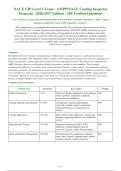
Content Area Overview:
Content Area Questions Key Topics Weight
Surface Preparation 1-50 Abrasive blasting, hand/power tool cleaning, 20%
surface profiles, cleanliness standards,
environmental conditions
Coating Materials and Selection 51-100 Coating types (epoxy, polyurethane, 20%
zinc-rich), volatile organic compounds,
curing mechanisms, coating selection
criteria
Coating Application 101-150 Spray, brush, roller application, mixing and 20%
thinning, application defects, environmental
control
Inspection and Testing 151-200 Inspection instruments (DFT, WFT, 20%
adhesion), testing methods (pull-off,
cross-cut), quality control documentation
Safety and Quality Management 201-250 Personal protective equipment, confined 20%
space entry, hazard communication, quality
assurance/quality control, reporting
Page 1
,Q1. A specification requires surface preparation to SSPC-SP10/NACE No. 2 (Near-White Blast
Cleaning). After blasting, the inspector observes scattered staining on less than 5% of the surface,
and the remaining area is completely free of visible oil, grease, dirt, mill scale, rust, and foreign
matter. Which of the following best describes the compliance status?
A. Compliant, because SSPC-SP10 allows staining on up to 5% of the surface.
B. Non-compliant, because SSPC-SP10 requires no staining or discoloration whatsoever.
C. Compliant, because the staining does not exceed 10% of the area.
D. Non-compliant, because near-white blasting requires 100% removal of all stains.
Correct Answer: A. Compliant, because SSPC-SP10 allows staining on up to 5% of the surface.
Rationale: SSPC-SP10/NACE No. 2 (Near-White Blast Cleaning) allows staining (spots or streaks of
discoloration) on no more than 5% of the surface. The description fits within this tolerance. Option B is
too strict (no staining allowed is white metal, SP5). Option C's 10% is incorrect. Option D overstates the
requirement.
Why Wrong:
B - SP10 permits up to 5% staining; white metal SP5 forbids all staining.
C - The allowed staining limit is 5%, not 10%.
D - SP10 allows some staining; only SP5 requires 100% removal.
Reference: NACE No. 2/SSPC-SP10, 'Near-White Blast Cleaning,' 2026 edition.
Q2. During a pre-application inspection, the ambient temperature is 85°F (29.4°C), relative
humidity is 75%, and the surface temperature is 80°F (26.7°C). Using a psychrometric chart, the
dew point is determined to be 76°F (24.4°C). Based on these conditions, what is the correct inspector
action regarding coating application?
A. Proceed with application because the surface temperature is 4°F above the dew point.
B. Proceed with application because the surface temperature is 4°F above the dew point, but monitor
closely.
C. Halt application because the surface temperature is less than 8°F above the dew point.
D. Halt application because the relative humidity exceeds 70%.
Correct Answer: B. Proceed with application because the surface temperature is 4°F above the dew
point, but monitor closely.
Rationale: Industry standards (e.g., NACE, SSPC) require the surface temperature to be at least 5°F
(3°C) above the dew point to prevent condensation. Here the surface is 4°F above dew point, which is
marginally below the recommended 5°F. While some specifications allow a 3°F margin, 4°F is borderline
but often acceptable with monitoring. Option C incorrectly states 8°F; option D is not a universal halt
condition.
Why Wrong:
A - While close, the minimum recommended margin is 5°F; 4°F is slightly below but may still be
allowed with monitoring.
C - The standard margin is 5°F, not 8°F.
D - High RH does not alone prohibit application; the dew point margin is key.
Reference: NACE SP0188, 'Discontinuity (Holiday) Testing of Protective Coatings,' and general coating
application best practices.
Page 2
,Q3. A coating inspector observes linear, shallow cracks that do not penetrate through the entire
coating thickness on a recently applied epoxy topcoat. The cracks form a small area pattern. Which
of the following is the most likely cause?
A. Mud cracking due to application over a flexible substrate.
B. Crazing due to solvent entrapment during rapid curing.
C. Checking due to excessive film thickness in a single coat.
D. Alligatoring due to poor intercoat adhesion between coats.
Correct Answer: C. Checking due to excessive film thickness in a single coat.
Rationale: Checking refers to shallow, non-penetrating cracks often caused by applying a coating too
thick or under rapid drying conditions. Mud cracking (A) typically occurs in high-build coatings over
rigid surfaces with deep cracks. Crazing (B) is a network of fine cracks on the surface from solvent loss.
Alligatoring (D) forms a pattern resembling reptile skin from lack of adhesion between coats.
Why Wrong:
A - Mud cracking is deep and often occurs on rigid substrates, not shallow as described.
B - Crazing is a fine network of cracks, not shallow linear cracks.
D - Alligatoring involves lifting of the topcoat due to poor intercoat adhesion.
Reference: NACE Standard RP0288, 'Inspection of Coating Systems,' and Coating Inspector Program
(CIP) Level 1 manual.
Q4. When measuring dry film thickness (DFT) on a complex steel H-beam using a magnetic pull-off
gauge, the inspector records the following readings (in mils) on the flange: 12, 14, 13, 16, 15, 11, 12,
14. The specified DFT range is 12-18 mils. According to SSPC-PA 2, what is the minimum number
of spot measurements required per 1,000 ft² of surface area?
A. One spot measurement consisting of five gauge readings.
B. Three spot measurements, each consisting of three gauge readings.
C. Five spot measurements, each consisting of one gauge reading.
D. Ten spot measurements, each consisting of one gauge reading.
Correct Answer: B. Three spot measurements, each consisting of three gauge readings.
Rationale: SSPC-PA 2 requires that for each 1,000 ft² of area, at least three spot measurements are
taken, and each spot measurement comprises three gauge readings. The average of those three readings
is the spot measurement. Option A describes a single spot; options C and D do not use the required three
readings per spot.
Why Wrong:
A - Three spot measurements are needed per 1,000 ft², not one.
C - Each spot measurement requires three gauge readings, not one.
D - A single gauge reading does not constitute a valid spot measurement.
Reference: SSPC-PA 2, 'Measurement of Dry Coating Thickness With Magnetic Gages,' 2026 edition.
Page 3
, Q5. An inspector is to enter a confined space (a storage tank) for a visual inspection. The
atmosphere was tested before entry: O = 19.5%, LEL = 0%, HS = 0 ppm. Which of the following
additional safety measures is REQUIRED by OSHA standards (29 CFR 1910.146)?
A. Continuous forced air ventilation at 20 air changes per hour.
B. Continuous atmospheric monitoring of oxygen and flammability while occupied.
C. Use of a full-facepiece air-purifying respirator with organic vapor cartridge.
D. A permit-required confined space entry permit signed by the site safety officer.
Correct Answer: D. A permit-required confined space entry permit signed by the site safety officer.
Rationale: OSHA 29 CFR 1910.146 requires a written permit for any permit-required confined space
(PRCS). The tank storage likely meets the criteria (limited entry/exit, hazardous atmosphere potential).
Even if initial readings are safe, a permit is required. Option B is also a requirement but the question asks
for what is REQUIRED; both are required, but the permit is the overarching requirement. Ventilation (A)
may be needed but not at a specific rate; respirator (C) is not indicated for safe atmosphere.
Why Wrong:
A - Continuous ventilation is not specified at 20 air changes per hour; it may be needed but not the
primary requirement.
B - Continuous monitoring is also required, but the permit is the most fundamental requirement.
C - An air-purifying respirator would only be used if contaminants are present; here they are not.
Reference: OSHA 29 CFR 1910.146, 'Permit-Required Confined Spaces,' and NACE CIP Level 1 safety
module.
Q6. A coating is being applied using airless spray with a pump pressure of 3,000 psi and a tip orifice
of 0.021 inches. The paint is a high-solids, high-viscosity epoxy. The inspector notices excessive
overspray and poor atomization. Which adjustment would most likely improve atomization without
causing solvent popping?
A. Increase pump pressure to 3,500 psi.
B. Decrease pump pressure to 2,500 psi and reduce tip size to 0.017 inches.
C. Increase tip size to 0.025 inches without changing pressure.
D. Switch to conventional spray using lower pressure and higher air volume.
Correct Answer: A. Increase pump pressure to 3,500 psi.
Rationale: For high-viscosity coatings, increasing pump pressure improves atomization by breaking the
coating into finer droplets. Option B would reduce pressure, worsening atomization. Option C increases
tip size, which reduces atomization and may cause runs. Option D (conventional spray) can improve
atomization but introduces solvent and potential popping; airless is preferred for high-solids.
Why Wrong:
B - Lower pressure and smaller tip reduce atomization for high-viscosity material.
C - Larger tip reduces atomization and increases flow, likely causing runs.
D - Conventional spray may cause solvent popping and is less suitable for high-solids.
Reference: NACE CIP Level 1 Application Methods chapter, section on airless spray parameters.
Page 4
Program - 2026/2027 Edition - 250 Verified Questions
NACE CIP Level 1 Exam 2026-2027 QUESTIONS AND ANSWERS ALREADY GRADED A+. 100% Verified
Solutions | Updated Per Latest AMPP Guidelines | Graded A+
This comprehensive exam preparation document provides 250 verified questions and answers for the
NACE CIP Level 1 Coating Inspector exam, aligned with the 2026/2027 AMPP curriculum. It covers
essential topics including surface preparation, coating application, inspection techniques, and safety
protocols. Each question is crafted to reflect the actual exam format and difficulty, ensuring candidates
gain a deep understanding of coating inspection principles. Ideal for professionals seeking certification
or recertification, this resource is a reliable study aid for mastering the core competencies required of a
NACE Level 1 Inspector.
Abstract:
The NACE CIP Level 1 Exam is a foundational certification for coating inspectors, emphasizing practical
knowledge and safety. This 2026/2027 edition compiles 250 verified questions that rigorously test candidates on
surface preparation, coating application, inspection tools, and safety protocols. Each question is aligned with
AMPP learning objectives and includes detailed rationales to reinforce understanding. The document
systematically addresses key content areas such as abrasive blasting, coating defects, environmental conditions,
and quality assurance. By simulating the exam experience, it helps candidates build confidence and achieve a high
level of proficiency. This resource is indispensable for those pursuing or maintaining AMPP coating inspector
credentials, offering a focused and up-to-date study tool. The questions are designed to mirror the real exam's
format, including multiple-choice and scenario-based items, ensuring comprehensive preparation.
Content Area Overview:
Content Area Questions Key Topics Weight
Surface Preparation 1-50 Abrasive blasting, hand/power tool cleaning, 20%
surface profiles, cleanliness standards,
environmental conditions
Coating Materials and Selection 51-100 Coating types (epoxy, polyurethane, 20%
zinc-rich), volatile organic compounds,
curing mechanisms, coating selection
criteria
Coating Application 101-150 Spray, brush, roller application, mixing and 20%
thinning, application defects, environmental
control
Inspection and Testing 151-200 Inspection instruments (DFT, WFT, 20%
adhesion), testing methods (pull-off,
cross-cut), quality control documentation
Safety and Quality Management 201-250 Personal protective equipment, confined 20%
space entry, hazard communication, quality
assurance/quality control, reporting
Page 1
,Q1. A specification requires surface preparation to SSPC-SP10/NACE No. 2 (Near-White Blast
Cleaning). After blasting, the inspector observes scattered staining on less than 5% of the surface,
and the remaining area is completely free of visible oil, grease, dirt, mill scale, rust, and foreign
matter. Which of the following best describes the compliance status?
A. Compliant, because SSPC-SP10 allows staining on up to 5% of the surface.
B. Non-compliant, because SSPC-SP10 requires no staining or discoloration whatsoever.
C. Compliant, because the staining does not exceed 10% of the area.
D. Non-compliant, because near-white blasting requires 100% removal of all stains.
Correct Answer: A. Compliant, because SSPC-SP10 allows staining on up to 5% of the surface.
Rationale: SSPC-SP10/NACE No. 2 (Near-White Blast Cleaning) allows staining (spots or streaks of
discoloration) on no more than 5% of the surface. The description fits within this tolerance. Option B is
too strict (no staining allowed is white metal, SP5). Option C's 10% is incorrect. Option D overstates the
requirement.
Why Wrong:
B - SP10 permits up to 5% staining; white metal SP5 forbids all staining.
C - The allowed staining limit is 5%, not 10%.
D - SP10 allows some staining; only SP5 requires 100% removal.
Reference: NACE No. 2/SSPC-SP10, 'Near-White Blast Cleaning,' 2026 edition.
Q2. During a pre-application inspection, the ambient temperature is 85°F (29.4°C), relative
humidity is 75%, and the surface temperature is 80°F (26.7°C). Using a psychrometric chart, the
dew point is determined to be 76°F (24.4°C). Based on these conditions, what is the correct inspector
action regarding coating application?
A. Proceed with application because the surface temperature is 4°F above the dew point.
B. Proceed with application because the surface temperature is 4°F above the dew point, but monitor
closely.
C. Halt application because the surface temperature is less than 8°F above the dew point.
D. Halt application because the relative humidity exceeds 70%.
Correct Answer: B. Proceed with application because the surface temperature is 4°F above the dew
point, but monitor closely.
Rationale: Industry standards (e.g., NACE, SSPC) require the surface temperature to be at least 5°F
(3°C) above the dew point to prevent condensation. Here the surface is 4°F above dew point, which is
marginally below the recommended 5°F. While some specifications allow a 3°F margin, 4°F is borderline
but often acceptable with monitoring. Option C incorrectly states 8°F; option D is not a universal halt
condition.
Why Wrong:
A - While close, the minimum recommended margin is 5°F; 4°F is slightly below but may still be
allowed with monitoring.
C - The standard margin is 5°F, not 8°F.
D - High RH does not alone prohibit application; the dew point margin is key.
Reference: NACE SP0188, 'Discontinuity (Holiday) Testing of Protective Coatings,' and general coating
application best practices.
Page 2
,Q3. A coating inspector observes linear, shallow cracks that do not penetrate through the entire
coating thickness on a recently applied epoxy topcoat. The cracks form a small area pattern. Which
of the following is the most likely cause?
A. Mud cracking due to application over a flexible substrate.
B. Crazing due to solvent entrapment during rapid curing.
C. Checking due to excessive film thickness in a single coat.
D. Alligatoring due to poor intercoat adhesion between coats.
Correct Answer: C. Checking due to excessive film thickness in a single coat.
Rationale: Checking refers to shallow, non-penetrating cracks often caused by applying a coating too
thick or under rapid drying conditions. Mud cracking (A) typically occurs in high-build coatings over
rigid surfaces with deep cracks. Crazing (B) is a network of fine cracks on the surface from solvent loss.
Alligatoring (D) forms a pattern resembling reptile skin from lack of adhesion between coats.
Why Wrong:
A - Mud cracking is deep and often occurs on rigid substrates, not shallow as described.
B - Crazing is a fine network of cracks, not shallow linear cracks.
D - Alligatoring involves lifting of the topcoat due to poor intercoat adhesion.
Reference: NACE Standard RP0288, 'Inspection of Coating Systems,' and Coating Inspector Program
(CIP) Level 1 manual.
Q4. When measuring dry film thickness (DFT) on a complex steel H-beam using a magnetic pull-off
gauge, the inspector records the following readings (in mils) on the flange: 12, 14, 13, 16, 15, 11, 12,
14. The specified DFT range is 12-18 mils. According to SSPC-PA 2, what is the minimum number
of spot measurements required per 1,000 ft² of surface area?
A. One spot measurement consisting of five gauge readings.
B. Three spot measurements, each consisting of three gauge readings.
C. Five spot measurements, each consisting of one gauge reading.
D. Ten spot measurements, each consisting of one gauge reading.
Correct Answer: B. Three spot measurements, each consisting of three gauge readings.
Rationale: SSPC-PA 2 requires that for each 1,000 ft² of area, at least three spot measurements are
taken, and each spot measurement comprises three gauge readings. The average of those three readings
is the spot measurement. Option A describes a single spot; options C and D do not use the required three
readings per spot.
Why Wrong:
A - Three spot measurements are needed per 1,000 ft², not one.
C - Each spot measurement requires three gauge readings, not one.
D - A single gauge reading does not constitute a valid spot measurement.
Reference: SSPC-PA 2, 'Measurement of Dry Coating Thickness With Magnetic Gages,' 2026 edition.
Page 3
, Q5. An inspector is to enter a confined space (a storage tank) for a visual inspection. The
atmosphere was tested before entry: O = 19.5%, LEL = 0%, HS = 0 ppm. Which of the following
additional safety measures is REQUIRED by OSHA standards (29 CFR 1910.146)?
A. Continuous forced air ventilation at 20 air changes per hour.
B. Continuous atmospheric monitoring of oxygen and flammability while occupied.
C. Use of a full-facepiece air-purifying respirator with organic vapor cartridge.
D. A permit-required confined space entry permit signed by the site safety officer.
Correct Answer: D. A permit-required confined space entry permit signed by the site safety officer.
Rationale: OSHA 29 CFR 1910.146 requires a written permit for any permit-required confined space
(PRCS). The tank storage likely meets the criteria (limited entry/exit, hazardous atmosphere potential).
Even if initial readings are safe, a permit is required. Option B is also a requirement but the question asks
for what is REQUIRED; both are required, but the permit is the overarching requirement. Ventilation (A)
may be needed but not at a specific rate; respirator (C) is not indicated for safe atmosphere.
Why Wrong:
A - Continuous ventilation is not specified at 20 air changes per hour; it may be needed but not the
primary requirement.
B - Continuous monitoring is also required, but the permit is the most fundamental requirement.
C - An air-purifying respirator would only be used if contaminants are present; here they are not.
Reference: OSHA 29 CFR 1910.146, 'Permit-Required Confined Spaces,' and NACE CIP Level 1 safety
module.
Q6. A coating is being applied using airless spray with a pump pressure of 3,000 psi and a tip orifice
of 0.021 inches. The paint is a high-solids, high-viscosity epoxy. The inspector notices excessive
overspray and poor atomization. Which adjustment would most likely improve atomization without
causing solvent popping?
A. Increase pump pressure to 3,500 psi.
B. Decrease pump pressure to 2,500 psi and reduce tip size to 0.017 inches.
C. Increase tip size to 0.025 inches without changing pressure.
D. Switch to conventional spray using lower pressure and higher air volume.
Correct Answer: A. Increase pump pressure to 3,500 psi.
Rationale: For high-viscosity coatings, increasing pump pressure improves atomization by breaking the
coating into finer droplets. Option B would reduce pressure, worsening atomization. Option C increases
tip size, which reduces atomization and may cause runs. Option D (conventional spray) can improve
atomization but introduces solvent and potential popping; airless is preferred for high-solids.
Why Wrong:
B - Lower pressure and smaller tip reduce atomization for high-viscosity material.
C - Larger tip reduces atomization and increases flow, likely causing runs.
D - Conventional spray may cause solvent popping and is less suitable for high-solids.
Reference: NACE CIP Level 1 Application Methods chapter, section on airless spray parameters.
Page 4


