

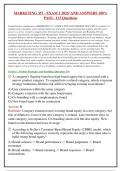
MARKETING 357 - EXAM 2 2025/ AND ANSWERS 100%
PASS - 113 Questions
Comprehensive examination on MARKETING 357 - EXAM 2 2025/ AND ANSWERS 100% PASS. It contains 113
multiple-choice questions, each with four distractors and a fully worked rationale that explains why the keyed
answer is correct. Content is organized into 8 focused sections: Product Strategies and Branding, Pricing
Strategies, Distribution and Supply Chain Management, Promotion and Integrated Marketing Communications,
Consumer Behavior, Market Segmentation, Targeting, and Positioning, Marketing Research and Analytics, Digital
and Social Media Marketing. Targeted learning outcomes include: Demonstrate mastery of core concepts. Every
item has been reviewed for clinical accuracy, current guidelines, and clarity so that students can study with
confidence and self-correct as they work through the bank. Use it as a high-yield review immediately before the
exam, or as a structured practice tool during the unit - the rationales double as concise teaching notes. The
recommended writing time is 3 hours, with a passing score of 70%. Aligned with Aligned with US university
standards. standards and reflects the question style commonly seen on accredited program examinations. Students
consistently achieving above the cut score on this bank have historically gone on to earn A+ on the corresponding
course exam. Read every stem carefully - distractors are written to look plausible, and the best answer is
sometimes the one that addresses the patient's most immediate physiological or safety need. Where multiple
options appear correct, prioritize airway, breathing, circulation, safety, and Maslow's hierarchy before
Section 1: Product Strategies and Branding (Questions 1-9)
1 A company's flagship brand has high brand equity but is associated with a
narrow product category. To expand into a related category, which extension
strategy minimizes dilution risk while leveraging existing associations?
A) Line extension within the same category
B) Category extension with the same brand name
C) Co-branding with a complementary brand
D) New brand name with no connection
Answer: B
Rationale: Category extension uses existing brand equity in a new category, but
risk of dilution is lower if the new category is related. Line extension stays in
same category, not expansion. Co-branding shares risk but also equity. New
brand avoids dilution but loses leverage.
2 According to Keller's Customer-Based Brand Equity (CBBE) model, which
of the following sequences correctly represents the steps a firm must take to
build strong brand equity?
A) Brand salience -> Brand performance -> Brand judgments -> Brand
resonance
B) Brand identity -> Brand meaning -> Brand responses -> Brand
relationships
,C) Brand awareness -> Brand associations -> Brand loyalty -> Brand equity
D) Brand differentiation -> Brand relevance -> Brand esteem -> Brand
knowledge
Answer: B
Rationale: Keller's CBBE pyramid: 1) Brand identity (salience) who are you? 2)
Brand meaning (performance & imagery) what are you? 3) Brand responses
(judgments & feelings) what about you? 4) Brand relationships (resonance)
what about you and me? Option B matches.
3 A premium electronics manufacturer is considering a cobranding partnership
with a luxury fashion house. Which potential benefit is most critical for the
electronics brand?
A) Access to new distribution channels
B) Enhanced brand image through association
C) Reduced production costs
D) Increased market share in existing segments
Answer: B
Rationale: Cobranding with a luxury partner primarily elevates brand image and
prestige. While distribution access and market share may be secondary, the
core benefit for a premium brand is image enhancement. Cost reduction is
unlikely in such partnerships.
4 During the maturity stage of the product life cycle, a firm decides to modify
the product to extend its life. Which strategy focuses on increasing usage
among current customers through new product features?
A) Market modification
B) Product modification
C) Marketing mix modification
D) Product elimination
Answer: B
Rationale: Product modification involves altering characteristics (features,
quality) to attract new users or increase usage. Market modification tries to find
new customers or segments. Marketing mix modification changes price,
promotion, etc. Elimination ends the product.
,5 A company's product mix has five product lines with a total of 30 items. If
the company adds three new variants to one line and drops two items from
another, what is the new product mix width and length?
A) Width: 5, Length: 31
B) Width: 6, Length: 30
C) Width: 5, Length: 30
D) Width: 4, Length: 31
Answer: A
Rationale: Width is number of distinct product lines (unchanged at 5). Length is
total items: 30 + 3 - 2 = 31. So width 5, length 31. Option B incorrectly
increases width; C misses net change; D reduces width.
6 A new entrant in the smartphone market wants to create strong brand
positioning against established competitors. Which approach would most
effectively build brand equity through product strategy?
A) Introduce a single high-end model with premium pricing
B) Launch a full line of models across price tiers
C) Focus on a unique product attribute that solves a specific consumer
problem
D) Price products below competition to gain market share rapidly
Answer: C
Rationale: Unique attribute/benefit differentiation creates distinctive brand
associations, key for new brand equity. Full line may dilute focus. Premium
single model risks low awareness. Penetration pricing can hurt perceived
quality.
7 When a company uses a multi-branding strategy, it operates multiple brands
in the same product category. What is the primary strategic risk of this
approach?
A) Higher production costs due to lack of standardization
B) Cannibalization of market share among own brands
C) Difficulty in achieving distribution coverage
D) Confusion among consumers regarding brand promises
Answer: B
Rationale: Multi-branding increases total shelf presence but risks
cannibalization: a new brand may steal sales from existing company brands.
, Production costs can be optimized across brands; distribution is often easier;
consumer confusion is possible but secondary.
8 In the context of brand extension, how does a 'fit' between the parent brand
and the extension affect consumer evaluation?
A) High fit always leads to positive evaluation regardless of parent brand
quality
B) Low fit can be overcome by strong parent brand image but risk of dilution
increases
C) Fit is irrelevant if the extension is priced lower than competitors
D) Fit only matters for functional products, not luxury brands
Answer: B
Rationale: Consumers perceive extensions with high fit more favorably. Low fit
may succeed if parent brand is very strong, but it risks diluting brand equity.
Pricing can't compensate for lack of fit; fit matters for all brand types.
9 A firm's product line is too short, failing to cover all consumer segments.
Which product line strategy directly addresses this gap by adding items at
different price points within the current line?
A) Line filling
B) Line stretching downward
C) Line stretching upward
D) Line pruning
Answer: A
Rationale: Line filling adds items within the existing range to serve more
segments, not extending the line's boundaries. Stretching (upward/downward)
changes price range. Pruning removes weak items. Filling is correct for
covering segments.
Section 2: Pricing Strategies (Questions 10-19)
10 A firm launches a novel product at a high price, planning to lower it over
time. However, early demand is highly elastic. This pricing approach is
most likely to result in:
A) Rapid market penetration
B) Insufficient sales volume
C) Maximized profit from early adopters
PASS - 113 Questions
Comprehensive examination on MARKETING 357 - EXAM 2 2025/ AND ANSWERS 100% PASS. It contains 113
multiple-choice questions, each with four distractors and a fully worked rationale that explains why the keyed
answer is correct. Content is organized into 8 focused sections: Product Strategies and Branding, Pricing
Strategies, Distribution and Supply Chain Management, Promotion and Integrated Marketing Communications,
Consumer Behavior, Market Segmentation, Targeting, and Positioning, Marketing Research and Analytics, Digital
and Social Media Marketing. Targeted learning outcomes include: Demonstrate mastery of core concepts. Every
item has been reviewed for clinical accuracy, current guidelines, and clarity so that students can study with
confidence and self-correct as they work through the bank. Use it as a high-yield review immediately before the
exam, or as a structured practice tool during the unit - the rationales double as concise teaching notes. The
recommended writing time is 3 hours, with a passing score of 70%. Aligned with Aligned with US university
standards. standards and reflects the question style commonly seen on accredited program examinations. Students
consistently achieving above the cut score on this bank have historically gone on to earn A+ on the corresponding
course exam. Read every stem carefully - distractors are written to look plausible, and the best answer is
sometimes the one that addresses the patient's most immediate physiological or safety need. Where multiple
options appear correct, prioritize airway, breathing, circulation, safety, and Maslow's hierarchy before
Section 1: Product Strategies and Branding (Questions 1-9)
1 A company's flagship brand has high brand equity but is associated with a
narrow product category. To expand into a related category, which extension
strategy minimizes dilution risk while leveraging existing associations?
A) Line extension within the same category
B) Category extension with the same brand name
C) Co-branding with a complementary brand
D) New brand name with no connection
Answer: B
Rationale: Category extension uses existing brand equity in a new category, but
risk of dilution is lower if the new category is related. Line extension stays in
same category, not expansion. Co-branding shares risk but also equity. New
brand avoids dilution but loses leverage.
2 According to Keller's Customer-Based Brand Equity (CBBE) model, which
of the following sequences correctly represents the steps a firm must take to
build strong brand equity?
A) Brand salience -> Brand performance -> Brand judgments -> Brand
resonance
B) Brand identity -> Brand meaning -> Brand responses -> Brand
relationships
,C) Brand awareness -> Brand associations -> Brand loyalty -> Brand equity
D) Brand differentiation -> Brand relevance -> Brand esteem -> Brand
knowledge
Answer: B
Rationale: Keller's CBBE pyramid: 1) Brand identity (salience) who are you? 2)
Brand meaning (performance & imagery) what are you? 3) Brand responses
(judgments & feelings) what about you? 4) Brand relationships (resonance)
what about you and me? Option B matches.
3 A premium electronics manufacturer is considering a cobranding partnership
with a luxury fashion house. Which potential benefit is most critical for the
electronics brand?
A) Access to new distribution channels
B) Enhanced brand image through association
C) Reduced production costs
D) Increased market share in existing segments
Answer: B
Rationale: Cobranding with a luxury partner primarily elevates brand image and
prestige. While distribution access and market share may be secondary, the
core benefit for a premium brand is image enhancement. Cost reduction is
unlikely in such partnerships.
4 During the maturity stage of the product life cycle, a firm decides to modify
the product to extend its life. Which strategy focuses on increasing usage
among current customers through new product features?
A) Market modification
B) Product modification
C) Marketing mix modification
D) Product elimination
Answer: B
Rationale: Product modification involves altering characteristics (features,
quality) to attract new users or increase usage. Market modification tries to find
new customers or segments. Marketing mix modification changes price,
promotion, etc. Elimination ends the product.
,5 A company's product mix has five product lines with a total of 30 items. If
the company adds three new variants to one line and drops two items from
another, what is the new product mix width and length?
A) Width: 5, Length: 31
B) Width: 6, Length: 30
C) Width: 5, Length: 30
D) Width: 4, Length: 31
Answer: A
Rationale: Width is number of distinct product lines (unchanged at 5). Length is
total items: 30 + 3 - 2 = 31. So width 5, length 31. Option B incorrectly
increases width; C misses net change; D reduces width.
6 A new entrant in the smartphone market wants to create strong brand
positioning against established competitors. Which approach would most
effectively build brand equity through product strategy?
A) Introduce a single high-end model with premium pricing
B) Launch a full line of models across price tiers
C) Focus on a unique product attribute that solves a specific consumer
problem
D) Price products below competition to gain market share rapidly
Answer: C
Rationale: Unique attribute/benefit differentiation creates distinctive brand
associations, key for new brand equity. Full line may dilute focus. Premium
single model risks low awareness. Penetration pricing can hurt perceived
quality.
7 When a company uses a multi-branding strategy, it operates multiple brands
in the same product category. What is the primary strategic risk of this
approach?
A) Higher production costs due to lack of standardization
B) Cannibalization of market share among own brands
C) Difficulty in achieving distribution coverage
D) Confusion among consumers regarding brand promises
Answer: B
Rationale: Multi-branding increases total shelf presence but risks
cannibalization: a new brand may steal sales from existing company brands.
, Production costs can be optimized across brands; distribution is often easier;
consumer confusion is possible but secondary.
8 In the context of brand extension, how does a 'fit' between the parent brand
and the extension affect consumer evaluation?
A) High fit always leads to positive evaluation regardless of parent brand
quality
B) Low fit can be overcome by strong parent brand image but risk of dilution
increases
C) Fit is irrelevant if the extension is priced lower than competitors
D) Fit only matters for functional products, not luxury brands
Answer: B
Rationale: Consumers perceive extensions with high fit more favorably. Low fit
may succeed if parent brand is very strong, but it risks diluting brand equity.
Pricing can't compensate for lack of fit; fit matters for all brand types.
9 A firm's product line is too short, failing to cover all consumer segments.
Which product line strategy directly addresses this gap by adding items at
different price points within the current line?
A) Line filling
B) Line stretching downward
C) Line stretching upward
D) Line pruning
Answer: A
Rationale: Line filling adds items within the existing range to serve more
segments, not extending the line's boundaries. Stretching (upward/downward)
changes price range. Pruning removes weak items. Filling is correct for
covering segments.
Section 2: Pricing Strategies (Questions 10-19)
10 A firm launches a novel product at a high price, planning to lower it over
time. However, early demand is highly elastic. This pricing approach is
most likely to result in:
A) Rapid market penetration
B) Insufficient sales volume
C) Maximized profit from early adopters


