

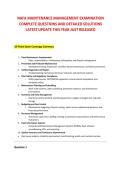
NAFA MAINTENANCE MANAGEMENT EXAMINATION
COMPLETE QUESTIONS AND DETAILED SOLUTIONS
LATEST UPDATE THIS YEAR JUST RELEASED
10-Point Exam Coverage Summary
1. Fleet Maintenance Fundamentals
o Roles, responsibilities, maintenance philosophies, and lifecycle management.
2. Preventive and Predictive Maintenance
o Scheduled servicing, inspections, condition-based maintenance, and failure prevention.
3. Vehicle Diagnostics and Repair
o Troubleshooting mechanical, electrical, hydraulic, and electronic systems.
4. Fleet Safety and Regulatory Compliance
o OSHA requirements, DOT/FMCSA regulations, environmental compliance, and
workplace safety.
5. Maintenance Planning and Scheduling
o Work order systems, labor scheduling, downtime reduction, and maintenance
prioritization.
6. Inventory and Parts Management
o Inventory control methods, purchasing practices, supplier management, and parts
storage.
7. Budgeting and Cost Control
o Maintenance budgeting, lifecycle costing, repair-versus-replacement decisions, and
financial performance.
8. Personnel Management
o Technician supervision, staffing, training, productivity measurement, and performance
evaluations.
9. Fleet Information Systems
o Computerized Maintenance Management Systems (CMMS), fleet software,
recordkeeping, KPIs, and reporting.
10. Quality Assurance and Continuous Improvement
Root cause analysis, reliability improvement, benchmarking, audits, and customer service.
Question 1
,Which maintenance philosophy primarily focuses on performing scheduled
inspections and servicing before equipment failures occur to maximize fleet
reliability and minimize unexpected downtime?
A. Corrective maintenance only
B. Preventive maintenance
C. Deferred maintenance
D. Emergency maintenance
Answer: B
Rationale: Preventive maintenance involves scheduled inspections and servicing
designed to detect and correct issues before failures occur, reducing downtime
and extending vehicle life.
Question 2
A fleet maintenance manager notices increasing repair costs despite regular
maintenance intervals. Which management approach should be implemented
first to identify the underlying causes affecting maintenance performance?
A. Increase technician overtime
B. Perform a root cause analysis
C. Purchase additional vehicles
D. Eliminate preventive maintenance
Answer: B
,Rationale: Root cause analysis identifies recurring problems and their true causes,
allowing corrective actions that improve reliability and reduce long-term
maintenance expenses.
Question 3
What is the primary objective of a Computerized Maintenance Management
System (CMMS) within an organized fleet maintenance program?
A. Replace qualified technicians
B. Track maintenance activities, assets, costs, and work orders
C. Eliminate preventive maintenance
D. Reduce fuel consumption directly
Answer: B
Rationale: A CMMS improves maintenance planning, scheduling, recordkeeping,
inventory management, and reporting for informed decision-making.
Question 4
Which key performance indicator best measures how effectively maintenance
activities minimize equipment downtime while maximizing vehicle availability for
operations?
A. Driver age
B. Vehicle color
C. Fleet availability percentage
, D. Tire brand preference
Answer: C
Rationale: Fleet availability percentage reflects how many vehicles are
operational and available for service, making it a critical maintenance
performance metric.
Question 5
Why is documenting every maintenance activity performed on fleet vehicles
considered an essential management practice?
A. It increases vehicle weight.
B. It supports maintenance history, compliance, warranty claims, and informed
replacement decisions.
C. It decreases technician accountability.
D. It eliminates repair costs.
Answer: B
Rationale: Complete maintenance records support regulatory compliance,
warranty recovery, lifecycle analysis, and future maintenance planning.
Question 6
Which maintenance strategy relies on monitoring equipment condition through
inspections, oil analysis, vibration monitoring, or diagnostic testing before
scheduling repairs?
A. Breakdown maintenance
COMPLETE QUESTIONS AND DETAILED SOLUTIONS
LATEST UPDATE THIS YEAR JUST RELEASED
10-Point Exam Coverage Summary
1. Fleet Maintenance Fundamentals
o Roles, responsibilities, maintenance philosophies, and lifecycle management.
2. Preventive and Predictive Maintenance
o Scheduled servicing, inspections, condition-based maintenance, and failure prevention.
3. Vehicle Diagnostics and Repair
o Troubleshooting mechanical, electrical, hydraulic, and electronic systems.
4. Fleet Safety and Regulatory Compliance
o OSHA requirements, DOT/FMCSA regulations, environmental compliance, and
workplace safety.
5. Maintenance Planning and Scheduling
o Work order systems, labor scheduling, downtime reduction, and maintenance
prioritization.
6. Inventory and Parts Management
o Inventory control methods, purchasing practices, supplier management, and parts
storage.
7. Budgeting and Cost Control
o Maintenance budgeting, lifecycle costing, repair-versus-replacement decisions, and
financial performance.
8. Personnel Management
o Technician supervision, staffing, training, productivity measurement, and performance
evaluations.
9. Fleet Information Systems
o Computerized Maintenance Management Systems (CMMS), fleet software,
recordkeeping, KPIs, and reporting.
10. Quality Assurance and Continuous Improvement
Root cause analysis, reliability improvement, benchmarking, audits, and customer service.
Question 1
,Which maintenance philosophy primarily focuses on performing scheduled
inspections and servicing before equipment failures occur to maximize fleet
reliability and minimize unexpected downtime?
A. Corrective maintenance only
B. Preventive maintenance
C. Deferred maintenance
D. Emergency maintenance
Answer: B
Rationale: Preventive maintenance involves scheduled inspections and servicing
designed to detect and correct issues before failures occur, reducing downtime
and extending vehicle life.
Question 2
A fleet maintenance manager notices increasing repair costs despite regular
maintenance intervals. Which management approach should be implemented
first to identify the underlying causes affecting maintenance performance?
A. Increase technician overtime
B. Perform a root cause analysis
C. Purchase additional vehicles
D. Eliminate preventive maintenance
Answer: B
,Rationale: Root cause analysis identifies recurring problems and their true causes,
allowing corrective actions that improve reliability and reduce long-term
maintenance expenses.
Question 3
What is the primary objective of a Computerized Maintenance Management
System (CMMS) within an organized fleet maintenance program?
A. Replace qualified technicians
B. Track maintenance activities, assets, costs, and work orders
C. Eliminate preventive maintenance
D. Reduce fuel consumption directly
Answer: B
Rationale: A CMMS improves maintenance planning, scheduling, recordkeeping,
inventory management, and reporting for informed decision-making.
Question 4
Which key performance indicator best measures how effectively maintenance
activities minimize equipment downtime while maximizing vehicle availability for
operations?
A. Driver age
B. Vehicle color
C. Fleet availability percentage
, D. Tire brand preference
Answer: C
Rationale: Fleet availability percentage reflects how many vehicles are
operational and available for service, making it a critical maintenance
performance metric.
Question 5
Why is documenting every maintenance activity performed on fleet vehicles
considered an essential management practice?
A. It increases vehicle weight.
B. It supports maintenance history, compliance, warranty claims, and informed
replacement decisions.
C. It decreases technician accountability.
D. It eliminates repair costs.
Answer: B
Rationale: Complete maintenance records support regulatory compliance,
warranty recovery, lifecycle analysis, and future maintenance planning.
Question 6
Which maintenance strategy relies on monitoring equipment condition through
inspections, oil analysis, vibration monitoring, or diagnostic testing before
scheduling repairs?
A. Breakdown maintenance


