

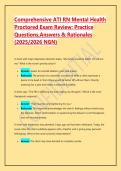
Comprehensive ATI RN Mental Health
Proctored Exam Review: Practice
Questions,Answers & Rationales
(2025/2026 NGN)
A client with major depressive disorder states, "My family would be better off without
me." What is the nurse's priority action?
Answer: Assess for suicidal ideation, plan, and means.
Rationale: The priority is to assess for suicidal risk when a client expresses a
desire to be dead or that others would be better off without them. Directly
assessing for a plan and means is essential for safety.
A client says, "The FBI is following me and reading my thoughts." Which is the most
therapeutic response?
Answer: "That must be very frightening for you."
Rationale: This response acknowledges the client's feelings without reinforcing
the delusion. Direct confrontation or questioning the delusion is not therapeutic
and can increase anxiety.
A client with depression was admitted 3 days ago and has been withdrawn. Today, the
nurse notes the client suddenly appears calm, cheerful, and is giving away personal
belongings. What is the nurse's priority interpretation?
Answer: The client may have decided to complete suicide.
, Rationale: Sudden mood improvement and giving away personal belongings are
warning signs that a client has made a decision to end their life. This requires
immediate intervention.
A nurse overhears a client saying, "I am a spy, a spy for the FBI. I am an I, an eye for an
eye in the sky. Sky is up high." The nurse should document this as which speech
alteration?
Answer: Clang association.
Rationale: Clang association involves stringing words together based on their
sound rather than meaning, often rhyming. This is commonly seen in manic
episodes or schizophrenia.
A client with alcohol use disorder is admitted for detoxification. Which medication is
most likely to be administered to prevent seizures and delirium tremens?
Answer: Chlordiazepoxide.
Rationale: Benzodiazepines (chlordiazepoxide, lorazepam) are the mainstay of
alcohol withdrawal management to prevent seizures, DT, and reduce autonomic
instability.
A client tells the nurse, "Don't tell anyone, but I hid a sharp knife under my mattress to
protect myself from my roommate." Which action should the nurse take?
Answer: Tell the client this must be reported to the healthcare team.
Rationale: Safety threats must be reported. The nurse should use the ethical
principle of veracity (truthfulness) by informing the client that confidentiality must
be breached due to safety concerns.
A nurse decides to place a client with a psychotic disorder in seclusion overnight
because the unit is short-staffed. The nurse's actions are an example of which tort?
Answer: False imprisonment.
, Rationale: False imprisonment is confining a client to a specific area for the
convenience of staff rather than for clinical necessity.
A nurse is teaching a client who has schizophrenia about her new prescription for
risperidone. Which of the following statements should the nurse include in the
teaching?
Answer: "You should continue this medication if you develop muscle rigidity."
Rationale: This answer choice reflects the need for the client to notify the
provider and continue the medication until directed otherwise.
The nurse is caring for a client following a physical assault. The client states "I don't
remember what happened to me." The nurse should recognize that the client is using
which defense mechanism?
Answer: Repression.
Rationale: Repression is the unconscious blocking of unacceptable thoughts and
impulses.
A nurse is caring for a client who has anorexia nervosa. Which of the following findings
require immediate intervention by the nurse?
Answer: Blood pH 7.60.
Rationale: A blood pH of 7.60 indicates metabolic alkalosis, a life-threatening
complication that can occur with self-induced vomiting.
A client is fearful of driving and enters a behavioral therapy program to help him
overcome his anxiety. Using systematic desensitization, he is able to drive down a
familiar street without experiencing a panic attack. The nurse should recognize that to
continue positive results, the client should participate in which of the following?
Answer: Biofeedback.
Proctored Exam Review: Practice
Questions,Answers & Rationales
(2025/2026 NGN)
A client with major depressive disorder states, "My family would be better off without
me." What is the nurse's priority action?
Answer: Assess for suicidal ideation, plan, and means.
Rationale: The priority is to assess for suicidal risk when a client expresses a
desire to be dead or that others would be better off without them. Directly
assessing for a plan and means is essential for safety.
A client says, "The FBI is following me and reading my thoughts." Which is the most
therapeutic response?
Answer: "That must be very frightening for you."
Rationale: This response acknowledges the client's feelings without reinforcing
the delusion. Direct confrontation or questioning the delusion is not therapeutic
and can increase anxiety.
A client with depression was admitted 3 days ago and has been withdrawn. Today, the
nurse notes the client suddenly appears calm, cheerful, and is giving away personal
belongings. What is the nurse's priority interpretation?
Answer: The client may have decided to complete suicide.
, Rationale: Sudden mood improvement and giving away personal belongings are
warning signs that a client has made a decision to end their life. This requires
immediate intervention.
A nurse overhears a client saying, "I am a spy, a spy for the FBI. I am an I, an eye for an
eye in the sky. Sky is up high." The nurse should document this as which speech
alteration?
Answer: Clang association.
Rationale: Clang association involves stringing words together based on their
sound rather than meaning, often rhyming. This is commonly seen in manic
episodes or schizophrenia.
A client with alcohol use disorder is admitted for detoxification. Which medication is
most likely to be administered to prevent seizures and delirium tremens?
Answer: Chlordiazepoxide.
Rationale: Benzodiazepines (chlordiazepoxide, lorazepam) are the mainstay of
alcohol withdrawal management to prevent seizures, DT, and reduce autonomic
instability.
A client tells the nurse, "Don't tell anyone, but I hid a sharp knife under my mattress to
protect myself from my roommate." Which action should the nurse take?
Answer: Tell the client this must be reported to the healthcare team.
Rationale: Safety threats must be reported. The nurse should use the ethical
principle of veracity (truthfulness) by informing the client that confidentiality must
be breached due to safety concerns.
A nurse decides to place a client with a psychotic disorder in seclusion overnight
because the unit is short-staffed. The nurse's actions are an example of which tort?
Answer: False imprisonment.
, Rationale: False imprisonment is confining a client to a specific area for the
convenience of staff rather than for clinical necessity.
A nurse is teaching a client who has schizophrenia about her new prescription for
risperidone. Which of the following statements should the nurse include in the
teaching?
Answer: "You should continue this medication if you develop muscle rigidity."
Rationale: This answer choice reflects the need for the client to notify the
provider and continue the medication until directed otherwise.
The nurse is caring for a client following a physical assault. The client states "I don't
remember what happened to me." The nurse should recognize that the client is using
which defense mechanism?
Answer: Repression.
Rationale: Repression is the unconscious blocking of unacceptable thoughts and
impulses.
A nurse is caring for a client who has anorexia nervosa. Which of the following findings
require immediate intervention by the nurse?
Answer: Blood pH 7.60.
Rationale: A blood pH of 7.60 indicates metabolic alkalosis, a life-threatening
complication that can occur with self-induced vomiting.
A client is fearful of driving and enters a behavioral therapy program to help him
overcome his anxiety. Using systematic desensitization, he is able to drive down a
familiar street without experiencing a panic attack. The nurse should recognize that to
continue positive results, the client should participate in which of the following?
Answer: Biofeedback.


