Page 1 of 178
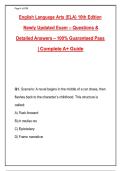
English Language Arts (ELA) 10th Edition
Newly Updated Exam – Questions &
Detailed Answers – 100% Guaranteed Pass
| Complete A+ Guide
Q1. Scenario: A novel begins in the middle of a car chase, then
flashes back to the character’s childhood. This structure is
called:
A) Flash-forward
B) In medias res
C) Epistolary
D) Frame narrative
,Page 2 of 178
Answer: B
Rationale: In medias res (Latin for “into the middle of things”)
starts with action to hook readers. A (flash-forward) jumps to
the future; C (epistolary) uses letters; D (frame narrative) is a
story within a story.
Q2. Scenario: A poem describes a rose as “a bleeding heart
wrapped in velvet.” This is an example of:
A) Simile
B) Metaphor
C) Personification
D) Hyperbole
Answer: B
Rationale: Metaphor directly compares without “like” or “as.”
A (simile) would use “like”; C (personification) gives human
traits to non-human; D (hyperbole) exaggerates.
,Page 3 of 178
Q3. Which point of view uses “you” to address the reader
directly?
A) First-person
B) Second-person
C) Third-person limited
D) Third-person omniscient
Answer: B
Rationale: Second-person (“you”) is rare in fiction but common
in instructional writing. A (first-person) uses “I”; C and D use
“he/she/they.”
Q4. Scenario: In a story, a storm destroys a character’s home
right after he rejects his family’s values. The storm represents:
A) Foreshadowing
B) Symbolism / pathetic fallacy
C) Irony
D) Allegory
, Page 4 of 178
Answer: B
Rationale: Pathetic fallacy is a type of symbolism where
nature reflects human emotion or moral turmoil. A
(foreshadowing) hints at future events; C (irony) is
contradiction; D (allegory) is extended metaphor.
Q5. The phrase “a wheel of fire” in a tragedy suggests:
A) Rebirth
B) Unending torment
C) Celebration
D) Forgiveness
Answer: B
Rationale: From Shakespeare’s King Lear; wheel imagery
represents cyclical suffering. A, C, D contradict the tragic
context.
English Language Arts (ELA) 10th Edition
Newly Updated Exam – Questions &
Detailed Answers – 100% Guaranteed Pass
| Complete A+ Guide
Q1. Scenario: A novel begins in the middle of a car chase, then
flashes back to the character’s childhood. This structure is
called:
A) Flash-forward
B) In medias res
C) Epistolary
D) Frame narrative
,Page 2 of 178
Answer: B
Rationale: In medias res (Latin for “into the middle of things”)
starts with action to hook readers. A (flash-forward) jumps to
the future; C (epistolary) uses letters; D (frame narrative) is a
story within a story.
Q2. Scenario: A poem describes a rose as “a bleeding heart
wrapped in velvet.” This is an example of:
A) Simile
B) Metaphor
C) Personification
D) Hyperbole
Answer: B
Rationale: Metaphor directly compares without “like” or “as.”
A (simile) would use “like”; C (personification) gives human
traits to non-human; D (hyperbole) exaggerates.
,Page 3 of 178
Q3. Which point of view uses “you” to address the reader
directly?
A) First-person
B) Second-person
C) Third-person limited
D) Third-person omniscient
Answer: B
Rationale: Second-person (“you”) is rare in fiction but common
in instructional writing. A (first-person) uses “I”; C and D use
“he/she/they.”
Q4. Scenario: In a story, a storm destroys a character’s home
right after he rejects his family’s values. The storm represents:
A) Foreshadowing
B) Symbolism / pathetic fallacy
C) Irony
D) Allegory
, Page 4 of 178
Answer: B
Rationale: Pathetic fallacy is a type of symbolism where
nature reflects human emotion or moral turmoil. A
(foreshadowing) hints at future events; C (irony) is
contradiction; D (allegory) is extended metaphor.
Q5. The phrase “a wheel of fire” in a tragedy suggests:
A) Rebirth
B) Unending torment
C) Celebration
D) Forgiveness
Answer: B
Rationale: From Shakespeare’s King Lear; wheel imagery
represents cyclical suffering. A, C, D contradict the tragic
context.