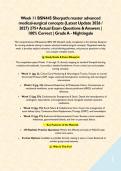
Week 11 BSN445 Sherpath: master advanced
medical-surgical concepts (Latest Update 2026 /
2027) 275+ Actual Exam Questions & Answers |
100% Correct | Grade A - Nightingale
This comprehensive 278-question BSN 445 Sherpath study compilation is the ultimate blueprint
for nursing students aiming to master advanced medical-surgical concepts. Organized week-by-
week, it provides explicit rationales, critical-thinking pathways, and practice questions to help
you conquer complex exams.
Study Guide & Exam Blueprint
This compilation spans Weeks 11 through 15, directly mapping to standard Sherpath learning
modules and textbooks. It provides a detailed breakdown of core critical care and complex
nursing concepts.
• Week 11 (pg. 2): Critical Care Monitoring & Neurological Trauma. Focuses on normal
Intracranial Pressure (ICP) ranges, advanced hemodynamic monitoring, and neurological
interventions.
• Week 12 (pg. 33): Advanced Respiratory & Multisystem Failure. Concentrates on
mechanical ventilation, acute respiratory distress syndrome (ARDS), and ethical
dilemmas.
• Week 13 (pg. 59): Cardiovascular Emergencies & Shock. Details the hemodynamics of
cardiogenic, hypovolemic, and anaphylactic shock, alongside essential vasoactive
medication.
• Week 14 (pg. 75): Renal Failure & Collaborative Care. Covers the management of
acute kidney injury, Continuous Renal Replacement Therapy (CRRT), and hemodialysis.
• Week 15 (pg. 97): Endocrine & Gastrointestinal Crises. Reviews critical metabolic
imbalances, gastrointestinal bleeds, and liver or pancreatic failure.
Key Features of the Material
• 278 Realistic Practice Questions: Mimics the difficulty and style of NCLEX-style
critical care exams.
• Format Options: Available in printable formats, making it easy to create flashcards or
conduct group study sessions.
Who Is This For?
1
, This material is perfect for nursing students in the BSN 445 program (such as Nightingale
College) who are preparing for heavily weighted weekly exams or cumulative midterms and
finals. It bridges the gap between theoretical knowledge and practical, evidence-based bedside
care
Quiz_________________?
1. Which examination assesses level of consciousness?
Glasgow Coma Scale (GCS)
Cranial nerve testing
Mini Mental Status Exam (MMSE)
Deep tendon reflex (DTR) -
Answer
Glasgow Coma Scale (GCS)
Quiz_________________?
2. Which factor is associated with assessing the progression of symptoms? Select all that apply.
One, some, or all responses may be correct.
Infection
Fall
Dental procedure
Initial onset
Duration
Aggravating factor -
Answer
Initial onset
Duration
Aggravating factor
2
, Quiz_________________?
3. Which component is the most important part of a neurologic assessment?
Change in status
Medication use
Radiologic studies
Medical history -
Answer
Change in status
Quiz_________________?
4. Which determination can be made from a Glasgow Coma Scale (GCS) score?
Gross assessment of consciousness
Brainstem function
Lateralization
Fine condition change -
Answer
Gross assessment of consciousness
Quiz_________________?
5. Which Full Outline of UnResponsiveness (FOUR) score would be assigned for a patient who
is breathing independently but exhibits a pattern that varies between apnea and
hyperventilation?
2
3
4
5-
3
, Answer
3
Quiz_________________?
6. Which process describes a doll's eye test in an unconscious patient?
Passive lateral head turn with ocular observation
Irrigation of ear canal with ocular observation
Passive cervical flexion/extension with ocular observation
Touching the eyeball with a cotton wisp. -
Answer
Passive lateral head turn with ocular observation
Quiz_________________?
7. Which range represents deep tendon reflexes (DTRs) testing responses?
0 to 4+
0+ to 4+
0 to 3+
0+ to 6+ -
Answer
0 to 4+
Quiz_________________?
8. Which reflex is considered superficial?
Patellar
Abdominal
4
medical-surgical concepts (Latest Update 2026 /
2027) 275+ Actual Exam Questions & Answers |
100% Correct | Grade A - Nightingale
This comprehensive 278-question BSN 445 Sherpath study compilation is the ultimate blueprint
for nursing students aiming to master advanced medical-surgical concepts. Organized week-by-
week, it provides explicit rationales, critical-thinking pathways, and practice questions to help
you conquer complex exams.
Study Guide & Exam Blueprint
This compilation spans Weeks 11 through 15, directly mapping to standard Sherpath learning
modules and textbooks. It provides a detailed breakdown of core critical care and complex
nursing concepts.
• Week 11 (pg. 2): Critical Care Monitoring & Neurological Trauma. Focuses on normal
Intracranial Pressure (ICP) ranges, advanced hemodynamic monitoring, and neurological
interventions.
• Week 12 (pg. 33): Advanced Respiratory & Multisystem Failure. Concentrates on
mechanical ventilation, acute respiratory distress syndrome (ARDS), and ethical
dilemmas.
• Week 13 (pg. 59): Cardiovascular Emergencies & Shock. Details the hemodynamics of
cardiogenic, hypovolemic, and anaphylactic shock, alongside essential vasoactive
medication.
• Week 14 (pg. 75): Renal Failure & Collaborative Care. Covers the management of
acute kidney injury, Continuous Renal Replacement Therapy (CRRT), and hemodialysis.
• Week 15 (pg. 97): Endocrine & Gastrointestinal Crises. Reviews critical metabolic
imbalances, gastrointestinal bleeds, and liver or pancreatic failure.
Key Features of the Material
• 278 Realistic Practice Questions: Mimics the difficulty and style of NCLEX-style
critical care exams.
• Format Options: Available in printable formats, making it easy to create flashcards or
conduct group study sessions.
Who Is This For?
1
, This material is perfect for nursing students in the BSN 445 program (such as Nightingale
College) who are preparing for heavily weighted weekly exams or cumulative midterms and
finals. It bridges the gap between theoretical knowledge and practical, evidence-based bedside
care
Quiz_________________?
1. Which examination assesses level of consciousness?
Glasgow Coma Scale (GCS)
Cranial nerve testing
Mini Mental Status Exam (MMSE)
Deep tendon reflex (DTR) -
Answer
Glasgow Coma Scale (GCS)
Quiz_________________?
2. Which factor is associated with assessing the progression of symptoms? Select all that apply.
One, some, or all responses may be correct.
Infection
Fall
Dental procedure
Initial onset
Duration
Aggravating factor -
Answer
Initial onset
Duration
Aggravating factor
2
, Quiz_________________?
3. Which component is the most important part of a neurologic assessment?
Change in status
Medication use
Radiologic studies
Medical history -
Answer
Change in status
Quiz_________________?
4. Which determination can be made from a Glasgow Coma Scale (GCS) score?
Gross assessment of consciousness
Brainstem function
Lateralization
Fine condition change -
Answer
Gross assessment of consciousness
Quiz_________________?
5. Which Full Outline of UnResponsiveness (FOUR) score would be assigned for a patient who
is breathing independently but exhibits a pattern that varies between apnea and
hyperventilation?
2
3
4
5-
3
, Answer
3
Quiz_________________?
6. Which process describes a doll's eye test in an unconscious patient?
Passive lateral head turn with ocular observation
Irrigation of ear canal with ocular observation
Passive cervical flexion/extension with ocular observation
Touching the eyeball with a cotton wisp. -
Answer
Passive lateral head turn with ocular observation
Quiz_________________?
7. Which range represents deep tendon reflexes (DTRs) testing responses?
0 to 4+
0+ to 4+
0 to 3+
0+ to 6+ -
Answer
0 to 4+
Quiz_________________?
8. Which reflex is considered superficial?
Patellar
Abdominal
4