

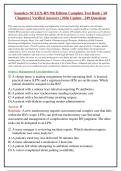
Saunders NCLEX-RN 9th Edition Complete Test Bank | All
Chapters | Verified Answers | 2026 Update - 249 Questions
This exam assesses advanced knowledge and application of nursing leadership, delegation, prioritization,
ethical/legal issues, quality improvement, and resource management in complex healthcare settings. Designed for
NCLEX-RN preparation and graduate-level competency. It contains 249 multiple-choice questions, each with four
distractors and a fully worked rationale that explains why the keyed answer is correct. Content is organized into 8
focused sections: Management of Care, Safety and Infection Control, Health Promotion and Maintenance,
Psychosocial Integrity, Basic Care and Comfort, Pharmacological Therapies, Reduction of Risk Potential,
Physiological Adaptation. Targeted learning outcomes include: Apply ethical and legal principles to nursing
management decisions.; Prioritize patient care assignments and delegate tasks appropriately.; Evaluate quality
improvement data and implement evidence-based changes.; Manage conflict and facilitate interprofessional
collaboration.. Every item has been reviewed for clinical accuracy, current guidelines, and clarity so that students
can study with confidence and self-correct as they work through the bank. Use it as a high-yield review
immediately before the exam, or as a structured practice tool during the unit - the rationales double as concise
teaching notes. The recommended writing time is 3 hours, with a passing score of 80%. Aligned with Meets AACN
and NLN standards for graduate-level nursing education in the United States. standards and reflects the question
style commonly seen on accredited program examinations. Students consistently achieving above the cut score on
Section 1: Management of Care (Questions 1-32)
1 A charge nurse is making assignments for the upcoming shift. A licensed
practical nurse (LPN) and a registered nurse (RN) are on the team. Which
patient should be assigned to the RN?
A) A patient with a urinary tract infection requiring IV antibiotics.
B) A patient with a new tracheostomy needing tracheostomy care.
C) A patient with a fractured femur awaiting surgery.
D) A patient with diabetes requiring insulin administration.
Answer: B
Rationale: A new tracheostomy requires assessment and complex care that falls
within the RN's scope. LPNs can perform tracheostomy care but initial
assessment and management of complications require RN judgment. The other
tasks can be delegated to an LPN.
2 A nurse manager is reviewing incident reports. Which situation requires
immediate root cause analysis?
A) A patient's meal tray was delivered 30 minutes late.
B) A nurse administered a medication 1 hour late.
C) A patient fell while attempting to ambulate without assistance.
D) A visitor complained about parking availability.
,Answer: C
Rationale: A patient fall is a sentinel event that requires immediate
investigation to prevent recurrence. Late meals and medication administration
are less critical, and parking complaints are not patient safety issues.
3 A nurse is delegating tasks to an unlicensed assistive personnel (UAP).
Which task is appropriate for delegation?
A) Assessing a patient's pain level after medication.
B) Evaluating the effectiveness of a new wound dressing.
C) Ambulating a patient with a walker.
D) Teaching a patient about insulin self-administration.
Answer: C
Rationale: Ambulation is a routine, stable task that can be delegated to a UAP.
Assessment, evaluation, and teaching require the knowledge and judgment of a
licensed nurse.
4 A nurse is caring for a patient who refuses a blood transfusion due to
religious beliefs. The nurse respects the decision. Which ethical principle is
being applied?
A) Beneficence
B) Nonmaleficence
C) Autonomy
D) Justice
Answer: C
Rationale: Autonomy respects the patient's right to make decisions about their
own healthcare. Beneficence (do good) and nonmaleficence (do no harm)
would support providing the transfusion, but autonomy overrides when the
patient refuses. Justice involves fairness.
5 A nurse manager notices an increase in medication errors on a unit. Which
quality improvement approach should be implemented first?
A) Disciplinary action for nurses involved.
B) Implementation of a barcode scanning system.
C) Root cause analysis to identify system failures.
D) Re-education on the five rights of medication administration.
Answer: C
,Rationale: Root cause analysis identifies underlying system issues, which is the
first step in quality improvement. Disciplinary action is punitive and may not
address root causes. Barcode scanning and re-education are interventions that
should follow analysis.
6 A nurse is advocating for a patient who speaks limited English. Which action
best demonstrates patient advocacy?
A) Using hand gestures to explain procedures.
B) Requesting a certified medical interpreter.
C) Asking a family member to translate.
D) Speaking slowly and loudly.
Answer: B
Rationale: A certified medical interpreter ensures accurate communication and
confidentiality, reducing errors. Family members may not be objective or have
adequate medical vocabulary. Hand gestures and speaking loudly are
ineffective.
7 A charge nurse is prioritizing care for four patients. Which patient should the
nurse assess first?
A) A patient with chest pain and diaphoresis.
B) A patient with a blood glucose of 60 mg/dL who is alert.
C) A patient with a fractured hip awaiting surgery.
D) A patient with a urinary tract infection and a fever of 38.5°C.
Answer: A
Rationale: Chest pain with diaphoresis suggests an acute myocardial infarction,
which is life-threatening and requires immediate assessment. Hypoglycemia
(60 mg/dL) is serious but the patient is alert; the other patients are stable.
8 A nurse is preparing to discharge a patient with a new colostomy. The patient
expresses anxiety about self-care. Which action is most appropriate?
A) Provide written instructions and a follow-up phone number.
B) Arrange a home health nurse visit for the next day.
C) Ask the patient to demonstrate colostomy care before discharge.
D) Reassure the patient that anxiety is normal.
Answer: C
Rationale: Demonstration of colostomy care ensures the patient can perform the
, task, which reduces anxiety and promotes independence. Written instructions
and home health are supportive but do not assess current ability. Reassurance
alone is insufficient.
9 A nurse on a medical-surgical unit is caring for a patient with a history of
opioid abuse who is in severe pain. The patient requests pain medication.
What is the nurse's priority action?
A) Administer the medication as prescribed.
B) Consult with the provider about alternative pain management.
C) Assess pain using a standardized pain scale.
D) Educate the patient about risks of addiction.
Answer: C
Rationale: Pain assessment is the first step in pain management, regardless of
history of abuse. The nurse must assess pain objectively before intervening.
Administering medication without assessment is inappropriate; consulting and
educating come after assessment.
10 A nurse manager is evaluating staffing needs. Which factor most directly
affects staffing requirements?
A) Number of patient admissions and discharges.
B) Patient acuity and census.
C) Budgetary constraints.
D) Staff satisfaction scores.
Answer: B
Rationale: Patient acuity and census directly determine the level of care needed
and thus staffing requirements. Admissions/discharges are components of
census but not as comprehensive. Budget and satisfaction are important but
secondary to patient needs.
11 A charge nurse on a medical-surgical unit is assigning patient care to a
registered nurse (RN) and a licensed practical nurse (LPN). Which patient
should be assigned to the LPN?
A) A patient with a new tracheostomy requiring frequent suctioning and
monitoring for bleeding
B) A patient with diabetes mellitus who needs reinforcement of insulin
injection technique
Chapters | Verified Answers | 2026 Update - 249 Questions
This exam assesses advanced knowledge and application of nursing leadership, delegation, prioritization,
ethical/legal issues, quality improvement, and resource management in complex healthcare settings. Designed for
NCLEX-RN preparation and graduate-level competency. It contains 249 multiple-choice questions, each with four
distractors and a fully worked rationale that explains why the keyed answer is correct. Content is organized into 8
focused sections: Management of Care, Safety and Infection Control, Health Promotion and Maintenance,
Psychosocial Integrity, Basic Care and Comfort, Pharmacological Therapies, Reduction of Risk Potential,
Physiological Adaptation. Targeted learning outcomes include: Apply ethical and legal principles to nursing
management decisions.; Prioritize patient care assignments and delegate tasks appropriately.; Evaluate quality
improvement data and implement evidence-based changes.; Manage conflict and facilitate interprofessional
collaboration.. Every item has been reviewed for clinical accuracy, current guidelines, and clarity so that students
can study with confidence and self-correct as they work through the bank. Use it as a high-yield review
immediately before the exam, or as a structured practice tool during the unit - the rationales double as concise
teaching notes. The recommended writing time is 3 hours, with a passing score of 80%. Aligned with Meets AACN
and NLN standards for graduate-level nursing education in the United States. standards and reflects the question
style commonly seen on accredited program examinations. Students consistently achieving above the cut score on
Section 1: Management of Care (Questions 1-32)
1 A charge nurse is making assignments for the upcoming shift. A licensed
practical nurse (LPN) and a registered nurse (RN) are on the team. Which
patient should be assigned to the RN?
A) A patient with a urinary tract infection requiring IV antibiotics.
B) A patient with a new tracheostomy needing tracheostomy care.
C) A patient with a fractured femur awaiting surgery.
D) A patient with diabetes requiring insulin administration.
Answer: B
Rationale: A new tracheostomy requires assessment and complex care that falls
within the RN's scope. LPNs can perform tracheostomy care but initial
assessment and management of complications require RN judgment. The other
tasks can be delegated to an LPN.
2 A nurse manager is reviewing incident reports. Which situation requires
immediate root cause analysis?
A) A patient's meal tray was delivered 30 minutes late.
B) A nurse administered a medication 1 hour late.
C) A patient fell while attempting to ambulate without assistance.
D) A visitor complained about parking availability.
,Answer: C
Rationale: A patient fall is a sentinel event that requires immediate
investigation to prevent recurrence. Late meals and medication administration
are less critical, and parking complaints are not patient safety issues.
3 A nurse is delegating tasks to an unlicensed assistive personnel (UAP).
Which task is appropriate for delegation?
A) Assessing a patient's pain level after medication.
B) Evaluating the effectiveness of a new wound dressing.
C) Ambulating a patient with a walker.
D) Teaching a patient about insulin self-administration.
Answer: C
Rationale: Ambulation is a routine, stable task that can be delegated to a UAP.
Assessment, evaluation, and teaching require the knowledge and judgment of a
licensed nurse.
4 A nurse is caring for a patient who refuses a blood transfusion due to
religious beliefs. The nurse respects the decision. Which ethical principle is
being applied?
A) Beneficence
B) Nonmaleficence
C) Autonomy
D) Justice
Answer: C
Rationale: Autonomy respects the patient's right to make decisions about their
own healthcare. Beneficence (do good) and nonmaleficence (do no harm)
would support providing the transfusion, but autonomy overrides when the
patient refuses. Justice involves fairness.
5 A nurse manager notices an increase in medication errors on a unit. Which
quality improvement approach should be implemented first?
A) Disciplinary action for nurses involved.
B) Implementation of a barcode scanning system.
C) Root cause analysis to identify system failures.
D) Re-education on the five rights of medication administration.
Answer: C
,Rationale: Root cause analysis identifies underlying system issues, which is the
first step in quality improvement. Disciplinary action is punitive and may not
address root causes. Barcode scanning and re-education are interventions that
should follow analysis.
6 A nurse is advocating for a patient who speaks limited English. Which action
best demonstrates patient advocacy?
A) Using hand gestures to explain procedures.
B) Requesting a certified medical interpreter.
C) Asking a family member to translate.
D) Speaking slowly and loudly.
Answer: B
Rationale: A certified medical interpreter ensures accurate communication and
confidentiality, reducing errors. Family members may not be objective or have
adequate medical vocabulary. Hand gestures and speaking loudly are
ineffective.
7 A charge nurse is prioritizing care for four patients. Which patient should the
nurse assess first?
A) A patient with chest pain and diaphoresis.
B) A patient with a blood glucose of 60 mg/dL who is alert.
C) A patient with a fractured hip awaiting surgery.
D) A patient with a urinary tract infection and a fever of 38.5°C.
Answer: A
Rationale: Chest pain with diaphoresis suggests an acute myocardial infarction,
which is life-threatening and requires immediate assessment. Hypoglycemia
(60 mg/dL) is serious but the patient is alert; the other patients are stable.
8 A nurse is preparing to discharge a patient with a new colostomy. The patient
expresses anxiety about self-care. Which action is most appropriate?
A) Provide written instructions and a follow-up phone number.
B) Arrange a home health nurse visit for the next day.
C) Ask the patient to demonstrate colostomy care before discharge.
D) Reassure the patient that anxiety is normal.
Answer: C
Rationale: Demonstration of colostomy care ensures the patient can perform the
, task, which reduces anxiety and promotes independence. Written instructions
and home health are supportive but do not assess current ability. Reassurance
alone is insufficient.
9 A nurse on a medical-surgical unit is caring for a patient with a history of
opioid abuse who is in severe pain. The patient requests pain medication.
What is the nurse's priority action?
A) Administer the medication as prescribed.
B) Consult with the provider about alternative pain management.
C) Assess pain using a standardized pain scale.
D) Educate the patient about risks of addiction.
Answer: C
Rationale: Pain assessment is the first step in pain management, regardless of
history of abuse. The nurse must assess pain objectively before intervening.
Administering medication without assessment is inappropriate; consulting and
educating come after assessment.
10 A nurse manager is evaluating staffing needs. Which factor most directly
affects staffing requirements?
A) Number of patient admissions and discharges.
B) Patient acuity and census.
C) Budgetary constraints.
D) Staff satisfaction scores.
Answer: B
Rationale: Patient acuity and census directly determine the level of care needed
and thus staffing requirements. Admissions/discharges are components of
census but not as comprehensive. Budget and satisfaction are important but
secondary to patient needs.
11 A charge nurse on a medical-surgical unit is assigning patient care to a
registered nurse (RN) and a licensed practical nurse (LPN). Which patient
should be assigned to the LPN?
A) A patient with a new tracheostomy requiring frequent suctioning and
monitoring for bleeding
B) A patient with diabetes mellitus who needs reinforcement of insulin
injection technique


