

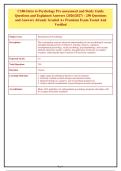
C180-Intro to Psychology Pre assessment and Study Guide
Questions and Explained Answers (2026/2027) - 250 Questions
and Answers Already Graded A+ Premium Exam Tested And
Verified
Subject Area Introduction to Psychology
Description This examination assesses advanced understanding of core psychological concepts
including biological bases of behavior, learning, memory, cognition,
developmental psychology, social psychology, psychopathology, and research
methods. Questions require synthesis and application of theories to complex
scenarios, reflecting the rigor of top-tier US university standards.
Expected Grade A+
Total Questions 250
Duration 3 hours
Learning Outcomes 1. Apply major psychological theories to novel situations
2. Critically evaluate research designs and statistical claims
3. Integrate biological, cognitive, and sociocultural perspectives
4. Analyze ethical considerations in psychological research and practice
Accreditation Meets APA guidelines for undergraduate psychology programs and aligns with
Ivy League curriculum standards.
Page 1
,1. A researcher reports a correlation of r = 0.72 between hours of sleep and
performance on a cognitive test. Which of the following conclusions is most justified?
A. Increasing sleep causes improved cognitive performance.
B. Sleep and cognitive performance are positively related, but causation cannot be inferred.
C. The strength of the relationship is weak.
D. The finding is likely due to a third variable such as age.
Answer: B. Sleep and cognitive performance are positively related, but causation
cannot be inferred.
Correlation does not imply causation; r = 0.72 indicates a strong positive relationship,
but without experimental manipulation, causal claims are unwarranted. Option B
correctly states the association without overinterpreting.
2. A patient with damage to the amygdala exhibits normal fear conditioning but
impaired recognition of fearful facial expressions. This dissociation suggests that:
A. The amygdala is not involved in emotional processing.
B. Different neural circuits subserve emotional expression recognition versus fear
conditioning.
C. Fear conditioning relies on the hippocampus rather than the amygdala.
D. The patient likely has damage to the prefrontal cortex.
Answer: B. Different neural circuits subserve emotional expression recognition
versus fear conditioning.
The double dissociation between fear conditioning and facial expression recognition
indicates distinct neural pathways within the amygdala or between amygdala and other
regions. Option B captures this nuanced understanding.
3. In a classic conditioning experiment, a tone is paired with a mild shock until the
tone elicits a fear response. Subsequently, the tone is presented alone, and the fear
response gradually diminishes. This process is called:
A. Spontaneous recovery
B. Extinction
C. Habituation
D. Operant extinction
Answer: B. Extinction
Extinction refers to the reduction of a conditioned response when the conditioned
stimulus is repeatedly presented without the unconditioned stimulus. Spontaneous
recovery is the reappearance after a pause, not the initial decline.
Page 2
,4. A student remembers a list of words by mentally associating each word with a
location in their childhood home. This memory strategy best exemplifies:
A. Elaborative rehearsal
B. Method of loci
C. Chunking
D. Maintenance rehearsal
Answer: B. Method of loci
The method of loci involves associating items with familiar spatial locations to enhance
recall. Elaborative rehearsal involves connecting new information to existing
knowledge, but the key here is the spatial mnemonic.
5. Two groups of participants solve anagrams. Group A is told they will be paid for
each correct solution; Group B is told to just do their best. Group A solves fewer
anagrams than Group B. This outcome is best explained by:
A. Cognitive dissonance
B. Overjustification effect
C. Social loafing
D. Reactance theory
Answer: B. Overjustification effect
The overjustification effect occurs when external rewards undermine intrinsic
motivation, leading to decreased performance. Group A's extrinsic reward reduced
their inherent interest in the task.
6. Which of the following research designs would best establish that a new therapy
reduces symptoms of depression?
A. A correlational study measuring therapy attendance and symptom severity
B. A case study of one patient who improved after therapy
C. A randomized controlled trial with a placebo control group
D. A longitudinal study tracking depression rates over 10 years
Answer: C. A randomized controlled trial with a placebo control group
A randomized controlled trial (RCT) with a placebo control minimizes confounds and
allows causal inference. Correlational and case studies cannot rule out alternative
explanations.
Page 3
, 7. A child who understands that pouring water from a short, wide glass into a tall,
narrow glass does not change the amount of water has likely reached which stage of
cognitive development?
A. Sensorimotor
B. Preoperational
C. Concrete operational
D. Formal operational
Answer: C. Concrete operational
Conservation of liquid volume is typically mastered during the concrete operational
stage (ages 7-11), when children can mentally reverse actions and understand that
transformations do not alter quantity.
8. In a study on obedience, participants were asked to administer electric shocks to a
learner. The experimenter wore a lab coat and insisted the shocks were necessary.
Which factor most likely increased obedience?
A. The learner's visible distress
B. The proximity of the experimenter
C. The participant's personality traits
D. The gender of the participant
Answer: B. The proximity of the experimenter
Milgram's obedience studies found that proximity of the authority figure significantly
increased obedience. The experimenter's presence and insistence provided direct social
pressure.
9. A patient reports hearing voices that comment on their behavior and believes the
voices are sent by a government agency. These symptoms are most consistent with:
A. Major depressive disorder with psychotic features
B. Schizophrenia
C. Bipolar I disorder, manic episode
D. Obsessive-compulsive disorder
Answer: B. Schizophrenia
Auditory hallucinations (commenting voices) and persecutory delusions (government
agency) are hallmark positive symptoms of schizophrenia. While psychotic features can
occur in mood disorders, the combination here is classic for schizophrenia.
Page 4
Questions and Explained Answers (2026/2027) - 250 Questions
and Answers Already Graded A+ Premium Exam Tested And
Verified
Subject Area Introduction to Psychology
Description This examination assesses advanced understanding of core psychological concepts
including biological bases of behavior, learning, memory, cognition,
developmental psychology, social psychology, psychopathology, and research
methods. Questions require synthesis and application of theories to complex
scenarios, reflecting the rigor of top-tier US university standards.
Expected Grade A+
Total Questions 250
Duration 3 hours
Learning Outcomes 1. Apply major psychological theories to novel situations
2. Critically evaluate research designs and statistical claims
3. Integrate biological, cognitive, and sociocultural perspectives
4. Analyze ethical considerations in psychological research and practice
Accreditation Meets APA guidelines for undergraduate psychology programs and aligns with
Ivy League curriculum standards.
Page 1
,1. A researcher reports a correlation of r = 0.72 between hours of sleep and
performance on a cognitive test. Which of the following conclusions is most justified?
A. Increasing sleep causes improved cognitive performance.
B. Sleep and cognitive performance are positively related, but causation cannot be inferred.
C. The strength of the relationship is weak.
D. The finding is likely due to a third variable such as age.
Answer: B. Sleep and cognitive performance are positively related, but causation
cannot be inferred.
Correlation does not imply causation; r = 0.72 indicates a strong positive relationship,
but without experimental manipulation, causal claims are unwarranted. Option B
correctly states the association without overinterpreting.
2. A patient with damage to the amygdala exhibits normal fear conditioning but
impaired recognition of fearful facial expressions. This dissociation suggests that:
A. The amygdala is not involved in emotional processing.
B. Different neural circuits subserve emotional expression recognition versus fear
conditioning.
C. Fear conditioning relies on the hippocampus rather than the amygdala.
D. The patient likely has damage to the prefrontal cortex.
Answer: B. Different neural circuits subserve emotional expression recognition
versus fear conditioning.
The double dissociation between fear conditioning and facial expression recognition
indicates distinct neural pathways within the amygdala or between amygdala and other
regions. Option B captures this nuanced understanding.
3. In a classic conditioning experiment, a tone is paired with a mild shock until the
tone elicits a fear response. Subsequently, the tone is presented alone, and the fear
response gradually diminishes. This process is called:
A. Spontaneous recovery
B. Extinction
C. Habituation
D. Operant extinction
Answer: B. Extinction
Extinction refers to the reduction of a conditioned response when the conditioned
stimulus is repeatedly presented without the unconditioned stimulus. Spontaneous
recovery is the reappearance after a pause, not the initial decline.
Page 2
,4. A student remembers a list of words by mentally associating each word with a
location in their childhood home. This memory strategy best exemplifies:
A. Elaborative rehearsal
B. Method of loci
C. Chunking
D. Maintenance rehearsal
Answer: B. Method of loci
The method of loci involves associating items with familiar spatial locations to enhance
recall. Elaborative rehearsal involves connecting new information to existing
knowledge, but the key here is the spatial mnemonic.
5. Two groups of participants solve anagrams. Group A is told they will be paid for
each correct solution; Group B is told to just do their best. Group A solves fewer
anagrams than Group B. This outcome is best explained by:
A. Cognitive dissonance
B. Overjustification effect
C. Social loafing
D. Reactance theory
Answer: B. Overjustification effect
The overjustification effect occurs when external rewards undermine intrinsic
motivation, leading to decreased performance. Group A's extrinsic reward reduced
their inherent interest in the task.
6. Which of the following research designs would best establish that a new therapy
reduces symptoms of depression?
A. A correlational study measuring therapy attendance and symptom severity
B. A case study of one patient who improved after therapy
C. A randomized controlled trial with a placebo control group
D. A longitudinal study tracking depression rates over 10 years
Answer: C. A randomized controlled trial with a placebo control group
A randomized controlled trial (RCT) with a placebo control minimizes confounds and
allows causal inference. Correlational and case studies cannot rule out alternative
explanations.
Page 3
, 7. A child who understands that pouring water from a short, wide glass into a tall,
narrow glass does not change the amount of water has likely reached which stage of
cognitive development?
A. Sensorimotor
B. Preoperational
C. Concrete operational
D. Formal operational
Answer: C. Concrete operational
Conservation of liquid volume is typically mastered during the concrete operational
stage (ages 7-11), when children can mentally reverse actions and understand that
transformations do not alter quantity.
8. In a study on obedience, participants were asked to administer electric shocks to a
learner. The experimenter wore a lab coat and insisted the shocks were necessary.
Which factor most likely increased obedience?
A. The learner's visible distress
B. The proximity of the experimenter
C. The participant's personality traits
D. The gender of the participant
Answer: B. The proximity of the experimenter
Milgram's obedience studies found that proximity of the authority figure significantly
increased obedience. The experimenter's presence and insistence provided direct social
pressure.
9. A patient reports hearing voices that comment on their behavior and believes the
voices are sent by a government agency. These symptoms are most consistent with:
A. Major depressive disorder with psychotic features
B. Schizophrenia
C. Bipolar I disorder, manic episode
D. Obsessive-compulsive disorder
Answer: B. Schizophrenia
Auditory hallucinations (commenting voices) and persecutory delusions (government
agency) are hallmark positive symptoms of schizophrenia. While psychotic features can
occur in mood disorders, the combination here is classic for schizophrenia.
Page 4


